The trailer for Disclosure Day has been released, providing a haunting glimpse at what first contact with an alien intelligence might be like.
In the clip, a newsreader, played by Emily Blunt, is seized by an extraterrestrial force and breaks into a chilling series of clicks and chirps.
But would aliens really sound like this?
Some of the world’s leading experts have now revealed what noises life beyond Earth might really make – and they say Steven Spielberg‘s trailer might not be far off.
Although aliens might be vastly different to humans, scientists believe they probably still follow the same rules of evolution as life on Earth.
So, if a species evolves on an Earth–like planet, their means of communication might not be all that different from our own.
According to the experts, extraterrestrials really might use a spoken language just like Emily Blunt’s bizarre clicking.
However, whether or not aliens will be friendly enough to spark up a conversation remains to be seen.

As the trailer for Steven Spielberg’s Disclosure Day shows Emily Blunt seized by an extraterrestrial force, scientists have revealed how aliens would really communicate
Dr Douglas Vakoch, chair of METI (Messaging to Extra–Terrestrial Intelligence) International, told Daily Mail: ‘To guess how aliens will communicate with one another, we need to know how they encounter one another face–to–face.
‘If, like humans, aliens live in an environment where it is vital to communicate even when it’s too dark to see one another, then they too might communicate with something akin to human speech.’
We can’t say exactly what that speech might sound like, but it’s likely to resemble the variety of sounds we already hear on Earth.
‘From the warbling of birds, to the trumpeting of elephants, to the chirping of crickets, [animal communications] all operate on the same principle,’ says Dr Vakoch.
‘Animals create sounds that vary over time.
‘It’s through the distinctive patterning of these manifold sounds that meaning arises.
‘We would expect the same in any aliens who want to communicate with one another through the medium of air.’
Although the noises created by Emily Blunt in the Disclosure Day trailer seem bizarre, they are just as likely as any other type of sound.

While the alien messages in the trailer (pictured) seem bizarre, scientists say that alien life would probably use a spoken language to communicate if they lived on a planet with air
In fact, Dr Vakoch points out that the clicks which ‘sound eerily out of this world’ to our ears are a defining feature of the Khoisan family of languages spoken in West Africa.
However, the researchers caution that the movie trailer doesn’t get everything right.
The big problem is that we have no reason to believe aliens would use sound alone to communicate.
Mia Belle Parkinson, a PhD candidate at the UK Centre for Astrobiology, told Daily Mail: ‘It’s easy to think about intelligent alien beings that look and sound like us.
‘However, this would not be the case at all. What if these beings evolved on a world completely dissimilar to ours?’
Just as life at the bottom of the ocean has evolved to flash messages to each other with bioluminescence, aliens might have evolved with different means of communication.
Mrs Parkinson adds: ‘I think we shouldn’t discount anything because the only example of life we have is Earth. And what if Earth truly is unique?’
So, in a scientifically accurate movie, Emily Blunt would be just as likely to start flashing a torch about or releasing noxious chemicals as to start chatting away.

Just as life at the bottom of the ocean has evolved to flash messages to each other with bioluminescence, aliens might have evolved with different means of communication. Pictured: Humboldt squid
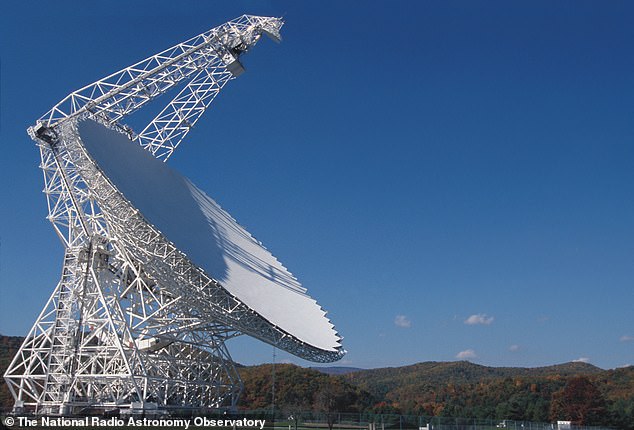
Scientists say the biggest mistake in the trailer is that aliens wouldn’t really communicate with humans using their own language. They are more likely to send a simple, repeating radio signal, which would be picked up by Earth’s telescopes. Pictured: The Green Bank Observatory radio telescope
But where the trailer really goes wrong is with the idea that aliens would try to speak with us in their own language in the first place.
Dr Sheri Wells-Jensen, an astrobiologist from Bowling Green State University, told Daily Mail: ‘The sounds here seem to have been strategically designed to freak out the average human filmgoer. But our first contact is likely to be a little less filmable.
‘They will email us, not crawl out from under our beds.’
Due to the massive distance involved, any communication with aliens will require sending signals that could take millions of years to reach their destination.
That means first contact will likely come through a reliable, tried and tested means that has the highest likelihood of being recognised.
Dr John Eliot, a researcher at the University of St Andrews and Chair of the UK SETI (Search for Extraterrestrial Intelligence) Research Network, told Daily Mail: ‘The scenario depicted here is a sensationalised fiction.
‘Communication is most likely to take the form of a remote signal or beacon, which will manifest itself as detectable by radio or optical telescopes.
‘If an intended communication for us, it will likely comprise, at first, repeated patterns or images, to provide us with clear evidence of intent from another intelligent civilisation.’
WHAT IS THE FERMI PARADOX?
The Fermi Paradox questions why, given the estimated 200-400 billion stars and at least 100 billion planets in our galaxy, there have been no signs of alien life.
The contradiction is named after its creator, Italian physicist Enrico Fermi.
He first posed the question back in 1950.
Fermi believed it was too extraordinary that a single extra-terrestrial signal or engineering project has yet to be detected in the universe — despite its immense vastness.
Fermi concluded there must a barrier that limits the rise of intelligent, self-aware, technologically advanced space-colonising civilisations.
This barrier is sometimes referred to as the ‘Great Filter’.

Italian physicist Enrico Fermi devised the so-called Fermi Paradox in the 1950s, which explores why there is no sign of alien life, despite the 100 billion planets in our galaxy
If the main obstacle preventing the colonisation of other planets is not in our past, then the barrier that will stop humanity’s prospects of reaching other worlds must lie in our future, scientists have theorised.
Professor Brian Cox believes the advances in science and engineering required by a civilisation to start conquering the stars will ultimately lead to its destruction.
He said: ‘One solution to the Fermi Paradox is that it is not possible to run a world that has the power to destroy itself.
‘It may be that the growth of science and engineering inevitably outstrips the development of political expertise, leading to disaster.’
Other possible explanations for the Fermi Paradox include that intelligent alien species are out there, but lack the necessary technology to communicate with Earth.
Some believe that the distances between intelligent civilisations are too great to allow any kind of two-way communication.
If two worlds are separated by several thousand light years, it’s possible that one or both civilisations would become extinct before a dialogue can be established.
The so-called Zoo hypothesis claims intelligent alien life is out there, but deliberately avoids any contact with life on Earth to allow its natural evolution.