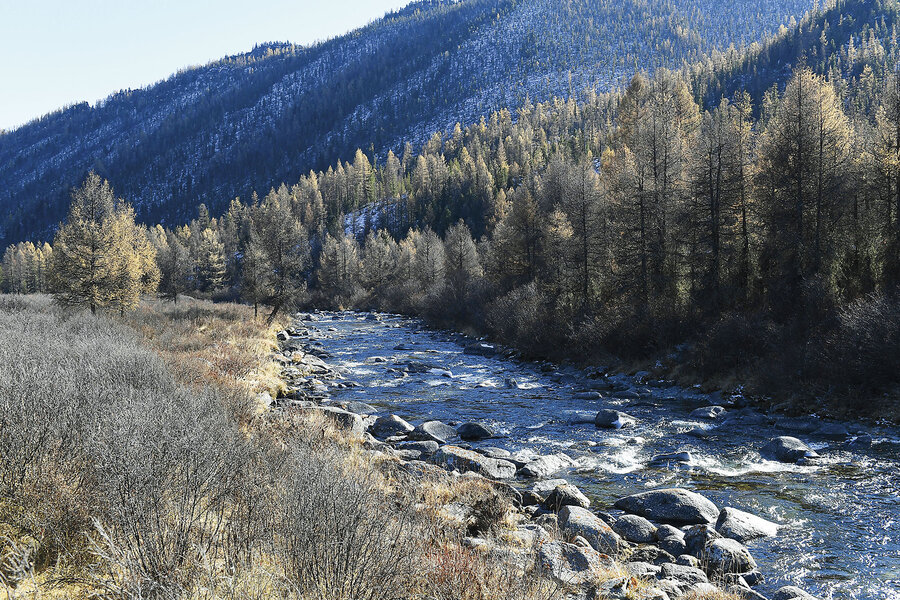
Forests appear throughout Russian folklore, literature, and film, serving not only as safe hiding places and menacing dark realms, but also as cultural touchstones.
In “The Oak and the Larch: A Forest History of Russia and Its Empires,” Sophie Pinkham, a professor of comparative literature at Cornell University, examines the relationship of Russia and its trees. As she unfolds the history of land use, she also emphasizes the urgency of protecting this vital natural resource – not just for the region, but also for the planet.
“Russia has more trees than there are stars in our galaxy,” she writes in the introduction. “From the Baltic to the Pacific, from the Arctic to the steppes of Central Asia, Russia’s forests account for nearly one-fifth of the world’s forest cover. It is not surprising, then, that … the forest has been at the heart of national identity.”
Why We Wrote This
Sophie Pinkham’s book, “The Oak and the Larch,” traces how Russian history and literature have shaped – and been shaped by – the country’s deep forests. Russia’s trees account for nearly one-fifth of the world’s forest cover, and Pinkham urges protection of this vital natural resource, not just for the region but also for the planet.
She focuses on how Russian literature and cinema have spurred resistance to the exploitation of natural resources by heedless and myopic rulers. “With its power to leap across boundaries of time, space, and identity,” writes Pinkham, “literature is an ideal dwelling place for new visions of society and nature. This is why writers have pride of place in this book.”
One of the greatest literary champions of the forest was the 19th-century novelist Leo Tolstoy, who “used the royalties he had earned from War and Peace to buy more than fifty thousand birch and fir seedlings. Most writers merely turn trees into books; he closed the loop, turning his novel into a forest.”

In Pinkham’s telling, forests were Russia’s birthright, but in the quest for empire, the trees that had protected the country from invasions became targets. Czar Peter the Great’s “passion for the sea” led to the massive clearing of western Russia’s oldest forests. Trees were simply material for his navy; it required “four to ten thousand oaks to make a warship.”
The southern forests once shielded the various peoples of the Caucasus from the ever-encroaching Russian empire: “Mountains were immutable, but forests could be cut down. The Russians … would expand their own empire by cutting down the forest of their enemies,” Pinkham writes. The 19th century brought the arrival of another modern wonder that impacted the environment: the railroad, “a machine for devouring forests.”
Josef Stalin depleted the forests’ resources until the economics of preservation outweighed the costs of exploitation. “The best strategy to save the forests,” conservationists saw, “was to treat their preservation as instrumental to Soviet modernization. This was a precursor to more recent ideas that ecological protections must be justified with economic rationales.”
While Pinkham keeps herself out of the narrative, it is clear she believes these priceless forests should be appreciated for their own sake, not just for what they provide humans.
She describes filmmaker Andrei Tarkovsky’s depiction of the sacredness of trees in a beautifully recounted sequence from “Andrei Rublev.” A boy digging a hole attempts to pull out a root, until he recognizes that it belongs to a flowering tree. “He stops digging and gazes up at its pale flowers, as if admiring the work of a fellow artisan. We see the tree from his perspective; then we see him; and then the camera begins to float up, so that at last we see him and his fellow diggers from the tree’s perspective.”
Russia’s inconsistency regarding the environment brings us into the present day, in which some of the most outspoken advocates for preserving the forests are also gung-ho nationalists keen on the brutal war on Ukraine, which itself is devastating to trees.
“Yet Ukraine’s forests are not only victims of war; they are also tools. Ukrainian environmentalists have noted that the forests are again functioning as zaseki, the forest fortresses once used in defense against steppe nomads like the Mongols.”
Pinkham concludes with stories about Russian environmentalists whose back-to-nature adventures have inspired their fellow citizens to imagine opting out of Putin’s world and retreating into the wilderness: “In the summer, the forest offered up plump crimson lingonberries, tiny, exquisite blueberries, tart cranberries, and luscious orange cloudberries.”
Pinkham, ever a realist, sounds a somber note when she writes: “In Anton Chekhov’s last play, a felled cherry orchard stands for the death of the old social order. The fate of the vast northern Eurasian forests will help determine the future climate of the whole world. … The story of these forests is a testament to human cruelty, shortsightedness, and vain ambition. But it is also a tale of resilience and of the power of art.” ■