It started with a few cars. They were dotted around my neighbourhood in south Birmingham, with oddly prominent lettering on the number plate – lettering that was raised a few millimetres off the plate’s flat surface.
They struck me as odd: Aesthetically, they did not add anything to the look of the car, so why bother taking the trouble?
Soon more cars started to appear with these number plates. And then still more. Too many to be explained by a fashionable fad.
Now, on my short, seven-minute walk to the gym, I will see up to 15 cars with these peculiar plates parked along just a small handful of residential roads.
Something is driving this trend and the clue, I soon realised, lay in the type of motorist whose car was sporting one of the number plates: Those guilty of jaw-dropping recklessness behind the wheel.
For a grim reality of everyday life in Birmingham is that the city is in the grip of a dangerous driving epidemic, one so severe that the council has declared a ‘road safety emergency’.
And police are struggling to curb this crisis due to the very number plates which have flooded my neighbourhood.
The raised ‘3D’ or ‘4D’ number-plate characters which had first drawn my eye are, it turns out, causing a headache for authorities across the country – because, very often, road cameras struggle to see them at all.
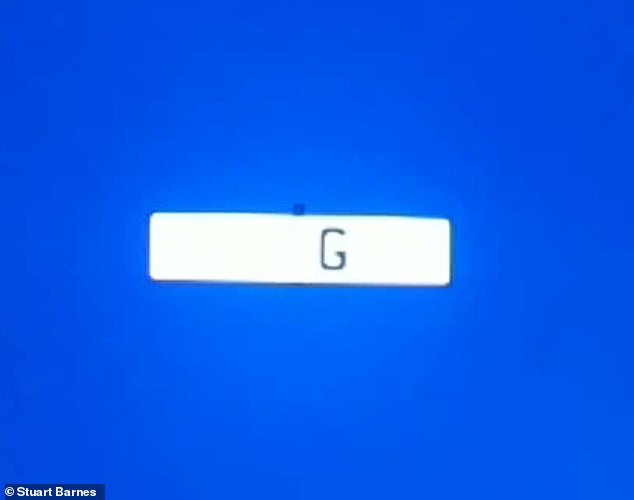
The ‘true ghost plates’ obtained by the Mail were almost entirely invisible when photographed under infrared light, which is used by road cameras at night or in low visibility
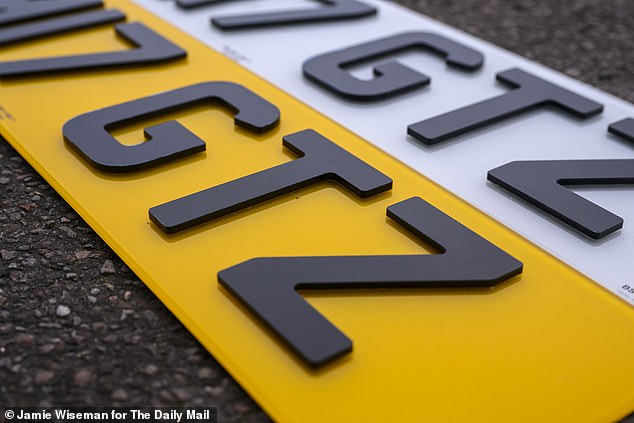
The ghost plates had so-called 4D lettering with characters raised off the flat surface, which can confuse road cameras by creating shadows and distortions
Known as ‘ghost’ plates, they are being sold openly online by official suppliers registered with the DVLA and are now feared to be on as many as one in 15 cars in the UK.
This is a discomforting fact when you live in an area where these plates are common; a jarring daily assault on your sense of safety.
It is shocking enough when you are overtaken by someone driving at close to 60mph on a 30mph road, but all the more chilling to know that, if the worst were to happen, they may vanish and never be caught.
The truth is that ghost number plates are being used across the country by dangerous and speeding drivers to evade police Automatic Number Plate Recognition cameras which cannot read them.
They are used by hardened criminals to escape police detection, and by mini-cab and private taxi drivers to get round congestion charges and low-emission zone fines, which causes local authorities and civic bodies to lose vast sums of revenue. One estimate suggests that Transport for London is missing out on a staggering £950million in lost fines due to ghost plates.
Little wonder MPs are calling for a radical overhaul of Britain’s ‘completely unfit for purpose’ vehicle registration plate system, which they say has allowed criminals and rogue businesses to infiltrate the supply chain.
This ‘Wild West’ market, where ghost plates are readily available, is creating a potentially catastrophic risk to national security and road safety, while depriving the public purse of more than £1billion each year, experts warn.
Indeed, it took me only a few clicks to order two sets of plates from separate DVLA-registered suppliers, which arrived within days despite the sellers carrying out zero checks.
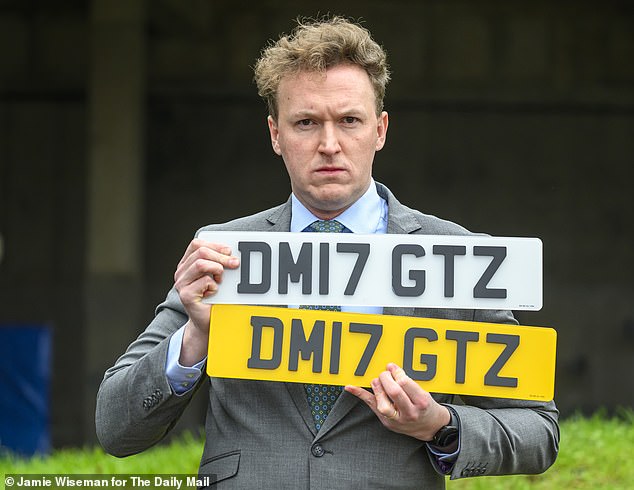
Daily Mail reporter Jack Hardy was able to obtain the ghost plates through an official DVLA-registered supplier, without any checks being carried out
Analysis by a specialist laboratory at Cranfield University found they were both likely to be ghost plates, yet they were delivered to me bearing official markings showing they were legal to use on the road.
Shockingly, one set of plates used material on six of the seven letters that became transparent when viewed under infrared light, which is used by road cameras to see in the dark or when visibility is poor.
Pictures taken in these conditions show just one character eerily visible on an otherwise blank number plate.
The expert who tested the plates, Dr Stuart Barnes, told me: ‘A number plate is like the vehicle version of the passport and it should be treated with the same level of importance and security as a passport would.’
The MP leading the campaign to ban ghost plates, Labour’s Sarah Coombes, first became aware of the problem in the same way that I had, through the road safety crisis facing West Midlands Police.
Her own constituency of West Bromwich has been blighted by illegal drag racing – where criminals stage illicit and highly dangerous car races on public roads – and she suggested to a police officer that road cameras might help fix the issue.
‘They just said to me, “There is no point getting a camera because they’ve all got ghost plates”. That was literally the first I heard of it,’ she told me.
She began to investigate further and soon made a stark discovery: A ‘gaping hole’ had been created in the UK’s policing and security system by the unregulated number plate market.
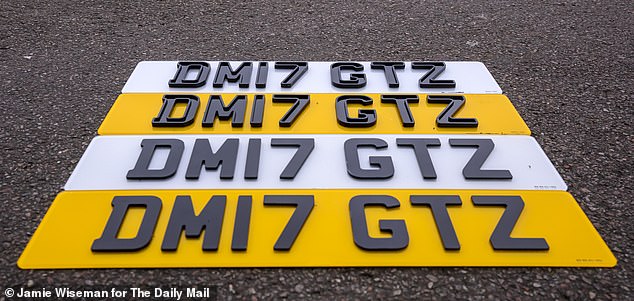
The plates ordered by our reporter used the fictitious registration ‘DM17 GTZ’, which includes letters from the acronym of the Mail’s parent group, the Daily Mail and General Trust (DMGT)
‘The number plate system is just completely broken, completely messed up,’ she said. ‘If you’ve got this enormous loophole which is freely available on the internet, where it’s very unlikely you’re going to get caught and, if you do get caught, you hardly get punished at all, it clearly undermines the whole system.’
The problem stems from a scheme rolled out by the Government in 2003 to free up the market and encourage businesses that allowed anyone to register as a number-plate supplier by paying a one-off fee of £40 and providing some basic details. The process involves no criminal background check.
You do not have to be cynical to think this sounds like a bad idea, you simply have to look at how few other countries followed suit.
The National Police Chiefs’ Council said recently: ‘The UK seems to be operating a different system for number-plate supply from the rest of Europe and much of the wider world.’
The results have been predictable. There are now 34,455 suppliers registered with the DVLA, which is four times the number of petrol stations in the UK.
All too often, those running the companies are less than reputable. National Trading Standards found suppliers with multiple convictions for dishonesty and fraud who are now trusted with collecting and storing details of customer-identity documents which should be supplied when applying for number plates, including personal ID and vehicle registration certificates. The risk of identity fraud is painfully obvious.
An official told MPs: ‘You are handing your identity to somebody who I wouldn’t trust with a pencil.’
One of the most proactive groups of investigators in this area has been Rochdale Trading Standards, who were spurred into action when they asked the DVLA how many suppliers were operating on their small patch, expecting to be told around 20.
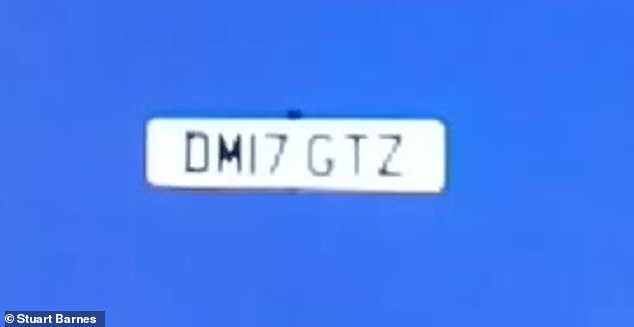
Separate plates bought by the Mail had thinned characters ‘which could potentially confuse an ANPR camera’ when photographed under infrared – with the ‘G’ here already looking like a ‘C’
‘We nearly fell off our chairs when we were told 600,’ they said.
Their investigations found the DVLA-registered suppliers included ‘known criminals with horrific backgrounds linked to murder, firearms, drugs, robbery and violent assault’.
Darren Hughen, a senior trading standards officer, told me: ‘We do visits (to suppliers) with DVLA enforcement officers and we did one at number 33, say, Smith Street and then the next one was two doors down – it’s so lucrative.’
But this ballooning number of official suppliers has not been met by a corresponding rise in enforcement. There are only five or six DVLA staff responsible for the monitoring of thousands of number plate sellers, with only 23 per cent of those registered as suppliers audited in the past five years.
Critics argue this has created a culture of impunity, where companies no longer bother carrying out certain legal requirements, such as checking whether customers actually own the car for which they are ordering number plates, or stopping criminals cloning plates for vehicles they do not own.
It is this toxic combination of poor enforcement and brazen suppliers that has helped lead to the rise of the ghost plate.
The plates often use so-called 3D or 4D digits made of gels or plastics which cause road cameras to misread them, either due to the characters appearing transparent or creating shadows that distort the image.
Other ghost plates are more rudimentary, simply using a plastic film that renders the characters unreadable by reflecting back the infrared light used by cameras.
The unsatisfactory and confusing regulatory environment is perhaps best demonstrated by the fact it is not illegal to sell 3D and 4D plates, while at the same time experts from Cranfield University’s Vehicle Identification Group say cameras routinely fail to read them, which means they would be illegal to use on the roads because number plates have to be recognisable to cameras.
Dr Barnes said: ‘When you look at them just as a human being, you would probably think it looks OK, but for cameras themselves, it’s a real challenge.’
Many rogue suppliers openly market their products as ghost plates, particularly on social media platforms such as TikTok, where they are advertised as a way of dodging hated road schemes like London’s Ulez zone.
One loophole regularly exploited by suppliers is marketing ‘ghost plates’ as being for ‘show use’ only, meaning that, although they are advertised as having properties that make them invisible to cameras, they are sold on the basis they cannot be used on the roads.
Fraser Sampson, the Government’s former surveillance camera commissioner, told me: ‘Imagine if we did that with currency and said ,“I promise I won’t use this in a shop” if you sell me £100 worth of tenners – once they get into circulation, you can’t control how they’re used.’
The very fact they are invisible to cameras makes accurate estimates for the number of ghost plates hard to gauge.
A recent operation by the West Midlands Police and Crime Commissioner identified more than 4,000 in a single location over a two-week period in Birmingham using a specialist camera.
‘It’s a problem everywhere, we’ve had a 100 per cent hit rate everywhere we’ve been,’ said Mr Hughen, who educates authorities across the country about ghost plates. ‘Everywhere has ghost plates, it’s huge – it’s so far out of control.’
At the sharp end, ghost plates pose a major problem to a police service increasingly reliant on the network of 18,000 Automatic Number Plate Recognition (ANPR) cameras to track criminals and suspects across the country.
There has been a steep decline in the number of officers policing roads over the past decade, meaning the camera is now the police’s most important tool to detect and prevent road crime.
As Professor Sampson put it: ‘If you are an active criminal and you were caught simply by the use of a number plate and ANPR, then you’re pretty inept at your chosen profession. It’s so easy to defeat.’
Indeed, grooming gangs, drug traffickers and serious organised crime gangs have already been found by Trading Standards to be among those using ghost plates to hide their movements.
But the Metropolitan Police told MPs the problem could be worse still, as ‘the inability to track a vehicle using the ANPR network creates a critical vulnerability for national security’.
The force added: ‘Vehicles used by terrorists could travel freely, making it difficult to monitor movement in high-security areas.’
Unavoidably, however, the growth of green schemes such as Ulez, as well as road charging fees and camera-enforced parking zones at airports, has created an ‘incentive’ for many regular motorists to try to dodge the rules.
This is perhaps best demonstrated by their rampant popularity among mini-cab taxi drivers. A check of 1,000 private-hire vehicles in London in 2023 found 41 per cent were using ghost plates.
Police believe taxi drivers resort to stealth ‘to evade the congestion charge and any local council enforcement or restrictions’.
This carries a clear safety threat to passengers, particularly women and girls. One trading standards official said: ‘Would you let your daughter, or anyone, go into a taxi that cannot be traced?’
Then there is the sheer cost to public finances. That estimate suggesting Transport for London is missing out on £950million a year in lost fines due to ghost plates, up to one in seven traffic offences going unpunished, demonstrates the gargantuan scale of the problem nationwide.
One driver owes Hackney Council £250,000 in unpaid fines, it emerged, with the authority telling MPs it has missed out on £11million over the past decade as ghost plates became more popular.
Professor Sampson said part of the problem was the rate of number plate ‘misreads’ police were willing to tolerate on the ANPR network, which he roughly estimated to be around 160,000 vehicles an hour.
He said: ‘To whom is that acceptable? If you imagine you accepted 2,500 known common vulnerability exposures in a cyber security setting for our critical infrastructure, I don’t think anyone would accept it. It illustrates the ragged nature of the whole regulatory coverage.’
A report this month by the All-Party Parliamentary Group for Transport Safety called for an ‘overhaul’ of the registration-plate sale system, including banning 4D and 3D plates and imposing tougher penalties for rule breaking.
‘The problem has now far exceeded the ability of the relevant bodies to manage or bring it under control,’ the report concluded. ‘Councils, the police, the DVLA and trading standards bodies all evidence a scale of evasion resulting in enormous revenue losses each year and the ability for any body, jointly or in isolation, to recover that money.
‘The answer is wholesale revision of the registration plate system from production to supply, usage and management.’
The MPs have urged the Government to use its planned New Road Safety Strategy to address their concerns when it is published in the new year.
A DVLA spokesman said: ‘There are strict laws in place which demand number plate suppliers are properly registered with DVLA, and robust identification standards for buyers.
‘DVLA works with police and Trading Standards to enforce these strict rules, and we will investigate any reports of suppliers failing to comply with the law.
‘On top of this, there is a review on the current standards on number plates which aim to ban production of plates that are specifically designed to evade Automatic Number Plate recognition cameras.’
Review or no review, in my neighbourhood ghost number plates continue to proliferate as criminals exploit the loopholes in a desperately inadequate regulation system.