“Como las cosas humanas no sean eternas.” As nothing that is man’s can last forever. These words from the final chapter of Don Quixote seem ever more apt for Spanish Prime Minister Pedro Sánchez. Though heralded abroad, the Iberian nation’s glamorous leader is behind in the polls, and last week saw tens of people with ties to his government implicated in the latest corruption investigation to rock his administration. The governing socialist party (the PSOE) is backed by a series of small allies who all squirmed as they justified their continued support. But the Prime Minister, unperturbed, gave an hour-long PowerPoint and started packing for his holiday. He believes in his own myth, and for now that’s all he needs. The rest will have to do with Feliz Navidad.
Last week, three tramas, or corruption cases, exploded onto the Spanish front pages. They span the acronym-filled, arm’s-length bodies of Spain’s public sector, and most deal with classic contracts corruption. SEPI, the nation’s sovereign wealth fund, is at the heart of a case involving public contract grants worth €132.9 million. Investigators allege that it implicates former governing party activist Leire Díez, along with numerous other PSOE-linked businessmen and officials.
By the end of the week, that case had been overtaken by an even more politically acute scandal. The airline Plus Ultra had received a €53 million public bailout in 2021, but prosecutors say this was actually used to launder money from the Venezuelan government. The case grew even graver when a member of the airline’s board was photographed — 72 hours before his arrest — having a Sopranos-style early-morning rendezvous in a guarded rural restaurant with none other than former PSOE Prime Minister José Luis Zapatero.
Even after leaving out lurid details of expensive chalets, laundering-linked lesbian bars, and at least one more new case, this sits on top of the summer’s huge corruption scandal involving three of the Prime Minister’s closest associates. There appear to be links between one of those men, Santos Cerdán — until his arrest, the PSOE’s Secretary of Organisation — and some of the new cases. The other two involved in the summer’s scandal, José Luis Ábalos and Koldo García, spent their days before being imprisoned on remand giving interviews to the right-wing press. Tales of their alleged escapades in Madrid’s lupanares — brothels — have scandalised Spain’s political autumn, with this farce culminating in “everything I’m taking to prison” reels.
Despite enough scandal for three or four governments, Pedro Sánchez will go into Christmas with no threat of a real crisis. The dystopian polling landscape means no separatist party wants to bring about elections that would lead to a right-wing government dependent on the nationalist Vox party. This sacred tenet was obscured by more earthly demands from the fragmented far-left coalition for “re-orientation”, and a bizarre lecture that “no communist party had known any corruption.”
The minority government’s allies are caught in a trap because things are not only very bad, but getting worse and worse. Despite this, the only credible solution — elections — would bring a nationalist government with Vox into power: the separatists’ nightmare. Knowing this, Sánchez ignored his subservient allies’ flailing demands for change, and while Gabriel Rufián, the Spanish parliamentary leader of the Catalan separatist left, cried chantaje — blackmai l —Sánchez continued as if nothing had happened. Assembling the nation’s journalists and his cabinet for an hour-long presentation on his government’s achievements, it was Rioja off a duck’s back. Don Quixote would be proud, after all: “That is not and ought not to be called deception which aims at virtuous ends.”
Machiavellian might be our favourite descriptor for successful politicians, but Westminster’s protagonists could learn far more from Don Quixote
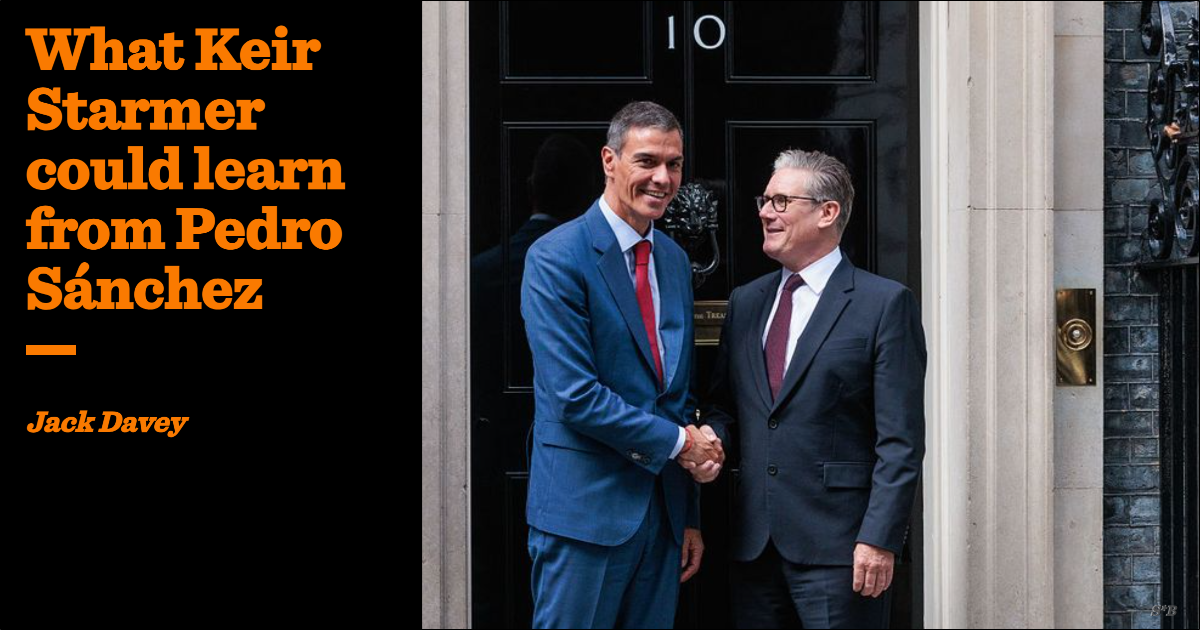
While Sánchez has a situation that perhaps even Keir Starmer wouldn’t envy, this similarity to Don Quixote de la Mancha lies at the heart of his success. Reading through a boring PowerPoint of his government’s macroeconomic success and offering a cut-price public transport subscription may not quite be a chivalric deed, but his mythical self-belief certainly is.
Machiavellian might be our favourite descriptor for successful politicians, but Westminster’s protagonists could learn far more from Don Quixote. Pedro Sánchez has mythicised his government into the last hope for Spanish progressives, as Cervantes’s creation was the last representation of a dying chivalric age. By triggering the right across every possible domain, from gender to immigration, and even the Civil War, he has made the teetering windmills of Spanish nationalist politics grow the arms, legs, and grim visages of giants. The great politicians know that if their myth dies, they die themselves, like the Knight of La Mancha who cannot survive as the lowly Alonso Quijano.
Keir Starmer may seem a world away from Spain’s plains — Manchego from a Camden deli does not a hidalgo make — but Sir Keir would do well to understand that the first person who has to believe his own myth is himself. Sánchez is in the minority and has governed for eight years without a majority of more than a few votes. However, all his actions have been directed at rewarding his supporters and radicalising the right into a monster he uses to keep his allies chained. His quest seems destined to finally come to an end in the 2027 election, but whatever happens, he will have done far more with far less than Britain’s unhappy PM. Sir Keir Starmer would do well to remember the key to Pedro Sánchez’s success, in the words of Machiavelli: “Whosoever wishes to delude will always find someone willing to be deluded.”