It’s sometimes possible to wonder whether environmentalists can count — even whether they can think. This latest dyspepsia is driven by a new report featured in The Guardian: “Revealed: Europe losing 600 football pitches of nature and crop land a day”. This really does sound terrible, doesn’t it?
Except, well, some of us — if not environmentalists — can count. A football pitch is, -ish, a hectare and Europe has a billion of those (hectares, that is, not football pitches). 365 times 600 hectares and we end up at 0.02 per cent of Europe’s land area each year. It will take a century for this disgusting waste of nature to reach the 2 per cent of land which is the density of houses and gardens here in lovely Britain. This is, perhaps, something not to get too worried about.
But this is so important that The Guardian runs two articles on it in one day. Clearly, it is vital to something or other.
But let us move on from wittering about sums and actually examine the report. One obvious limitation is that they used journalists to do their counting — an obvious problem given the general numeracy of the craft. We also find that of the 1500 km2 per year, 900, or 3/5ths, is just nature having a go. Only 2/5ths of the claimed overall number is actually humans building something. So we’re doing less than Mother N herself — and it will now take well over two centuries for us to use even 2 per cent.
At which point we could just pack up and go home. Trivia about a marginal issue — why waste effort on this drivel? Well, because it gets worse.
Their actual method was to use satellite imagery, break that down into pixel by pixel status and assign land which had been developed — by humans, not Mother N, obviously — as having gone from green to grey. Then the journos pooled their fingers and toes to count and we got to our final number.
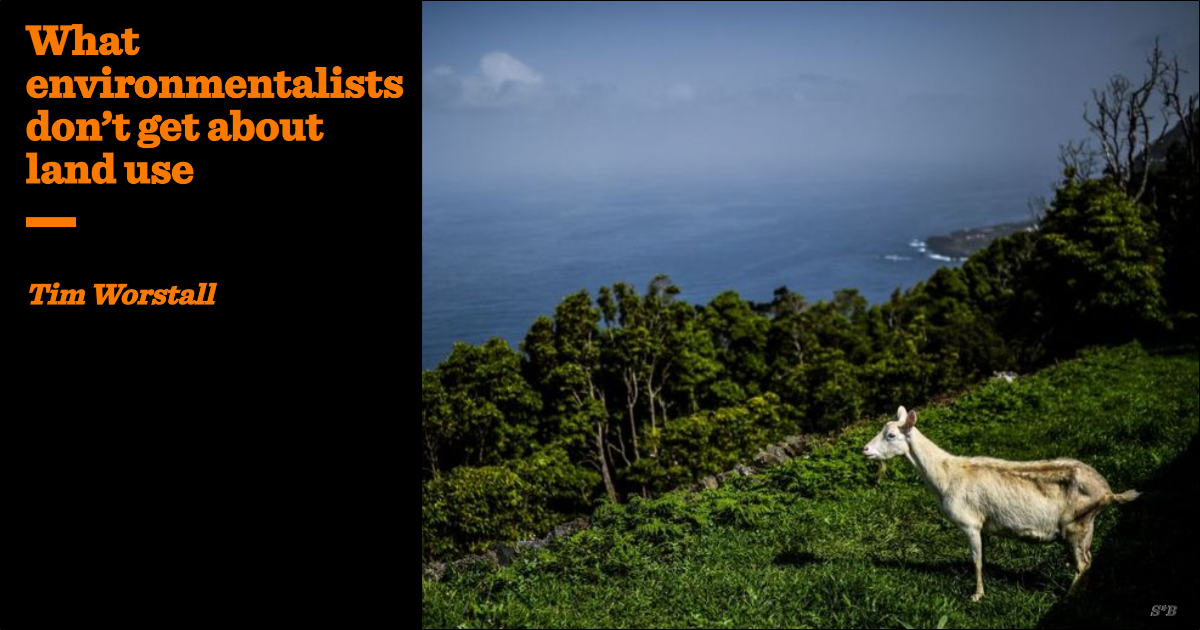
Ah, good, yes, the perceptive have got there ahead of the explanation. But we know that land is moving from grey to green as well. We’ve even talked about it here at The Critic. Portugal has wildfires because of the shortage of goats — or, more pertinently, the shortage of peasants living out in the boonies off a few goats feeding on scrub. Their kids moved to the big city, and as Gramps dies off the land is being abandoned. This is happening all over rural southern Europe. Vast swathes of Northern Portugal, in fact — a band extending right across Galicia. The Spanish will subsidise people moving into swathes of the country given how bad the depopulation is getting.
The entire measurement system being used is gross movement of green to grey, not net movement. And if there is anything at all important, it’s that net position, not gross.
As an example, we’re in the autumn now and the newspapers will be full of those travel articles suggesting visiting New England to see the trees turn red and gold and so on. A lovely thing, to see of course, but a century or a century and a half back the entirety of that area was clear cut. What were known as “hardscrabble” farms. It’s possible to wander through those woods now and fall over all sorts of interesting walls — houses, barns, field dividers and so on. That’s all, wholly and entirely, second growth from humans simply clearing out of an area and not farming it any more.
All that happened was that poor folk decided that getting rich farming the flat land of the prairies with great big tractors was more fun — which is, in fact, the big story about land use this past century.
Land use as a problem is over. We humans, here in Europe at least, are retreating from it
We’ve industrialised farming, hugely increasing the yield from any particular patch of it. Sure, there are those arguing for organic farming to increase that footprint again but fools always exist. Humanity uses less land per person now than it used to — vastly less in fact. And given fertility rates, the population itself is about to start declining — significantly, too, here in Europe, at least absent migration.
Land use as a problem is over. We humans, here in Europe at least, are retreating from it — ever more is left to be wild. But we still have that shrieking over nature being lost even as it booms — largely, it seems, because these environmental journalists have been able to teach themselves to count but not to think. How could you go out and count nature lost to development without including past development now returning to nature?
Answers on a postcard to The Guardian.