In yesterday’s extract from his definitive biography of the late Queen, ROBERT HARDMAN explained the truth behind claims that Andrew was her favourite child. In today’s excerpt, he reveals what Donald Trump told him about Elizabeth II during an incredibly honest dinner at Mar-a-Lago…
President Donald Trump has never forgotten his first meeting with Elizabeth II. ‘The first time I met her, we were only supposed to have 15 minutes, and it just went on because she liked me and I liked her,’ the US President told me.
He smiled as he recalled trying to persuade her to name her favourite occupant of the White House. ‘I kept asking her, “Who was your favourite president? Was it Reagan? Or Eisenhower?” and she just said, “They were all very nice”. That sort of thing.’
Mr Trump explained that he decided to switch tack. He began to ask the late Queen about the residents of Downing Street.
‘So then I tried her on, “Who’s your favourite prime minister? Must have been Churchill, right?” And she said again, “No, they were all very nice”.’
At which point, President Trump twigged. ‘So I realised: that’s why she lasted 70 years without a complaint – because she was so good at it. The rest of us would have said, “Oh, I liked so-and-so”. But she was so clever. And I know she liked me because we talked a lot.’
She was – as he told me more than once – ‘unbelievable’.
For all his recent broadsides aimed at Sir Keir Starmer and the state of Britain’s Armed Forces, Mr Trump’s affection for Britain and, above all, for the monarchy, runs deep.
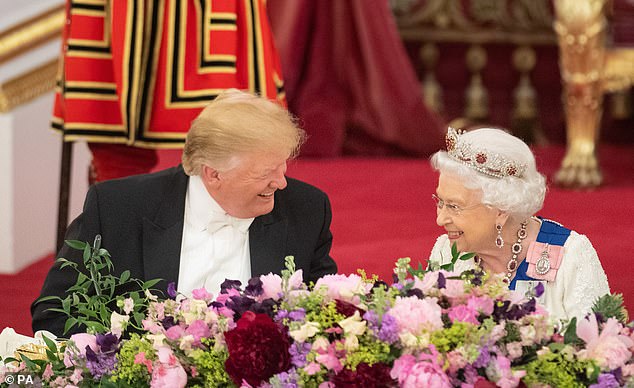
Donald Trump was left impressed by Queen Elizabeth’s diplomacy during his time with her
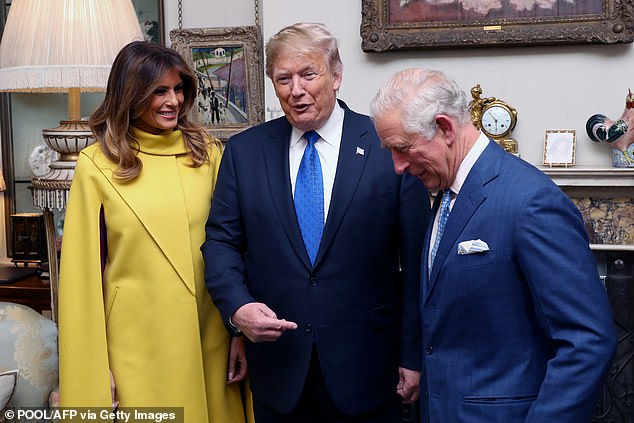
Trump said King Charles’ battle with cancer was ‘something that’s down a lot of other people’ and admired his resilience. Trump and Charles pictured with First Lady Melania Trump in 2019
The man who identified and codified the concept of soft power, Harvard’s Professor Joseph Nye, told me that the English language and the Royal Family remain the UK’s two greatest soft power assets.
This explained why, just three months after President Trump’s state visit to the UK last September, I found myself sitting at breakfast with him at his Florida golf club and then at dinner at his Mar-a-Lago home. The only reason I was there was because he had agreed to an informal chat about the monarchy.
I had previously interviewed Presidents Bill Clinton and George W. Bush about links with Queen Elizabeth II. Mr Trump, though, will always retain the distinction of being the last state visitor of her record-breaking reign.
Over 70 years, she had welcomed 112 heads of state, from General de Gaulle to Nelson Mandela, two Popes, three emperors and a shah. And Mr Trump had been the very last one. He was also an ardent Anglophile, being half-British by descent (his mother was born on the Isle of Lewis). Mr Trump immediately asked me about the King and his health. It was not small talk. ‘He’s fantastic and he has fought very hard. He’s a fighter,’ Mr Trump said firmly. ‘We’re close. I have a really good relationship with him.
‘Let me just give you the bottom line. He’s a great guy and he’s grown so much in the last ten years and especially over the last couple of years as King. His fight has shown that.’
The King’s battle with cancer, he said, was ‘something that’s taken down a lot of other people’.As we shall see, that personal regard for the King may well have a direct and significant effect on one aspect of US foreign policy during his presidency.
Mr Trump remains extremely proud that he was the first (and – he very much hopes – the last) president of the United States to make two state visits to Britain. Even before then, he had been very keen to meet the late Queen following his first election as president in 2016.
His first regal encounter would take place in 2018 during an official trip (a notch below a full state visit) to see then prime minister Theresa May. As the British foreign secretary at that time, Jeremy Hunt, later admitted: ‘We were told by the Americans, “If you want him to come and it involves tea with the Queen, he’ll come”.’
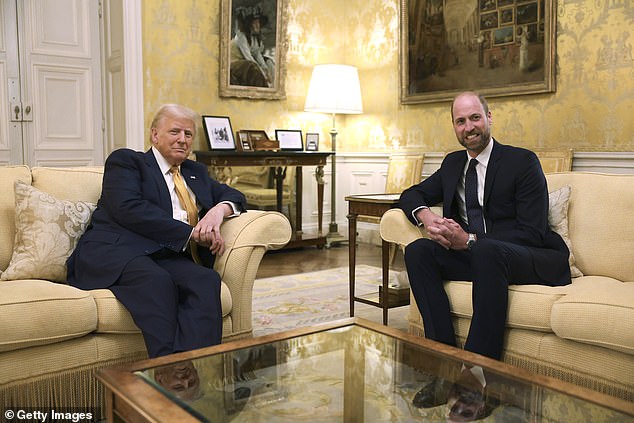
The President referred to Prince William as ‘remarkable’ and said Catherine had ‘performed so incredibly’ during her cancer battle
As a permanent reminder of the Queen, Trump acquired a signed reproduction of the last official portrait of Elizabeth II
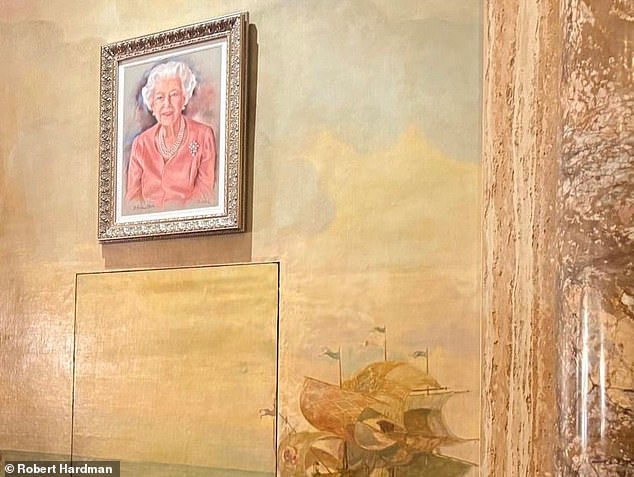
The signed portrait hanging in the dining room at Mar-a-Lago in Florida. Picture taken by Robert Hardman
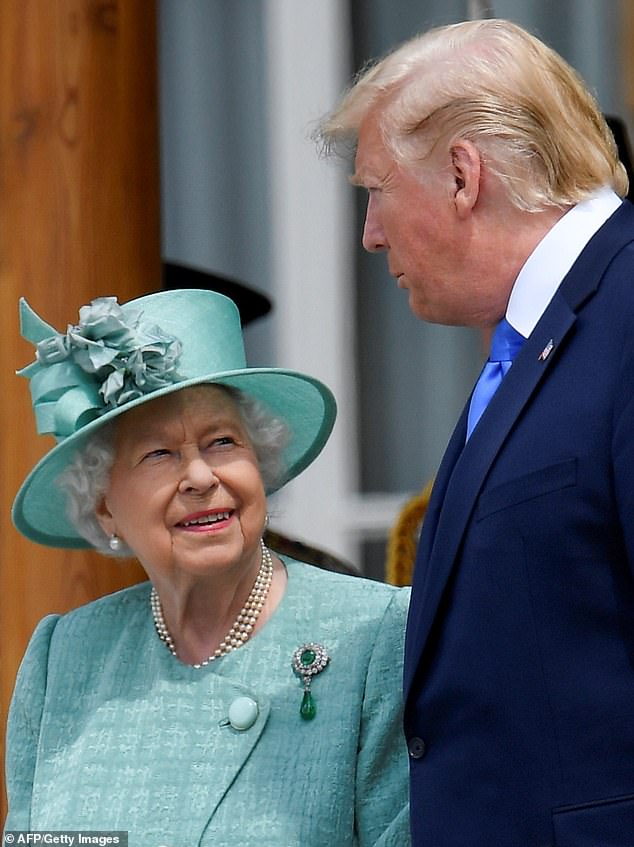
Before that tea, there was the usual inspection of the Guard of Honour. Mr Trump’s media critics made much of his alleged ‘rudeness’ walking down the ranks of the Coldstream Guards in front of the Queen, when, in fact, he had done exactly the right thing: the guest should always go first.
They formed an immediate rapport, said one of those present, over the fact that they both had Scottish mothers and Scottish land (Balmoral in her case, golf courses in his).
It helps explain why that initial meeting, scheduled for between 15 and 20 minutes, lasted for the best part of an hour. Afterwards, Mr Trump gladly posed for individual photos with the Queen’s staff at the bottom of the stairs.
‘No one’s too proud not to have a selfie with me!’ he said, beckoning a very senior (if bashful) courtier across for a shot.
The tea party was just a trial run for the full state visit the following June, when the President and First Lady, Melania Trump, arrived and the two heads of state renewed their easy rapport.
The next day, they sat next to each other at commemorations to mark the 75th anniversary of D-Day on Southsea Common. The Queen told the veterans: ‘It is with humility and pleasure on behalf of the entire country – indeed the whole free world – that I say to you all, thank you.’
After the ceremony, the Lord Chamberlain, Earl Peel, had the formal duty of accompanying the Trumps to Southampton Airport for their onward flight to commemorate the Normandy landings in France.
As Lord Peel bid farewell on behalf of the Queen, Mr Trump put his hand on his arm and declared: ‘So far as the Queen’s concerned, I’ve only got one thing to say. She’s one hell of a lady!’
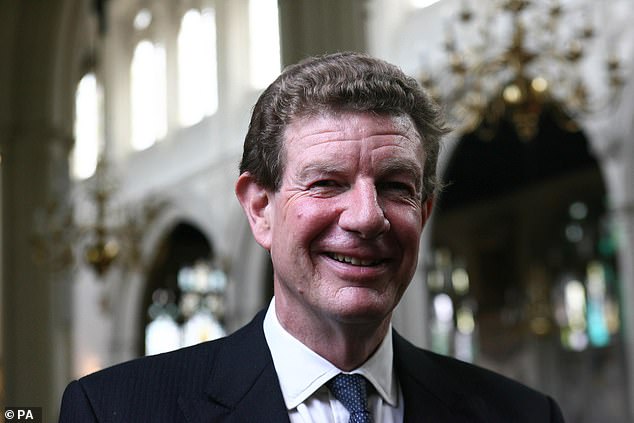
As Lord Peel bid farewell on behalf of the Queen, Mr Trump put his hand on his arm and declared: ‘So far as the Queen’s concerned, I’ve only got one thing to say. She’s one hell of a lady!’
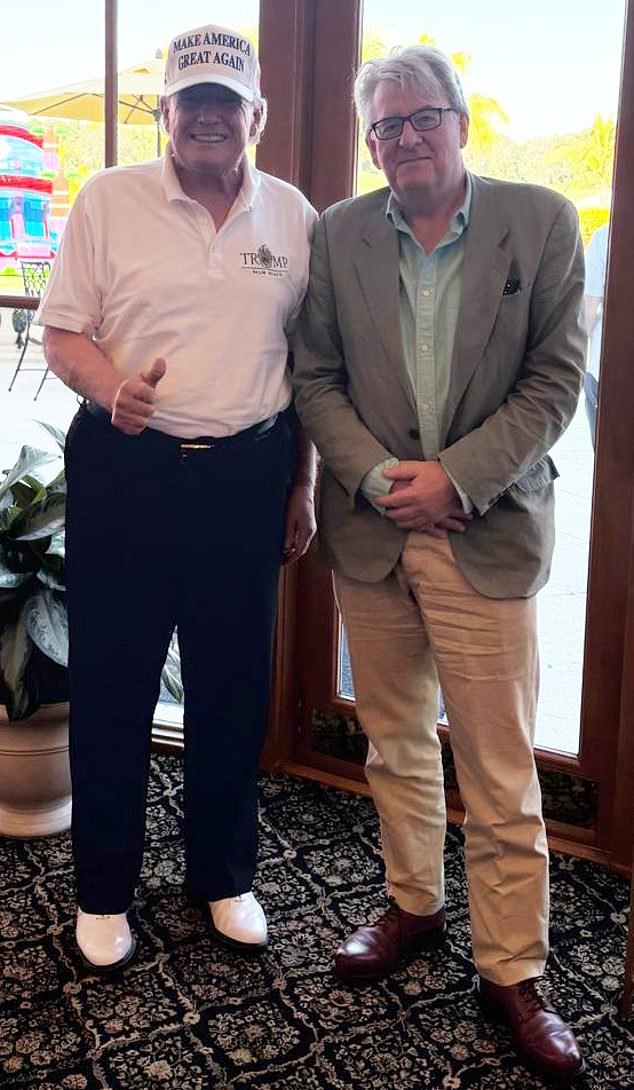
Robert Hardman with Donald Trump at the International Golf Club West Palm Beach
Following Mr Trump’s defeat in the 2020 presidential election, the Queen went on to meet the last of the 14 US presidents she would know in her lifetime.
Joe Biden had flown into Britain in June 2021 for the G7 summit, hosted by Boris Johnson in Cornwall.
The British government had not wanted to trouble the Queen just two months after the death of Prince Philip. However, she regarded duty and routine as the best way to deal with personal sadness.
At the summit, she helped break the ice as the heads of state stood stiffly in their socially distanced places for the group photo. ‘Aren’t you supposed to look like you’re enjoying yourselves?’ she asked, and smiles broke out. Two days later, she was laying on tea for President Biden and First Lady at Windsor. Whereas Donald Trump had strolled up the stairs, Mr Biden had needed the old elevator to bring him up to the Oak Room in the private wing of the castle.
It was a very happy moment, however. ‘I loved her sense of independence,’ the First Lady, Dr Jill Biden, recalled. ‘She had a big teapot. And Joe said to her, “Here, let me help you”. The Queen had been quite insistent, however. “No, no, no. You sit. I will serve you”.’
It was the Bidens who attended the Queen’s funeral in 2022. The First Lady returned to Britain to represent the USA the following May at the Coronation of King Charles III. All the King’s realms – 14 of them in addition to Britain – would expect a visit from their new sovereign. He started with the two largest. In 2024, he visited Australia. More significant, in May 2025, was a very brief trip to a very worried Canada.
Since winning his second US election in 2024, Donald Trump had repeatedly expressed a desire to annex the country. After winning the 2025 Canadian general election, the new prime minister, Mark Carney, asked the King of Canada to open the next session of Parliament.
It was especially challenging for the King since his British prime minister, Sir Keir Starmer, had just invited Mr Trump on a state visit to the UK. However, Charles could draw on more than half a century on the world stage. His quietly assertive message was clear enough, especially when he reached his conclusion: ‘As the anthem reminds us, “The True North” is indeed strong and free.’
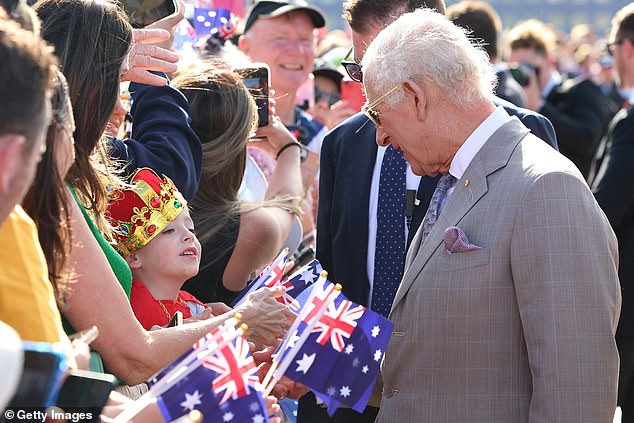
King Charles during a state visit to Australia in 2024. The following year he visited Canada, which has experienced increased tensions with the US over Trump’s tariffs
A ‘speech from the Throne’ would not normally generate applause. This one received two standing ovations. Washington would understand that monarchs act on the advice of their prime ministers, yet this speech had required very careful calibration. That the King had succeeded was evident four months later, as Mr Trump’s second state visit to the UK began with a spectacular cavalcade clattering through Windsor Home Park.
The Secret Service had never allowed any US president to ride in a public carriage procession on security grounds. However, the King knew that it would mean a great deal to Mr Trump and arranged a private one. Past Prince Albert’s dairy and sepulchral Frogmore they rode, up to the top of the Long Walk and through the George IV Gate into the Quadrangle.
There, the largest Guard of Honour ever mounted for a state visit – three companies – awaited the President’s inspection.
By the end of the day, Mr Trump had been treated to more immaculate drill, trotting and gun salutes than any visitor since the reign of Queen Victoria.
That evening, in white tie, the President heard the King reflect: ‘The ocean may still divide us but in so many other ways, we are now the closest of kin.’ His speech did not actually talk of a ‘special relationship’ (too boastful, perhaps). President Trump, however, did not hold back. ‘The word special does not begin to do it justice,’ he declared as he saluted the King for giving ‘everything he’s got’.
He praised Shakespeare, Dickens, the Magna Carta and the way in which the ‘incredible . . . unbelievable . . . lionhearted people of this kingdom defeated Napoleon, unleashed the Industrial Revolution, destroyed slavery and defended civilisation in the darkest days of fascism and communism.’
It was hard to recall the last time that a politician, even a British one, had been so unequivocally generous about imperial Britain. And it came from the leader of the first country to break away from it.
Sitting down with President Trump over breakfast three months later, I began by asking him about that second state visit.
British hospitality had impressed, not least the sight of the table in St George’s Hall laid out end to end for 160 guests. Mr Trump joked that his new White House ballroom would be considerably bigger.
He was well aware that the King had gone the extra mile to make his welcome an exceptional one. ‘He did make it a great state visit,’ he recalled. I observed that his speech had been one which no British politician would make these days. ‘It came from the heart, right,’ he shrugged.
The President had been much impressed by the Prince and Princess of Wales. In his Windsor speech, he had praised the King’s ‘remarkable son’. Shortly after being re-elected in 2024, Mr Trump had met Prince William in Paris at the re-opening of the Cathedral of Notre Dame – indeed, the president-elect had travelled to meet the prince, not the other way round.
Their talk had overrun for so long that the Élysée Palace had rung up the British Embassy to see when Mr Trump would be joining President Macron for dinner.
In Florida, the President’s mind was on the Princess of Wales. ‘How is the princess doing?’ he asked me. He had been impressed by her dedication to duty both before and after her cancer diagnosis became known in March 2024.
‘She performed so incredibly because that’s a very tough position, and you couldn’t do better than the way she did,’ he reflected. ‘And then she became ill and she didn’t want to talk about it and wanted to keep it private. And they were so nasty to her – saying that there was something wrong with her.’ He shook his head, recalling the spiteful online gossip following her absence from the public gaze in early 2024, prior to her remarkable message to the world, asking for understanding and private time.
‘And once they’d found out, she went on.’ He wondered about the delay in explaining the situation. ‘Why didn’t she want people to know?’ he asked. ‘Were certain people embarrassed?’ I explained that the princess’s priority, as ever, was her children and that she had wanted to tell them at the appropriate moment. ‘I see. She wanted to wait,’ he nodded.
He would not be drawn on prevailing Royal Family dramas, preferring to dwell on the late Queen. ‘I had a really good relationship with her,’ he said.
One senior member of her staff said that she had found him ‘charming, tall, tanned, big, courteous, mid-century – not at all how he had been portrayed.’
One thing which had particularly struck the late Queen about Mr Trump, according to aides, was his energy. Mr Trump, said one staffer, had ‘bounced’ up and down the stairs at both Windsor and the Palace. ‘I had no choice,’ the President recalled, ‘and there are a lot of stairs at Windsor and the Palace!’
Mr Trump explained that he had wanted a permanent reminder of the Queen and had given the matter a great deal of thought. He had recently acquired a signed reproduction of the last official portrait of Elizabeth II (she had sat for more than 200 during her lifetime).
The Polish-British artist Basia Kaczmarowska-Hamilton had painted her at Windsor just four months before her death. Basia went on to paint Mr Trump and recently gave him a copy of that royal portrait. ‘She was so great. I wanted to hang her picture in a room where there is no one else on the wall. You must take a look,’ he said. ‘I hope you approve.’
Later, I looked around Mar-a-Lago and went into the palatial dining room, modelled on Rome’s Chigi Palace, which Mr Trump uses for summit meetings. And there, in the middle of a fresco of a medieval ship, was the Queen, in pink.
During another conversation, the President asked what I thought of his quest to annex Greenland. ‘Do you think I should go to war with Denmark over Greenland?’ he asked mischievously.
I replied that this would probably destroy Nato and, while we were on the subject, could he please leave Canada alone, too. It had been a staunch ally through history, a gallant D-Day partner and attempting to acquire it would undoubtedly make the King of Canada unhappy. That prompted a slight pause. ‘Do they still recognise the King? Or have they stopped that?’ he wondered.
I said that they did indeed still recognise him as head of state. ‘But they have these terrible politicians. They’re nice to my face and then they say bad things behind my back,’ he replied, adding that the cold weather meant that most Canadians lived in the far south and were only just over the US border anyway.
‘The problem is some guy drew that straight line to make a border. He should just have drawn it 50 miles further north and then there wouldn’t be a problem.’
However, Mr Trump conceded that some things might be beyond even him during the rest of his presidency. ‘I suppose the Canadians have got 200 years of history and all that “Oh, Canada” thing,’ he reflected. ‘You can’t deal with that in three-and-a-half years. I guess it’s not going to happen!’
This was the closest I had heard to an acknowledgement that, as long as Canada had the King, Mr Trump was not going to usurp him. As he left for his next appointment, I handed him a copy of my biography of the King. ‘I hope you gave him good reviews,’ he said. ‘He’s a fantastic guy.’
There could be no doubting the esteem in which the late Queen was held by Mr Trump.
He had also voiced the highest praise for her son and heir, who appeared to be the primary reason why he was no longer sabre-rattling at Canada.
By any metric, this was soft power beyond the grasp of any politician and has to be a central element of any assessment of the legacy of Elizabeth II.
Mr Trump would continue to test the transatlantic alliance to the limit – not least in January 2026 with his absurd claim that Nato allies including Britain had ‘stayed a little back’ from the Afghan frontline.
He later rescinded the claim, though only with regard to Britain (after royal ‘concerns’ had been relayed via diplomatic channels).
Whatever else the monarchy’s critics might say, it remains hard to question its continued relevance.
Adapted from Elizabeth II by Robert Hardman (Pan Macmillan, £22) to be published April 9th. © Robert Hardman 2026. To order a copy for £18.70 (offer valid to 18/04/26; UK P&P free on orders over £25) go to www.mailshop.co.uk/books or call 020 3176 2937.
The Queen’s shocking frankness
To hear a candid, straight-talking Queen in private could surprise those used to the reticent public figure. ‘She could be very frank with her opinions. I was very struck by how forthcoming she could be about people,’ said one former (Labour) minister. A former (Tory) Cabinet minister described her outlook as ‘not the views of an aristocrat, or a very rich, out-of-touch person’. She hated prevarication. Lord Peel well remembered her first words when she appointed him as her Lord Chamberlain: ‘Do you really want this job?’ she asked with a big smile. She expressed similar sentiments to Boris Johnson when he arrived to be appointed as prime minister in 2019.
A senior clergyman awaiting a royal verdict on a carefully prepared sermon was both amused and bemused by her parting remark: ‘So many long words, bishop!’
Having won the 2015 election by a tiny margin, David Cameron arrived at the Palace to be greeted with a blunt assessment: ‘You haven’t got a very big majority.’ To which he instantly replied (much to the Queen’s amusement): ‘But it’s getting bigger all the time.’
Entire dramas have been based on speculation about the relationship between the Queen and her first female prime minister. What really happened? One common perception is that Mrs Thatcher did all the talking, based on a much-repeated remark attributed to the Queen: ‘Mrs Thatcher never listens to a word I say.’
One of the Queen’s most senior advisers, however, provides an intriguing counter to this. ‘I would often hear the Queen say to someone that “so-and-so wouldn’t let me get a word in edgeways”,’ says the former aide.
‘Except I knew that she very often had got a word in edgeways. So it would be a shame if people are left imagining that she was easily cowed or hectored, because she was not. This was just a very clever deflection. If someone said, “Why didn’t you tell Mrs Thatcher to do x?”, it would be much easier to say, “I can never get a word in”. But it was really just the Queen’s way of gently saying: “Back off”. Anyone with a greater ego would find that impossible but the Queen had a very low ego.’