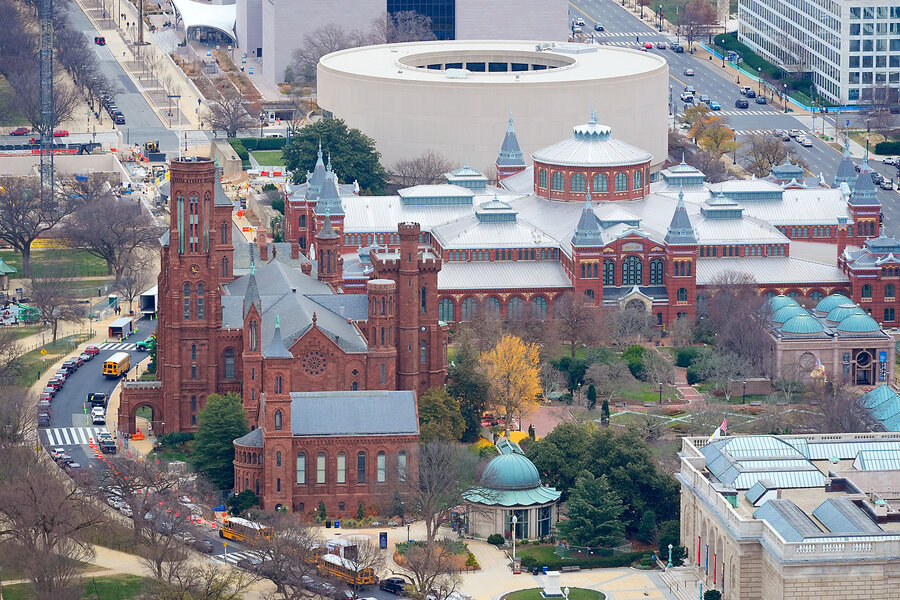
In a dispute with the Trump administration that threatens to change the museum’s historic independence from the executive branch, the Smithsonian Institution faces a Jan. 13 deadline to turn over records about its content to the government or face possible funding cuts.
The world’s largest museum and research complex, including 21 free museums in Washington that range in focus from American history to art, to air and space, makes its own decisions about its exhibits and how to present historical narratives. About 17 million people visit the museums each year.
The deadline signals a potential turning point in President Donald Trump’s yearlong effort to manage what visitors see at Smithsonian museums, including during the celebration of America’s 250th birthday. The Smithsonian did not immediately comment on whether it would comply with Mr. Trump’s demand.
Why We Wrote This
The Smithsonian Institution receives federal money but historically has made its own decisions about how to tell the American story. Now, the Trump White House wants to make sure museum exhibits conform to its ideology.
He has ordered the end of funding for exhibits that “divide Americans based on race,” an examination of historic displays in national parks, and a “focus on the greatness of the achievements and progress of the American people.” While many of President Trump’s supporters argue that highlighting historic divisions can diminish Americans’ sense of national pride, many historians say that grappling with the darker aspects of American history is important, so negative moves are not repeated.
“There’s always scrutiny around museums and how they tell stories,” says Suse Anderson, head of the Museum Studies Program at George Washington University. “That’s because the work of museums is deeply important in reflecting a people back to itself.”
But, Ms. Anderson says, the aggressiveness with which the Trump administration is pursuing its goals is unlike anything the Smithsonian has experienced before.
“Those with power are always interested in trying to get the official message within the museums to align their vision and what they’re trying to achieve,” she says. “It’s one of the reasons museums have developed practices, professional codes of ethics, why their institutional independence is so important.”

Removing “improper ideology”
The Smithsonian is a uniquely structured institution. It is overseen by a Board of Regents made up of citizens as well as members from the three branches of the U.S. government. Some 63% of the Smithsonian’s budget of over $1 billion is funded by congressional appropriations.
In March 2025, Mr. Trump signed an executive order titled “Restoring Truth and Sanity to American History.” He accused the Smithsonian of rewriting history in a way that contributed to a sense of “national shame.”
The President also ordered Vice President JD Vance to leverage his position on the Smithsonian’s Board of Regents to remove exhibits or programs with “improper ideology.” Examples included exhibitions featuring transgender athletes and those that presented race as a social, rather than biological, matter or construct.
Then, last August, the Trump administration wrote to the Smithsonian’s secretary announcing a comprehensive review of the content in eight museums ahead of the celebration of America’s 250th anniversary. The review sought to ensure museums “celebrate American exceptionalism” and “remove divisive or partisan narratives.” A follow-up letter dated Dec. 18 accused the Smithsonian of failing to turn over all the requested material and set a Jan. 13 deadline for the rest, noting that much of the Smithsonian’s funding is federal money, controlled by Congress.
The National Portrait Gallery, part of the Smithsonian, last week removed a label accompanying Mr. Trump’s portrait in the museum’s “America’s Presidents’’ exhibition, which included text that noted that he was “impeached twice, on charges of abuse of power and incitement of insurrection.” It’s not clear whether that was connected to the museum complex’s dispute with the administration.

Since at least 2020, Mr. Trump and conservative commentators have criticized the Smithsonian for incorporating what they call a leftist agenda. A 2020 exhibit at the National Museum for African American History and Culture drew particular ire for listing traits of “white dominant culture” including hard work and the nuclear family. Following backlash, the museum took down the exhibition and issued an apology.
Mr. Trump has also accused the museums of overemphasizing dark parts of U.S. history, like slavery, and downplaying American achievements. The public’s response is divided. Overall, 6 in 10 people oppose Mr. Trump’s efforts to review the Smithsonian’s contents, but almost 70% of Republicans indicate support, according to an August Quinnipiac University poll.
David Blight, a Yale history professor who sits on the National Portrait Gallery’s Board of Commissioners, says while disagreements often arise about a particular exhibit, outside interference, especially by politicians, is not needed. There are mechanisms within the museum’s independent structure, he notes, to have constructive debates and then find solutions.
“You can have tremendous fights, but that’s the professionalism of it,” he says.
Precedent of independence
Sarah Weicksel, the executive director of the American Historical Association and a former historian at the Smithsonian’s National Museum of American History, says complexity is part of the museum experience.
“A museum is never intended to produce a single definitive story,” Ms. Weicksel says. It is “an entry point for visitors to learn, to question, and to continue to explore once they leave that museum.”
Museum exhibitions typically undergo a lengthy internal review before being opened to the public. Mr. Blight says that process often takes two to three years and involves collecting input from groups of scholars as well as from experts in audio and visual displays.

Throughout history, there have been museum exhibits that sparked public controversy. In the mid-1990s, for example, a planned exhibit in the Smithsonian’s National Air and Space museum featuring a refurbished Enola Gay – the B-29 plane that dropped an atomic bomb on Hiroshima in World War II – was criticized by many veterans and citizens who said the script presented American soldiers as vengeful. The exhibit was eventually canceled.
However, experts say that although the Smithsonian has weathered heated disputes, it has dealt with them independently through intellectual discussion. The difference now, they say, is that a presidential administration is trying to leverage its power to influence what should and should not be displayed.
On Monday afternoon, Shawn Tes and her husband, Sam Tes, had just finished visiting the National Museum of African American History and Culture. It was the two Alaskans’ first time in D.C., and Mr. Trump’s plans for the Smithsonian have been on their minds.
“We’ve been talking about that since we got here,” said Ms. Tes. “This visit brings up a lot of emotions for us.”
Mr. Tes is a naturalized refugee who came to the U.S. from Cambodia in 1980. He says visiting D.C. and seeing museums makes him feel very “proud.’’ But he and his wife are unsettled. They say they are concerned that some important parts of history could be edited out.
“There’s a lot at stake,” said Ms. Tes. “We’ve come so far – have you been in there?” she asked, gesturing behind her to the African American history museum.
“We can’t move forward and heal if we don’t acknowledge the past.”