For all the talk of “BRICS” and “multipolarity”, America is still number one
Trump’s increasingly reckless and chaotic interventions in the global arena have seen many raise the question of whether we are seeing the twilight of the American and Western world order.
For decades commentators have been predicting the demise of American hegemony and the birth of a multipolar alternative. There was much fanfare about the rising Global South, the “BRICS” — Brazil, Russia, India, China and South Africa — a group that has since expanded to include Egypt, Ethiopia, Indonesia, Iran, and the United Arab Emirates. Founded with Russian inspiration, BRICS was a loosely convened anti-Western alignment of supposedly rising economic and military powers.
Yet the decline of the West and the rise of the “Rest” is a prediction that is getting rather long in the tooth. Some powers on the list above, like China and the UAE, have more or less lived up to their meteoric potential. Others, like India, have become serious mid-ranking powers despite profound structural issues.
Yet the rosy predictions of the sleeping southern giant shrugging off the might of the West has not come to pass. Brazil’s initial rapid growth was followed by a deep recession. South African growth soon flatlined following an early 2000s boom. Russia’s economy has gone into the doldrums since sanctions and the switch to a war footing following Crimea.
The gulf between the West and the Rest on non-economic factors remains almost as wide as ever. Leaving aside questions of human rights and political freedoms, most of the Global South remains politically dysfunctional, corrupt, unequal and faced with often intractable social problems.
And though European economic power has declined in relative terms, the USA represents the same share of the global economy it did in the mid 90s. In the military arena, whilst a number of regional powers have emerged, there is little sign of the scale of coordination and global alliances that characterised the Cold War.
American might was supposed to have been broken in Vietnam and Iraq, its humiliation completed in Afghanistan, and its nemesis arising in China with Russian and Iranian help. None of this has come to pass. Indeed the wild and reckless actions of America over the past months reveal a surprisingly durable American hegemon, and a shockingly passive and ineffectual set of supposed geopolitical rivals. We have all been reading books about Chinese tendrils reaching into every capital, of South America turning from the blue of US trade to the red of Chinese economic dominance, and of the neo-colonial empire being built in the sands of the Sahara.
But there is a wide gulf between the self-interested actions of a national regime, and the will to empire and global dominion. It’s far from clear that China, for all its industrial might and performative patriotism, really has the latter. Indeed, it has been a fairly passive observer of the unravelling of the supposedly potent anti-Western alliance.
And falling apart, in catastrophic fashion, is what has been happening to the West’s supposedly menacing foes. Saddam’s Iraq, Gaddafi’s Libya and Assad’s Syria have all vanished into history. Iran’s supposedly deadly terror network has been humiliated by Israel, and its nuclear programme and fleet dismembered by American and Israeli airpower. Venezuela, the champion of anti-American revolutionary sentiment in Latin America, saw its leader simply hauled off by US special forces as if he were a mid-ranking drug dealer. Russia, having planned a blitzkrieg to seize Ukraine, is now years into the most catastrophic war since its invasion of Afghanistan, as hundreds of thousands of lives are wasted in a NATO-funded meat grinder. Even Taliban-ruled Afghanistan — that bastion of asymmetrical, empire-proof guerilla warfare — is now bogged down fighting a border war with Pakistan. India, for all its rise, is in its turn locked into competition with China and an everlasting cold war with Pakistan.
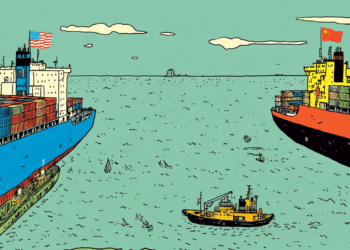
China is the only country which might plausibly challenge America and its allies, yet it has fundamentally not chosen to do so at present. China did not step in to stop the fall of Assad, tip the balance in Ukraine, counter US warships in the gulf, or save Maduro in Venezuela. It is building up a massive navy and stockpile of weapons systems, and is concentrated on building a hegemonic role in the region.
Yet it is far from clear that even regional hegemony is within its grasp. Even if China can act on its decades long ambitions to seize Taiwan, it remains encircled and constrained by rivals, unreliable allies and outright US-aligned powers. South Korea, Japan, Australia and the Philippines are not moving into the Chinese orbit anytime soon, India will be unhelpful so long as China backs Pakistan, and Russia, even when not distracted by war, is not remotely fully aligned with China.
We are living in a second American century
Pundits and academics, not without a certain amount of wishful thinking, a hatred of “eurocentrism”, and looking to shock readers, have got the nature of the 21st century precisely wrong. We are living in a second American century.
21st century globalisation, often heralded as a weakening of Western dominance, is in fact the reflection of America’s ability to set the tone of the world economy and global economic rules and conditions. It is far from a coincidence, that following the end of the Cold War, trade and finance liberalisation redistributed industry from the West to cheaper labour pools, and undermined the European economy whilst leaving American economic strength untouched. These changes were driven by American (de)regulation and capital markets, as well as its growing tech industry. The infrastructure, software and hardware that have facilitated the rise of a new stage of globalisation were largely designed and built in America.
The new “cosmopolitan” paradigm of global cities, the service economy, just-in-time production and digital capitalism, is in fact largely determined and shaped by American cultural, economic, and political norms. Its thinking is rooted in anglophone economic and political philosophy, and its governing elites are schooled in American and European universities.
Even in China, where a form of quasi-Maoist state capitalism persists, consumerism and individualism are increasingly dominant cultural paradigms, and even improbably alien features of US culture, like enthusiastic Protestant non-conformity, are increasingly common. It is converging on an American-defined “global default” that even extends to factors like rising pet ownership and US “furbaby” culture.
Nor is the only area of US hegemony. The wave of Islamic revivalism that looked unstoppable in the 80s-00s has probably broken. Younger Muslims across the Islamic world are becoming less religious, with a 2019 poll suggesting that as many as 18 per cent of young Arabs identify as “non-religious”. In Tunisia, the birthplace of the Arab Spring, nearly half of young people defined themselves as irreligious. A confidential state study in Iran, leaked to the press, revealed that over 70 per cent of Iranians would prefer a secular state.
Even if America can be economically and militarily contested by powers like China or Russia within limited regional theatres, the substantial post 1991 change is that it is no longer being intellectually or culturally contested. Western culture and consumerism is seen as a path to power and prosperity. For all its strength, China’s regime is ultimately fuelled by its ability to deliver economic growth, not by a deeper spiritual or ideological project.
As well as its dominant position in world markets, finance and military power, America has the ultimate civilisational edge: American citizens are the natives, progenitors and high priests of a new global civilisation. They are the true believers, for whom individualism and consumption have moral significance and spiritual urgency, taking on, sometimes literally, the quality of a religion. For all its divisions, this ultimately unites Americans, whether they are Trump supporters attending a prosperity Gospel mega-church, or liberal progressives buying their way into the good life in a leafy college town. America not only controls technology and finance, the governing aspects of our material world, but most importantly it monopolises the global imagination through Hollywood, social media, and international brands.
Even the ways in which “anti-Western” sentiments are thought of and expressed are largely American defined and derived. Post-colonial ideology is eagerly preached on US campuses, and the “decolonisation” of the curriculum has long been championed by the American “counterculture”, before becoming an institutional norm.
The most meaningful and authentic fightback against this 21st century US world culture has, ironically, been internal to the West. Trump himself, via protectionist measures, has shifted the economic world order further towards national economies and regional blocs. American and European populists have attempted to reassert national and local culture against the new cosmopolitanism, and restore a politics of place.
Such efforts have been heavily constrained by the intellectual and imaginative limits of populism. Often limited to a desire to halt mass migration and restore cultural pride, these movements have struggled to move to a structural critique of the digital capitalism and globalisation which drive rootlessness, the fluidity of labour and capital, and the erosion of the nation state.
Missing from both the prophets of multipolarity and the polemics of populism is the crucial insight that American civilisational power and dominance has only expanded since 1991, even if its national and military fortunes have fluctuated. Globalisation, paradoxically, is a local phenomenon, a culture as embodied as any other, discoverable in “world cities”, but most of all in the centres of its power in America, from Ivy League colleges to Silicon Valley.
The lesson of 1991 was never learnt. The Soviet Union and the Eastern Bloc did not fall apart because it was defeated in a war, or even because it was outcompeted economically by the West. Nuclear detente remained stable, proxy wars went both ways, and the standard of living of the East was lower for decades without triggering collapse. Instead, the defeat was moral, intellectual and civilisational. There was a wave of apostasy amongst the elites. People perpetuated regimes out of habit, rather than true belief. It took very little for stronger, more embedded ideas like nation and religion to fracture the empire apart in the historical equivalent of a heartbeat.
The power of American culture today is the hold it has on our desires and self-perpection. It isn’t that we all want to drink cola and wear blue jeans (although of course, we do). It’s that we long for the same existential goals. We want “self-actualisation” and we think we can achieve it through having a “career”, accumulating consumer goods, and creating “authentic” interpersonal bonds with others based on a shared respect for our mutual autonomy. Many of us have religious faith or patriotism, but rather than instantiating communities, these are fast becoming badges of individual “identity” rather than the basis for a social bond. Even the furies of populism and polarisation reflect an individualistic carelessness about shared institutions, truth and civility.
Everywhere, women are becoming educated and joining the job market. Everywhere, people are having fewer children. Everywhere people are getting smartphones and browsing short-form video content. Everywhere people are consuming more, living in cities more, and dressing according to global trends.
If in all of this rush to worldwide conformity, we see flashes of India, African, Arab or Chinese culture, it is largely as phrases, objects, and ideas ripped from their original context, and deployed in the service of an American derived culture.
Compared to past centuries, the 21st century is the least pluralistic, and the most culturally homogenous period of human history. Dress, music, cinema, speech, literature and social organisation are all converging. More than that, culture itself has become moribund, repetitive and captured by commercial interests. The age of the aristocratic patron was far from perfect, but the tyranny of algorithmically manipulated popular “taste” has proven infinitely worse and more degrading.
It gives me no pleasure, either for us in Britain or those living in America itself, to declare a second American century
Americans reading this may very well object that American culture is much more than individualism, consumerism and even more than just liberty and the pursuit of happiness. All this may be true, but America has not, for the most part, globalised small-town conviviality, townhall democracy, spontaneous social organisation, Southern manners, religious mysticism or transcendentalism, or any of a thousand local and national gifts. Nor, perhaps even more urgently, has it globalised or recently made much use of its own giant-killing history of reigning in corporate power and breaking up monopolies.
It gives me no pleasure, either for us in Britain or those living in America itself, to declare a second American century. The rule of tech barons, managerialism and world finance is a soul-destroying and culture-shredding business, not least for Americans themselves.
One thing is incredibly clear. The answers to the crisis of Western culture lie in a revolt of the West itself, both a rebalancing of American dominance by Europe, and a growing cultural challenge to destructive individualism in America itself. Change and challenge, when it comes, will have to involve the intellectual, not material, contestation and reform of Western culture.