We’ve long lived in the age of the remake. Intellectual properties are not so much resurrected these days as they are dug up, dismembered, and awkwardly reassembled into shambling zombies, mocking and desecrating once fresh and exciting stories. It isn’t only that we’ve become bad at storytelling, it’s that we seem to keep telling the same story, one that we impose on every genre, era and plotline.
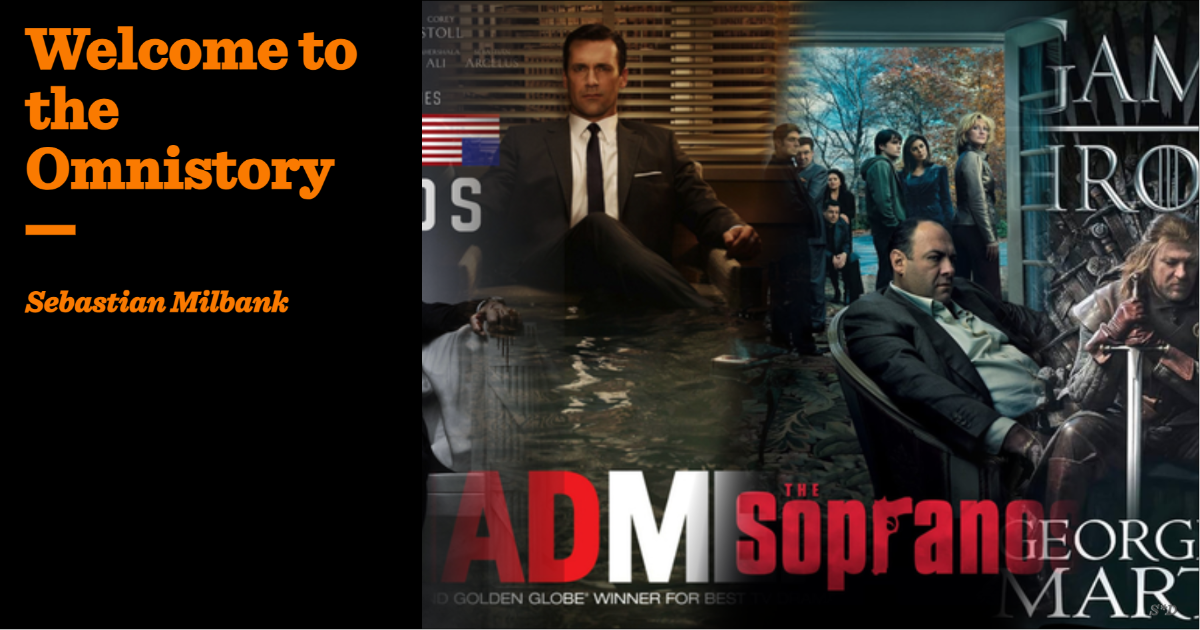
What is the story? It began in the days of “prestige television”, with series like The Sopranos. The “prestige”, as compared to the low budgets and amateurism of many historic shows, was obvious enough. The filming became professional and inventive. Trite episodic formats gave way to complex interweaving plotlines. Characterisation became more complex, and the quality and performances of actors improved markedly. The range of themes, from religion, to violence, to serious social problems widened. A trail of glory arched its way over the intervening decades as shows like Game of Thrones, Mad Men, Breaking Bad, House of Cards and Orange is the New Black inaugurated a “golden age of television”.
But is this age so golden? What if this apparent abundance was really an arid desert of declining creativity, masked by a mirage of skilled filming and performances, whilst the essential substance of compelling stories dwindled away? Beneath all the apparent teeming diversity, everything from novels to TV to movies was being sucked into what I call the “Omnistory”.
What is the Omnistory? Let’s start with The Sopranos. Strip it down to its essential elements. There is a troubled, morally compromised but personally sympathetic lead. As the show continues, this character’s psychology is dissected, and his world and life slowly come apart. This disintegration is accompanied by tragicomic absurdities, communicated with symbolically resonant images and themes. Shocking sex and violence occasionally breaks out amidst the otherwise mundane world of everyday life. The personal relationships between a colourful cast of characters is complicated by personal drama and deepening schemes, deceits and betrayals. As the drama progresses, we are compromised by our liking for the morally dubious lead, and gradually realise the underlying logic of power and violence that defines his world. But the show takes things a step further: the world itself, including the apparently “innocent”, is equally defined by that power and violence, just in more subtle ways.
All of these tropes are entirely cognisant and consistent with the story of a mafia family in 90s New Jersey, and the show is extremely attentive to the social, historical and cultural particularities of that context. But don’t be fooled. It is not the story that generates the tropes here, rather, The Sopranos was invented as the most effective vehicle for the tropes. This sets it apart from classic gangster movies like Goodfellas or Scarface, which follow a classical tragicomic form that would be recognisable to the 18th century audiences attending Don Giovanni. Whilst the exceptionalism and glamour of being a “made man” (and the tragic self-destruction this invites) is the topic of the classic gangster movie, the premise of The Sopranos is that there is no difference between gangsters and ordinary people. David Chase, creator of the show compares it to banking but with more violence (perhaps), whilst Chris Albrecht, who produced it, presents Tony Soprano as an everyman: “the only difference between him and everybody I know is he’s the Don of New Jersey.”
At some level we know that the “adult” activities that we find sophisticated arguments to defend are morally and psychologically corrosive
If you take the central trope of The Sopranos (morally ambiguous lead, gradually disintegrating life, machiavellian maneuvering, arresting absurdism with symbolic meaning, “adult” themes, implicit social commentary about cynicism of social mores) and apply it to other beloved and “complex” TV shows from the golden age, you quickly see how many fit the bill. Mad Men is an almost beat for beat repetition of the winning formula, with an equal precision in its use of costume, context and cultural references.
Sopranos and Mad Men are perhaps the “cleverest” of these shows, and the ones with the most respect for their source material. But many successors were far more casual and crude. As settings became more exotic and more distanced from modern conditions, the formula became ever more ill-fitted to the premise upon which it was forced. Deadwood and Game of Thrones didn’t just subtly subvert their settings, but basically threw out the central logic and morals of Western and Fantasy genres, simply taking “gritty, complex modern political/criminal drama”, but giving it a lush genre-specific “skin” with their Tony Soprano given a cowboy hat or mounted on a dragon. Likewise whilst The Sopranos gradually sidled up to the idea that the whole world is a corrupt, cynical power game, programs like House of Cards beat viewers over the head with it from the first minute, and didn’t stop for a single moment.
Why is this formula so pervasive, and why is it so successful? Audiences appear to love it, if the legions of superfans and the success of prestige TV in attracting viewers to streaming services is anything to go by. Critics rave about them, and the extremely repetitive formula is regularly praised as “complex”, “thoughtful” and “mature”. The formula is, when pulled off correctly, a very clever bag of tricks. If you tell a traditionally heroic story, but with lashing of villains getting blown up and women taking their clothes off, you just made a James Bond movie. People love Bond films, but you won’t win any Emmys for putting one on a TV screen, or boast to friends about having watched them. But make Bond into an agonised mafia boss killing his cousin, or turn Pussy Galore into a wisecracking prostitute, and you have just made Sophisticated Drama.
This double game is the defining feature of the Omnistory. By making your hero an “anti-hero” he can do both heroic things you can cheer on, and evil things you can secretly exult in or delightedly shudder at. The mafia boss who loves his kids is not an inherently more sophisticated psychological subject than, say, the young hero struggling to seek justice without simply taking revenge. In fact, anti-heroes, because random, chaotic and inconsistent personalities often result in “collage” like stories rather than the classical elegance of the hero’s journey or a tragic descent into evil or disaster. But the shock-factor of the inconsistent hero, along with the presence of psychoanalytic dialogue and heavy-handed clues creates an illusion of depth and complexity where none exists.
The Omnistory is brilliant at making the audience feel smart, whilst catering to their cruder impulses for melodrama, sex, and violence. It fools the viewer into thinking they are grasping subtle tropes and undercurrents, when in fact they are so heavily layered and served up through expositional dialogue as to be screaming from the TV screen. The illusion that you’ve spotted this, and the satisfaction of unpacking the tightly wrapped package with your friends, is a natural breeding ground for the sort of commentary, debate and fandom that fuels modern franchises.
The ubiquity of the Omnistory is increasingly evident, and as it becomes normalised and viewers become habituated to its norms, it takes on ever more extreme forms. Now, when the BBC do a big budget historical drama about the Norman Conquest, the primary reference point is not history or English literature, but Game of Thrones. As I recently wrote, this led to an “historical” adaptation in which medieval nobles act like schoolboys on their lunch break and go around murdering people at random.
A great test case of this phenomenon of every adaptation being subsumed into the same plot was the recent and very successful Fallout TV series, based on a popular video game franchise. Whilst historical source material may be complicated, culturally alien, and difficult to communicate, video game universes are by definition already pre-packed for modern sensibilities. Set in a post-apocalyptic alternative Earth, Fallout imagines a 1950s sci-fi world that destroyed itself in a nuclear exchange. Mutants and intelligent zombies roam a tragicomic wasteland comprising 1950s Americana, power-armoured “knights” hunt for lost technology and suburban families have been transformed into “tribes” which live off the land.
The games were thoughtful, funny, and didn’t offer a single simple message. Human nature, in its most heroic and villainous forms alike, persists into this future that is horrifying and funny in equal measure. Brutal gangs, cannibals and fanatics rub shoulders with caravan leaders, cowboys, idealistic dreamers, preachers, gamblers and ordinary family men. Although as with many RPGs, you could choose to be as villainous as you wanted, heroism exists and is rewarded even in this grimmest of futures. Crucially, unlike the “gritty” world of prestige TV, the games could be lighthearted, with the satire on human nature shaded with an indulgence and affection.
Stripped back, we are starting to see the ugly core of the Omnistory presented naked to adoring audiences
The TV show was very different. Someone is dismembered or brutalised in every episode. Most of the characters have grotesque, ugly personalities. The few likable characters are introduced only to be brutally murdered in quick succession. The entire premise of the show is the journey of the protagonist, a naïve girl raised in a nuclear bunker to believe that reason and morality can rebuild America, from her original idealism to a gritty cynicism. Every single character living in the wasteland hammers this message into the cartoonishly, unbelievably unworldly skull of the attractive heroine. This process descends into an almost pornographic sadism, culminating in her being abducted by a mutated bounty hunter who, after she bites his thumb off in a struggle, mutilates her hand in turn, calling it “the first honest exchange” they’ve had.
As the Omnistory continues to be told, the layers of sophistication and showmanship are gradually stripped back, till the point that we are starting to see its ugly core presented naked to adoring audiences. The central message is as slimy and vicious as they come. It is that innocence is only ignorance, that the world is ruled by power alone, and that those who transgress legal and moral norms are no different than the rest of us. This moral relativism is sold as psychological and narrative sophistication, but is in fact the opposite. The fictional universe that more and more stories are now being told in is one without objective good and evil, and is thus a world without stakes or ordering principles. Likewise, the much-vaunted “complexity” of plot and relationship in these narratives is nothing of the sort, as the reduction of all motivations to power and passions eliminates genuinely subtle characterisation.
Real storytelling operates in a moral universe. Even if good and evil are impossible to clearly perceive or judge in every case, and ambiguity always exists, it is the search to determine and live out the good which makes human life, and thus human stories, compelling. A novel like Conrad’s Lord Jim, which is entirely premised on the ambiguity of his morality and motivations, is only interesting because of our clear grasp of a moral and social order, and Jim’s own obsessive urge to live up to those values.
The reason so many of us want to imaginatively inhabit a world that is morally flat and relativistic is that it at once flatters our pretensions and forgives our faults. The reduction of human culture to power relationships is the common orthodoxy of a Foucauldian progressive left and a Schmittian authoritarian right alike. As well as fitting intellectual and political vogues, the antihero allows us to simultaneously indulge our highest and lowest urges. The anti-hero, like Walter White in Breaking Bad, is someone who “steps outside” social, legal and ethical norms. In the process they become something like an ubermensch, and are portrayed in their most violent and machiavellian episodes like dark superheroes. Walter White becomes “Heisenberg”, an ordinary middle-aged man who accesses his scientific knowledge in forbidden ways in order to escape the horror of his mundane existence and medical diagnosis. He is relatable for the worst reasons — he is a vague, agnostic, agreeable man without a strong culture or religious faith, who harbours unmet and unacknowledged desires for money, sex, glamour, fame and power.
Contrast the message of Breaking Bad with classic on screen stories about mid life crises and you quickly see how morally barren the Omnistory is by contrast. In It’s a Wonderful Life a similar figure, businessman George Bailey, faces financial ruin, and looks back on his life in despair, initially concluding that he has sacrificed his own ambitions for the service of others, and contemplates suicide as a result. Like Walter, he turned down a lucrative opportunity, and, like Walter at the end of Breaking Bad he faces imminent arrest. Yet whilst Walter embraces radical selfishness and nihilism, and builds a drug empire that destroys his family, George is visited by an angel who shows him how his community and family would be devastated if he had never been born. Finally, having been freed from despair and determined to face his fate with dignity, George is rescued from bankruptcy and prison by the generosity of the community he sacrificed for.
What happened in the intervening decades? We have gone from a cultural message that family, community and an ordinary life of service is meaningful, rewarding and beautiful, to the idea that mundane bourgeois existence is essentially soul-crushing, morality is relative and society exploits the individual, so he might as well exploit society back.
Perhaps the starkest contrast for those who doubt the shift is not between past and present drama, but between the stories we tell children and the stories we tell adults. Watch a children’s film or cartoon, and you will see classic storytelling with clear moral themes. Mad Men and Breaking Bad were on TV screens at the same time as cartoons like Avatar the Last Airbender, and having seen both, I consider the latter unambiguously more satisfying, well-told and morally sophisticated.
At some level, just as with smartphones, porn and social media, we know that the “adult” activities that we find sophisticated arguments to defend are morally and psychologically corrosive. There is a reason that the plotlines of the Omnistory don’t make their way into children’s TV and it’s not just because of the sex and violence. We want our children to develop moral sensibilities, we want them to understand the difference between right and wrong, and we know that they are naturally attracted to the clear and compelling structures of traditional storytelling. Like the nihilism lurking in many modern horror films, we enjoy and feel catharsis at the telling of the Omnistory, because we are both attracted and repelled by it. We fear that it is the truth, but it is still too ugly a truth for us to want to communicate it to our children.
But better stories exist. Even the moral ambiguity and convoluted political maneuvering that we enjoy is better presented in a story with moral stakes and moral (though highly imperfect) characters. Those sick of Game of Thrones-ified historical drama should try The Lion in Winter instead. Henry II is cooped up in a castle at Christmas with his rebellious sons and scheming wife, and there’s as much backstabbing, intrigue and drama as the most earnest of Game of Thrones fans could hope for. But, crucially, weight and grandeur is added to the scheming by the nobility, however compromised, of the characters. The moral danger of the Omnistory is directly confronted in an incredible scene in which Eleanor of Aquitaine confronts Prince Richard (the future King Richard the Lionheart). Plotting his father’s assassination, Eleanor denounces him as an “unnatural animal”. Richard’s reply is pure GoT (though of a much higher literary standard): “Unnatural, Mummy? You tell me, what’s nature’s way? If poisoned mushrooms grow and babies come with crooked backs, if goiters thrive and dogs go mad and wives kill husbands, what’s unnatural?”
But it is here where we see what genuinely great storytelling does, as opposed to the Omnistory. Whereas the Game of Thrones move would be some torrid mass stabbing — Red Wedding style — The Lion in Winter reaches a very different conclusion. After grappling with his sons in the darkness, Henry draws his sword and announces his intention to execute them. Yet as the sword descends, only the flat of the blade gently touches Prince Richard’s shoulder. Henry collapses, declaring that “children are all we have”, and allows the princes to escape. Intrigue, murder, and drama are present, and all the more compelling because the moral stakes of killing and family relationships have not been discarded. The threat of violence followed by its renunciation proves as dramatic as its outbreak.
If we want to have compelling and meaningful plots, we have to again operate in a moral universe, and develop a psychology and anthropology not rooted in materialism and nihilism. It means accepting the stories we tell have moral weight and pedagogic purpose, and don’t just exist to fascinate and entertain.