The Greens might have succeeded in Gorton and Denton but their strategy is unsustainable
It would be good to be able to say, following the Gorton and Denton by-election result, that the nation had a rendezvous with reality, and British politics was at a turning point.
Certainly, nobody could doubt that British politics was in an ongoing meltdown. The two main parties were shouldered aside, and Labour itself finished third in what had been a party stronghold. The election was won by the Greens, a party of the populist left, with Reform, a party of the populist right, finishing second.
It revealed a government in free-fall, with Keir Starmer’s cynical decision to block popular Manchester Mayor Andy Burnham’s bid to run for the seat now looking like a catastrophic and unforced error.
Matters aren’t much better for the Conservatives, with the “Kemi bounce” nowhere in evidence, as the party slid to fourth place, losing over 2000 votes along with their deposit.
This should be a clamorous wake up call; the most violent of jangling alarms breaking into the noontide slumber of a comatose political establishment.
But it was not to be. Labour figures on the so-called “soft left” of the party are convinced that “this must be the end of the McSweeney strategy of alienating our own voters”, with one MP declaring that “the political idea that we should try & out-Reform Reform is wrong & been rejected”.
But who are Labour voters? The voters who backed Reform were more likely to be from Denton, were less university educated, more likely to work a manual trade, were older and whiter, and were very much the sort of voters that once would have been at the core of the Labour vote. Increasingly, when appealing to the core “Labour voter” who gives the party its voice and soul, they mean people who live in places like Gorton — an urban ward with a large number of university graduates and a sizeable Pakistani community.
Much more of Britain looks like Denton than it does Gorton. Labour, having made slight, gestural moves in the direction of Reform, have certainly failed to out-Reform Reform, and find themselves sliding into irrelevance. The space that many Labour MPs and members would feel most comfortable with is that described by Steve Davies in The Great Realignment — as a cosmopolitan party of mobile elites and immigrants. But the ceiling for such a party remains low, with most voters outside of urban centres valuing a politics of belonging, place and national identity.
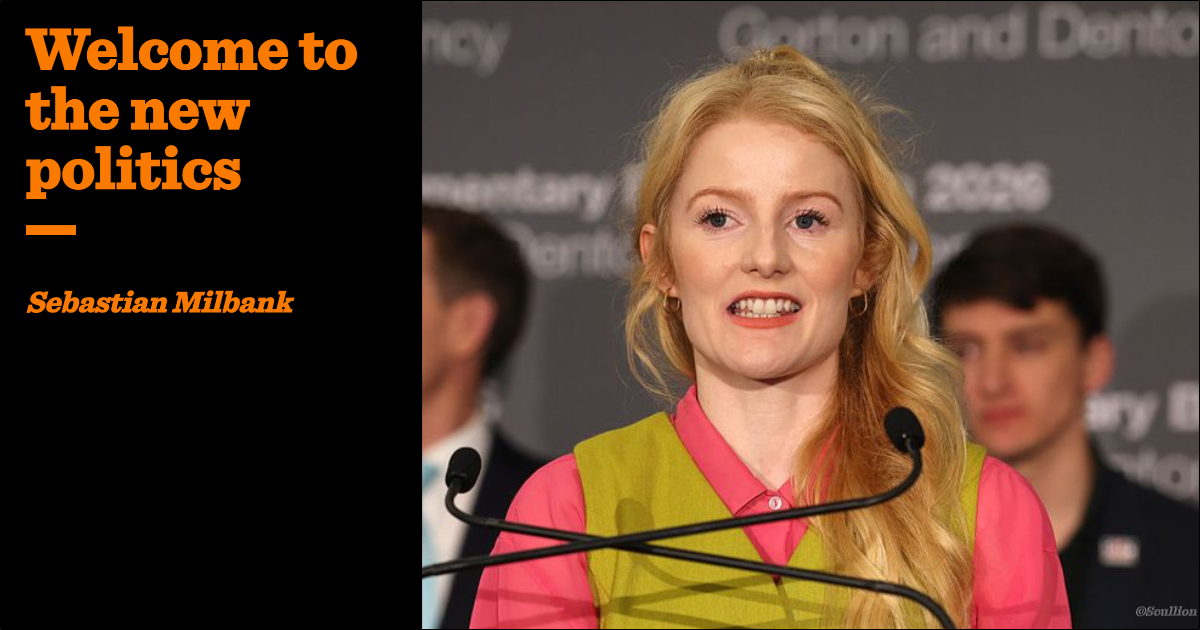
The new Green MP, Hannah Spencer, was undoubtedly a likable candidate and a political outsider. A professional plumber with fly-away blond locks, she somehow managed to embody both the worthy bohemianism of the Greens and the rooted politics of an older Labour movement. Yet the message did not live up to the messenger, with Spencer’s victory speech an incoherent set of moralisms about the need to stop “lining the pockets of billionaires”, and give workers “a nice life”. Even this would-be pro worker message was swiftly qualified to a lower level of seriousness as she assured us that “if you’re not able to work you should still have a nice life”.
But beneath the “be kind” messaging and the faux-tough posturing about billionaires (no doubt if they followed local British politics in the Cayman Islands and Monaco they would be very upset), a very different campaign was actually being waged on the ground.
A considerable 28 per cent of Gorton and Denton’s voters are Muslim, predominantly comprising Pakistanis. In the four most urban wards in Gorton, that proportion rises to 40 per cent. This has been a crucial demographic for the Greens nationally, who have tapped into anger over Gaza to win over Muslim voters. Indeed, the Greens recently elected Mothin Ali as their deputy leader, a man who said that he supported “the right of indigenous people to fight back” in the wake of the October 7th attack, and campaigns in traditional Islamic dress.
This improbable alliance of Islam and progressivism is a growing feature of the “stop Reform” vision of many on the Left, but it has often proven an explosive and unstable combination, as “Your Party” discovered. How long are socially conservative Muslims going to align with a party that wishes to abolish faith schools and legalise drugs? Something, somewhere, will have to give.
What do Greens really believe about traditional Pakistani communities? Spencer “called out” the “politicians and divisive figures who constantly scapegoat and blame our communities for all the problems in society” and stated that “my Muslim friends and neighbours are just like me: human”.
There is a divide between what progressives say about Muslim communities, and what their electoral tactics and targeted rhetoric reveals about how they really see them
Yet in what has been spun as an exciting, “multi-lingual” campaign, the Greens released a video in Urdu which showed images of Keir Starmer shaking hands with Netanyahu and Narendra Modi. Perhaps one could generously stretch the Israel factor to be about genuine humanitarian concern — but what on earth was the Modi image about if not a naked appeal to sectarian, anti-Hindu, sentiment?
There is a divide between what progressives say about Muslim communities, and what their electoral tactics and targeted rhetoric reveals about how they really see them. On the strength of that video, there seems little difference between what the populist Right accuses European Muslims of being — clannish, sectarian, Islamist — and what progressives appeal to when they’re trying to win the Muslim vote.
Neither account may be entirely fair, and any community has its worst instincts which can be appealed to by cynical politicians. But it is hard to dispute that many British Muslims seem more motivated by foreign policy than bin collections, as those unfortunate to live in the borough of Tower Hamlets could no doubt attest.
Nor was this the only aberration in the contest. Following the vote, there were widespread reports by election monitors of so-called “family voting” in which people accompanied voters into the voting booth, potentially influencing their vote.
A compelling story can be told of ethnic voting blocs, patronage networks, sectarianism and clannish corruption, and that’s just what Reform and Matt Goodwin have been saying in the wake of their defeat. Though raising suspicions of democratic votes may be seen as a Trumpian move, independent observers, and a remarkably ugly campaign, have given real fuel and weight to such rhetoric.
Welcome to the new politics, in which self-interest groups are asked to make judgements in the furious whirlwind of local and national campaigning, social media hysteria, and disinformation. In this environment, white identity politics, a marginal feature of British politics, is firmly on the rise and shows no signs of stopping.
By abandoning the white working class, stoking sectarian sentiment amongst Muslims, and promising pie-in-the-sky handouts for all, you can sustain a left-wing movement for the moment. But ironically for the Greens, it is the definition of unsustainable.