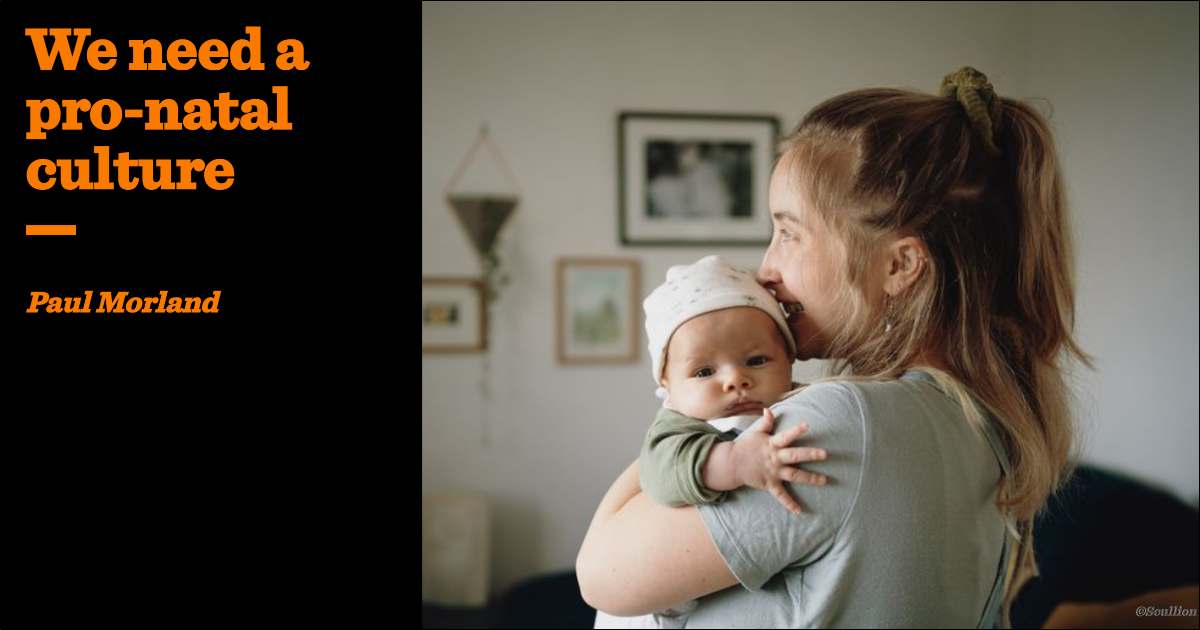
Changing our demographic future will require a new attitude towards having children
An ageing and forever declining population is a bad thing. It is less innovative and less entrepreneurial; it relies on a shrinking workforce to look after it. It will hope in vain for the robots to come over the horizon.
A human future with a waning and greying population is a bleak one. Even if technology could sort out the social care, the health care, the pensions, the fading creativity and the endless red ink on government budgets which go with a population’s shrivelling and shrinking, such a future represents the very opposite of the human flourishing and thriving to which we should aspire. Endless expansion in human numbers is perhaps unrealistic and undesirable, but as the global fertility rate sinks below replacement level and country after country experiences more deaths each year than births, the prospect haunting the globe is no longer uncontrollable population expansion but unstoppable population collapse. At recent South Korean fertility rates, more than 80 per cent of the population is lost in just two generations.
The first step, of course, is for politicians to acknowledge that there is a problem
The question then inevitably and quite rightly then emerges — what are we supposed to do about it? In these days, when problems of every kind end up at the door of government, and when politics is supposed to be the means by which to right all of society’s ills, it would be surprising if the demographic problem of too few children being born were not handed to politicians in the expectation that they should deal with it.
The first step, of course, is for politicians to acknowledge that there is a problem. A desire for a healthy, youthful and at least stable population has been quite normal from politicians of the left, right and centre outside the UK. President Macron of France, for example, talks unapologetically of the need of “demographic rearmament”. But in the UK no front-ranking politician has even mentioned the subject until our current Prime Minister whose only comment has been that he does not care.
But when we have got over the hurdle of our leaders understanding that too few children is a problem — and in the UK we are still not there after more than half a century of below-replacement fertility rates — the question of what to do remains. Many dislike any discussion of the subject. They consider it sexist (even when we point out that women say they want two to three children) or racist (even when we point out that non-white societies from Jamaica to Thailand have the same problem — as have many of our ethnic minorities at home have too). They are quick to pass from the phase of abusing anyone who mentions our demographic woes to the phase of saying nothing can be done and pointing at the supposed examples of places where pro-natal policies have been tried and, supposedly, have failed. When it comes to the problem of population they move straight from denial to surrender.
If we are going to fix this problem we need to turn to the cultural
What then can we do? Financial incentives can play a part: the baby bonus in the early twenty-first century seems to have had a positive impact, as indeed did some child-friendly tax changes in the Blair-Brown years. More affordable family housing would help, but in areas of the UK — and indeed Europe — where housing is relatively cheap, childbearing remains low. Likewise in countries where childcare subsidies make combining work and parenting affordable, the impact on the birthrate is modest at best. The material can only take us so far.
So if we are going to fix this problem we need to turn to the cultural. Any number of economically-driven policies can be suggested — and have been suggested, not least by me — from tax breaks for parents to planning policies aimed at the building of affordable family homes to a more flexible approach to home working for those with small children. But is it realistic to think that the culture can be changed? Can politics really be upstream rather than downstream of culture? Is it indeed not somewhat sinister to think that the government should be trying to manipulate the culture in a pro-natal direction? And if it is possible and acceptable, what could we do to shift the culture so that having children became a higher priority for those of childbearing age?
When I suggested in The Times that a telegram from the monarch on the birth of a fourth child, I was mocked; the idea, I was told, being laughable. Medals for prolific mothers, as given out in some of the more fecund central Asian republics, would probably not go down a treat in the UK. We need to be careful because the wrong steps might indeed be perceived as clunky and prove counterproductive.
However, discussing this with some old college friends recently, they started recalling some of the music of our university days. I’m afraid back then, in the mid-1980s, I was getting over my infatuation with the Brahms and Mahler and passing into a phase of Bruckner symphonies and late Beethoven string quartets. Whatever was in the popular cultural mix at the time passed me by, but fortunately most of my friends were not so culturally rarified (for rarified, read snobby) nor so detached from contemporary culture (for detached, read aloof). So they were able to fill me in.
At the time, the UK had a particular problem of teenage pregnancy. Even those of us who think that we need to have more children and that this means starting a family earlier do not generally believe that the teens are a good point to become a parent. Youngsters at that stage have rarely formed the emotional maturity or relationship stability to create the best start for a child. So it was reasonable for there to be concern. And by 2015 conceptions by those aged under 18 were at half the level experienced in the UK at the start of the 1990s. The cultural campaign to reduce teenage pregnancy — if a campaign it was — was a success.
But how was it achieved? My friends gave me multiple examples of popular songs of the era. There were The Specials who in 1979 came out with “Too Much Too Young” the lyrics of which included a warning of the pitfalls and youthful joys forgone by having children too young: “Now you’re married with a son / When you should be having fun with me… Ain’t you heard of contraception?” From the same year there was Squeeze’s “Up the Junction’”about the woes of a booted-out father: “She gave birth to a daughter… Alone here in the kitchen / I feel there’s something missing”. In 1983, the year we completed our A levels and started university, there were The Fun Boy Three and “The Tunnel of Love”: “So you get engaged and have a party / Only 17 when the wedding bells chimed out… And ended up in a divorce case … And threw away your life in the tunnel of love.”
I have no hard evidence that any of this was part of some governmental plot to reduce adolescent conception, nor can I trace a precise link from the words of the songs and actions — or inactions, or precautions — of a generation. But the culture shifted, and so did the data. If we could depress the birth rate through the culture the young and fertile were consuming back, then we can take a similar approach to increasing it. Perhaps now it is more about Instagram than Top of the Pops. But surely it’s worth a try if the future of the human race is at stake.