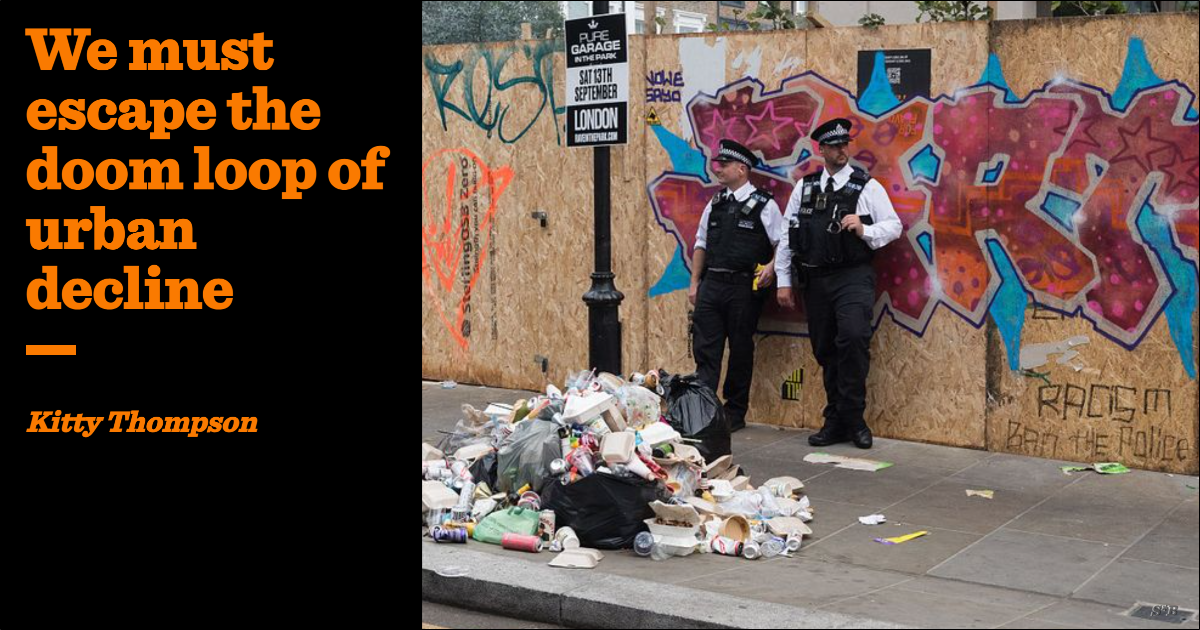
Nothing says “wakey wakey” on a Monday morning quite like discovering that a bright pink eye has been graffitied across your shop’s shutter and through to your shop window followed by the council politely explaining that, alas, it’s not obscene enough to remove for free. That’s the position my vape-shop-cum-florist owner found herself in this week: punished not just by the vandal, but by the state too.
The going rate to erase such an act of vandalism in SE1, she reckons, is around £300. That’s hundreds of pounds for the privilege of returning your shopfront to the plain black neutrality of the day before, and for your customers to peruse your wares clearly through the window. Your automatic assumption as a business owner would be to call the council. There have to be some benefits to paying those mounting business rates, right? Unfortunately, this is not the first time she has had to stump up the money so she knew better.
While businesses in Southwark Council’s jurisdiction will remove graffiti for free the first time, subsequent offences must be dealt with by businesses themselves, either by paying the council or hiring a private provider. That is unless the graffiti meets the council’s criteria: it must face the public highway, be less than two metres from the ground, be deemed “offensive,” and have the property owner’s permission. This shutter meets the first two requirements, and the fourth is easy enough to secure, but the third is the council’s get-out-of-jail-free card. Inevitably, “offensive” doesn’t mean aesthetic: it likely means penises or swastikas.
In theory, businesses could pay £300 on Monday, only to arrive on Tuesday to a fresh tag, a fresh invoice, and a fresh photo to send to the council, hoping the vandal shows some offensive imagination. This is now the doom-loop of decline we inhabit: petty crime becomes expensive to deal with, bureaucratically sanctioned, and endlessly recurring.
We have created a city where purveyors of a girl’s best friends — nicotine and roses — are penalised for existing on the wrong side of a boundary line. Public spaces are bifurcated into those the state maintains and those it leaves you to maintain yourself. Business Improvement Districts (BIDs), meant to revitalise high streets by pooling money to improve specific areas, were supposed to be a third way. Yet here she is, lamenting the hundreds of pounds she contributes to the Better Bankside BID while her actual business needs remain unmet. The bubblegum pink street cleaning vans she helps to finance do not clean her shop, the BID’s aspirational slogans do not deter vandals, and the council, for all its talk of action, offers little help.
Better Bankside can only do so much to rectify the political reality: the public realm has been hollowed out. Public space is maintained only in the abstract. There is an edgy event space in a railway arch and a PR consultant promoting “area-wide stories,” but the unglamorous, everyday maintenance that makes a place liveable — graffiti removal, safe streets, clear pavements — remain unresolved.
Decline in Britain has not arrived as a spectacular collapse but in the form of a thousand tiny, ridiculous indignities. Southwark’s rates of graffiti have doubled since 2018, and it has the third-highest rate of phone snatching. It needs more than reactive clean ups or the BID getting some bright ideas about a purple line being painted down Borough High Street.
Regardless of whether or not you subscribe to broken windows theory, the intuition behind it still shapes the way Londoners experience their streets: ignored acts of minor disorder signal that no one cares, encouraging more crime, and eroding respect for public space. The council won’t clean your shutter, the BID won’t protect your street, and the police, well, they’d love to help but they’re busy doing something else. Even the Mayor of London, whose job is to set policy priorities for the city, is more animated by his pet projects than improving the actual condition of the pavements he’s supposedly in charge of.
To live in much of the UK in 2025 is to be conditioned into a kind of civic helplessness
We are endlessly reassured that crime is down “in key areas,” that knife crime has fallen, that more surveillance has been erected, that fresh policing plans are just around the corner. But the things that actually make a city feel safe, like the absence of vandalism and the likelihood that your phone will still be in your pocket when you get home, are treated as too small to care about. Too many of us simply accept that phones will vanish, shopfronts will be defaced, and police reports will drift into the administrative afterlife. To live in much of the UK in 2025 is to be conditioned into a kind of civic helplessness.
Sadiq Khan can point to downward-trending charts in certain categories all he likes, but Londoners measure safety in lived experience, not selective metrics. And this experience is grim: a city where the streets are grimey but the social media content is immaculate.
Once the people in charge, whether they be the mayor, councillors, or even BIDs, start treating those small problems as inevitable, they stop being small. They become structural. They become the city. A London where petty crime is background noise isn’t a natural consequence of urban life. It is a political choice made by omission.
But if decline can be chosen, so can renewal. It starts with the boring, unfashionable things like criminals being caught, councils that fix small problems before they become big ones that cost millions, and a mayor who understands that safety is not a statistic but an atmosphere. A functional city is built on unglamorous competence. Until those in charge learn that, the doom loop continues: expecting little, receiving less, and paying more for the privilege.