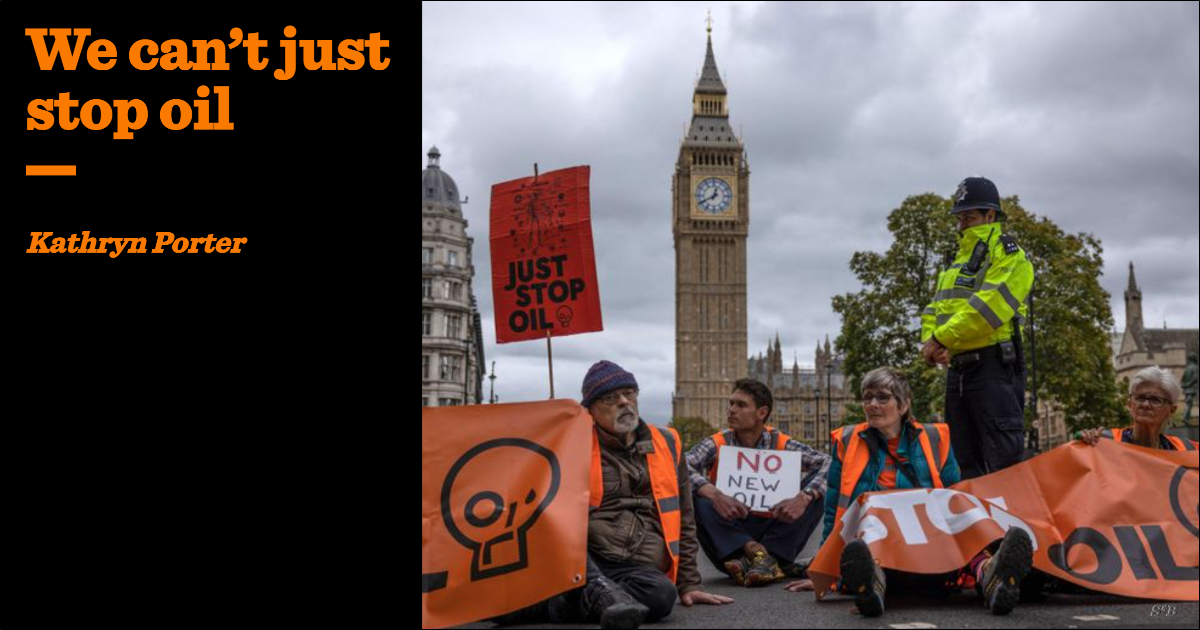
“Just Stop Oil” makes for a powerful slogan. It implies that if we simply switch off domestic production, we can accelerate the transition to a cleaner, cheaper energy system. Unfortunately this is a myth — as my new report for the Institute of Economic Affairs shows. The truth is that Britain cannot simply “just stop oil”, and pretending otherwise risks making us poorer, more dependent on imports and less secure.
Oil and gas companies are accused of being major polluters, but they do not produce oil and gas for its amusement value. They produce oil and gas because there is a deep market for these products. They are essential to modern life. Oil and gas do not just fuel our economies, they are the bedrock of our lives, forming the building blocks of agriculture, technology and medicine, and countless everyday products. Almost everything in a modern hospital apart from the people, from syringes to beds to diagnostic equipment to the drugs themselves is made from petrochemicals. Roughly half the world’s population depends on synthetic fertilisers made from natural gas to grow food.
Even under the Climate Change Committee’s Balanced Net Zero Pathway, Britain is still expected to consume around 168 million barrels of oil equivalent in 2050 — roughly 40 per cent of today’s annual production. Oil and gas are projected to meet around 15 per cent of total energy demand in 2050 and to provide the largest cumulative share of energy between now and then. In other words, there is no credible forecast in which hydrocarbons disappear from the UK economy in the next 25 years to 2050.
So the real question is not whether we will use oil and gas, but where they will come from. Unfortunately, current energy policy is not just prioritising imports it is doing so aggressively, despite the fact that imported oil and gas are associated with higher emissions than that produced here in the UK. The North Sea Transition Authority projects that by 2050 domestic production could fall to just 44 million barrels of oil equivalent, leaving the UK importing roughly three quarters of the oil and gas it consumes. And that makes us much more exposed to global price shocks and denies us a valuable source of tax receipts.
Importing rather than producing at home does not reduce oil and gas demand, it simply exports jobs, tax revenues and emissions. Arguments that the North Sea is “in decline” and therefore should be abandoned are facile — any time production begins from a mine or oil field that asset begins to “decline” that does not mean they are abandoned. If such a resource can be profitably exploited and the production is required it is clearly better to exploit that resource rather than importing the product from elsewhere.
In fact, the North Sea continues to have significant potential. In the past year, Norway has made significant discoveries adjacent to UK territories, and technological advancements have extended the lives of fields that had been expected to close. The UK still has commercially recoverable reserves and world-class engineering expertise — the difficulty is not geology, it’s policy.
The idea that renewables can seamlessly replace hydrocarbons is overstated. Wind and solar are intermittent and have low energy density which makes them expensive. They require backup generation or storage when it’s not windy or sunny. Keeping generation and demand balanced in real time becomes more expensive and more wires are needed to connect them, adding £billions to network costs, on top of huge subsidies for building them in the first place. All of these additional costs are added straight on to bills paid by consumers.
Meanwhile, fossil fuels still account for more than 80 per cent of global primary energy consumption. Replacing hydrocarbons in transport, industry and agriculture is vastly harder than decarbonising electricity.
Prematurely forcing the decline of UK oil and gas production has serious fiscal consequences. The UK is expected to move into a net decommissioning position in the early 2030s – years earlier than would otherwise have been the case. The UK’s decommissioning tax regime means that once the country enters net decommissioning the Treasury makes rather than receives net payments.
These are explicitly not subsidies — the state collects additional taxes while fields are producing and returns these funds once they stop producing to help ensure the oil and gas companies have cash on hand to fund their decommissioning obligations. Were the state to refuse to repay these amounts, companies could legitimately abandon these obligations leaving the state with the costs of decommissioning. By accelerating decommissioning, the state will not only forgo significant tax receipts it will bring forward these payment obligations.
Not even the most ambitious green forecasts suggest that the UK will stop needing oil and gas for decades to come. The idea that we can “just stop oil” is simply not credible by any measure. So if we accept the reality that we will keep using oil and gas, refusing to produce it ourselves in favour of expensive, high emissions imports makes absolutely no sense. It is an act of economic and environmental harm, and that, rather than oil, is what needs to stop.