This article is taken from the December-January 2026 issue of The Critic. To get the full magazine why not subscribe? Get five issues for just £25.
“Enshittification” is an angry, ugly newcomer to the lexicon which has now spawned an even angrier, uglier book. Responsible for both is Cory Doctorow, a Canadian polemicist born to Trotskyite schoolteachers. It refers to the degradation of online services, which occurs “when a company makes itself worse to increase profits”. Doctorow aims to expand the word into a theory.
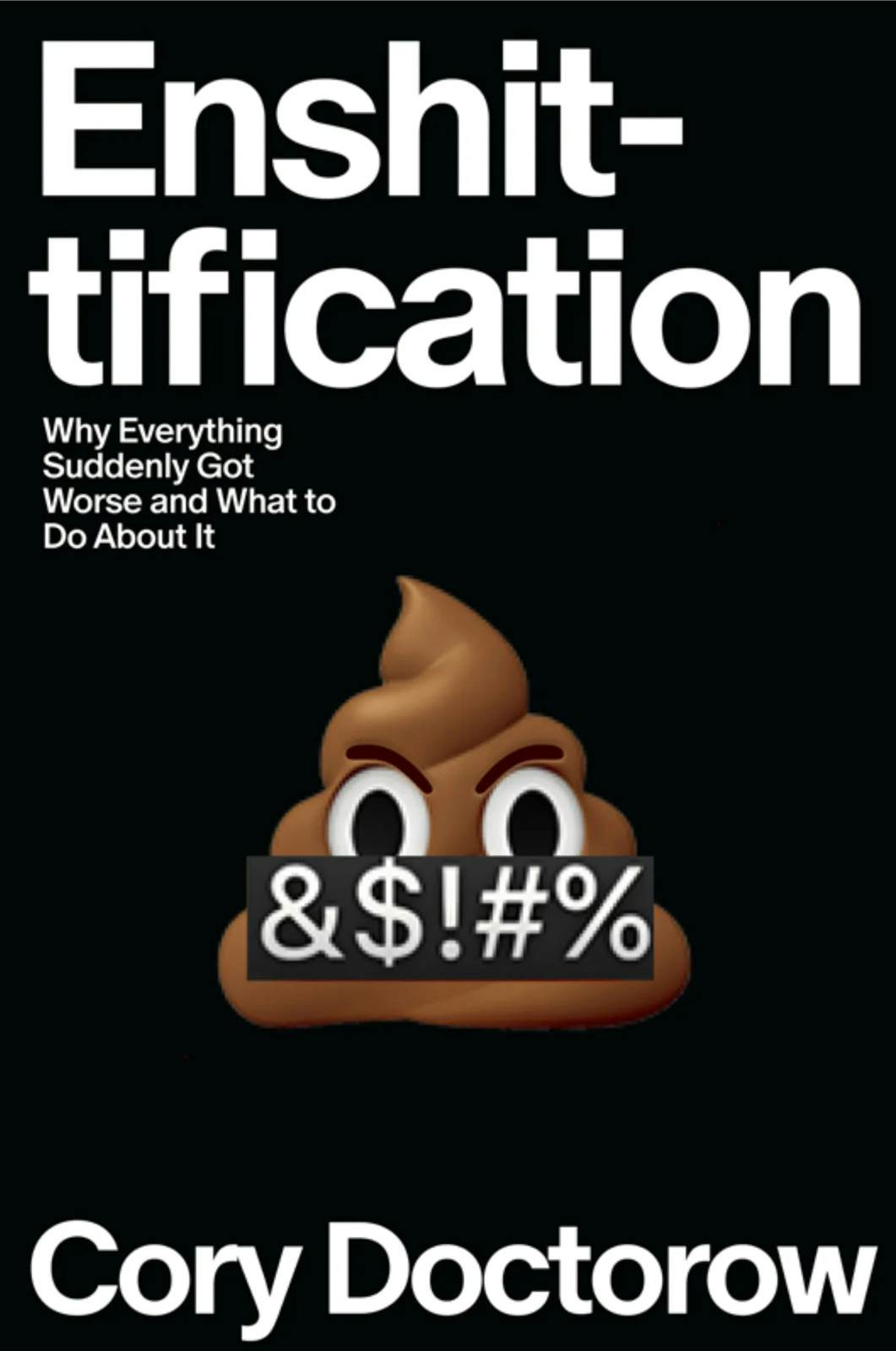
Cory Doctorow
(Verso, £22)
“One by one, each enshittification-constraining constraint was eroded until it dissolved, leaving the enshittificatory impulse unchecked, ushering in the Enshittocene,” we learn. Alas, there is a great deal of prose like this, in what the New Yorker calls “professional blogging extended for three-hundred-plus pages”.
Doctorow’s stylistic tics add to the difficulties. Compulsive italicisations and arbitrary quotation marks turn every page into a battlefield. The reader is addressed like a very stupid child, for whom the points must be hammered home. In one paragraph alone we find “progress”, “enclosed”, “so easy a child could use them”, “free (to work the land)”, and “moral philosophers” imprisoned in quotes. Arguments are not explored or sustained: Doctorow’s jabbing, didactic finger makes that impossible.
The book repackages what he has said many times before, over some two dozen novels and novellas — thinly disguised fan-fiction about his activist colleagues and opponents — and over several thousand articles and blog posts. For example, a recent fiction series stars “a hard-charging, two-fisted, high-tech forensic accountant”. Enshittification likewise charges hard, with two fists; violence is never far away.
In the late 1990s, after dropping out of several colleges, Doctorow described himself as “the world’s happiest geek” on a personal website that lovingly detailed his obsession with Disney memorabilia. But around the age of 30, a terrible shadow fell upon this innocent playground: copyright. Intellectual Property (IP) became Doctorow’s Great White Whale.
IP rights, as defined by Doctorow, are “any law or regulation that allows a company to reach beyond its own walls and exert control over its competitors, critics, and customers”. Any law? Really? For Doctorow, IP ruins the frictionless digital utopia. Creators who want to assert their legal and moral rights are being short-sighted or selfish. Copyright’s role in enabling markets is barely acknowledged.
Whilst Doctorow now presents himself as a “technology critic”, this is a recent conversion: 2008’s teen novella Little Brother even has a chapter dedicated to Amazon (“I can’t think of a better group of people to be facing down a thorny set of problems”).
The central irony of this book is that Doctorow played a key role in the degraded internet we must endure today. He dutifully defended the rights of pirates to steal with impunity, giving his own work away and urging others to do so. Much of this was for a “digital rights” NGO funded by Silicon Valley, the Electronic Frontier Foundation (EFF).
Piracy was helpful to Google as it could profit from an unlicensed supply chain through its advertising business, and thwart the creation of digital markets. Doctorow was the public face of this fight: a Google executive told me that he was its staunchest and most useful influencer. Unfortunately for the author, many in the creative and academic sectors have not forgotten.
“Doctorow has been a reliable ally of Silicon Valley in enshittifying the internet,” recalls one. “An astroturf lobbyist for Big Tech,” agrees the author and journalist Yasha Levine. “That shitty internet we all inhabit today? That system dominated by giant monopolies, powered by for-profit surveillance and influence, and lacking any democratic oversight? EFF is directly responsible for bringing it into being,” she wrote in 2018. “Despite writing that information doesn’t want to be free, Doctorow still blames artists for wanting income for work,” noted the late Professor David Golumbia.
Doctorow has belatedly accepted that anti-trust action against the tech platforms is necessary, but without a focus on markets any remedy is performative: the companies are likely to reconstitute themselves in a different form, which is what happened when the AT&T monopoly was broken up.
This is an odd time to be fighting against intellectual property. Generative AI (artificial intelligence) has been scraping all the digitalised material that humans have ever created, almost entirely without any licence or permission and creating ever-expanding torrents of slop. Copyright has emerged as the only effective tool for halting the descent into derivative banality and reasserting human dignity.
Anthropic recently agreed to pay $1.5 billion to settle a lawsuit filed by book authors, and many more lawsuits are in the works. Unable to acknowledge the value of these rights, Doctorow is in a quandary. Far from presenting us with the future of the internet, Enshittification prolongs its squalid past.