The Victoria Cross awarded to a war hero who took on 100 Germans armed with machine guns has sold for nearly £320,000.
Captain Reginald Haine led six assaults in a clash on the front line during the First World War, later saying of his enemies: ‘By jove, they could fight.’
His unit eventually captured the German stronghold in the Battle of Arras, along with 50 prisoners after more than 30 hours of continuous fighting.
He received Britain’s highest gallantry award for his exploits in 1917, with the Victoria Cross citation highlighting the officer’s ‘splendid personal example’.
He even won the Military Cross two years later during a hilltop attack in Dakka after joining the Indian army. And during the Second World War, in his mid-50s, he also signed up for the ‘Dad’s Army’ Home Guard.
In a letter home describing the ‘ding-dong battle’ for which he was given his VC, Captain Haine said of the Germans: ‘By jove, they could fight – an awfully sporty crowd.’ The chartered accountant died in Midhurst, West Sussex, aged 85 in 1982.
He was married for nearly 60 years to his wife Dora and they had a daughter and three granddaughters.
His medals had resided in Lord Ashcroft’s VC Gallery at the Imperial War Museum until its recent controversial closure.
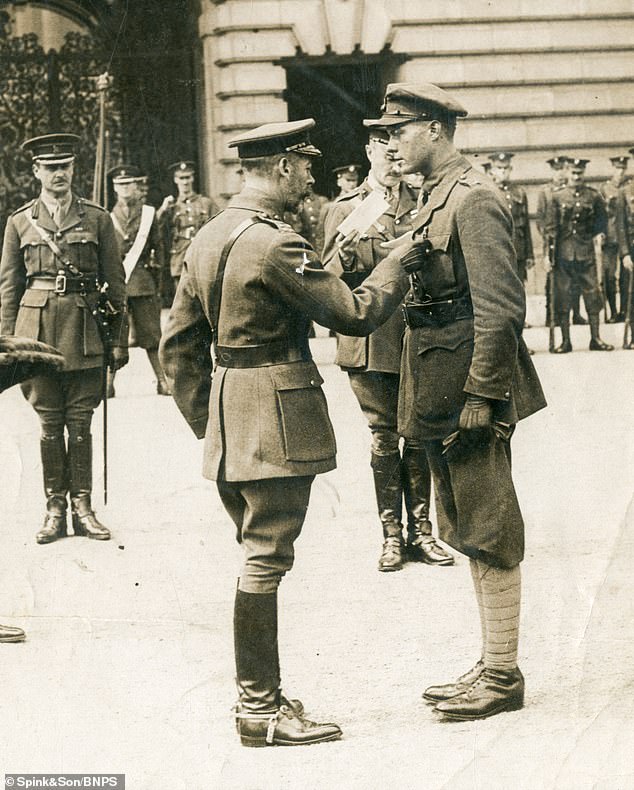
Captain Reginald Haine (pictured right) presented with the Victoria Cross by King George V at Buckingham Palace
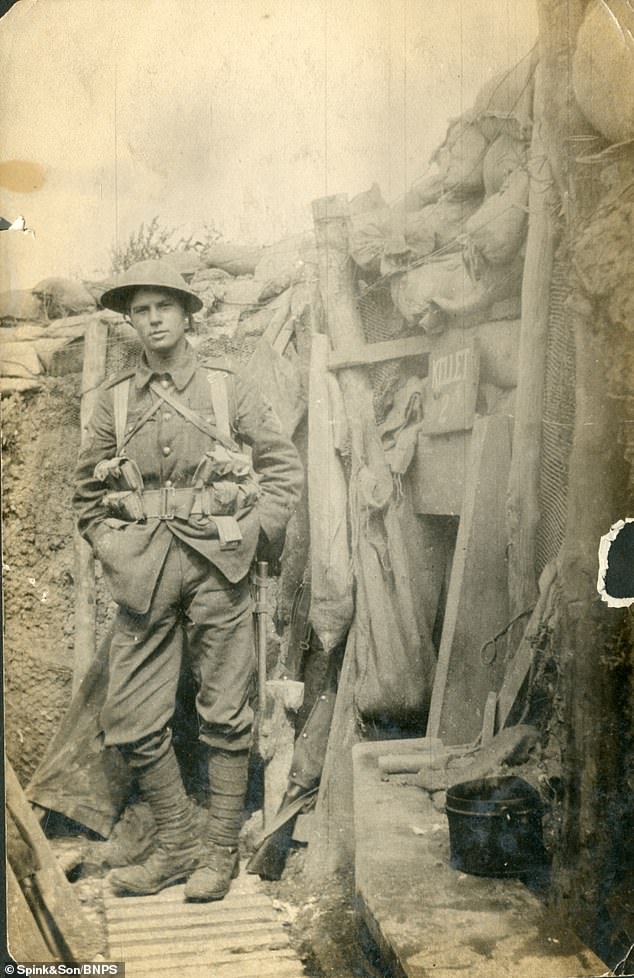
Captain Reginald Haine (pictured) received Britain’s highest gallantry award for his exploits in 1917, with the Victoria Cross citation highlighting the officer’s ‘splendid personal example’.
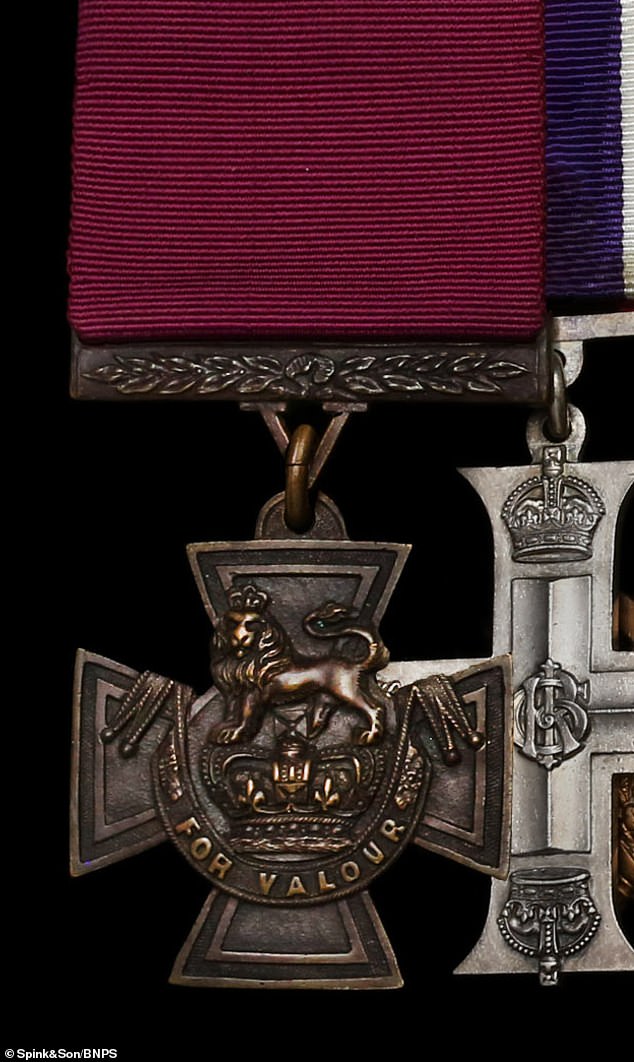
The captain’s medal which sold for £260,000, but with fees added on the total price paid for them was £318,000
After the collection was returned, his family decided to sell it through London-based auctioneers Spink & Son.
The medals sold for £260,000, but with fees added on the total price paid for them was £318,000.
A Spink & Son spokesman said: ‘We are thrilled at the outstanding result for the VC awarded to Captain Haine.
‘He was a true hero of the First World War and this strong price is testament to his bravery.’
Captain Haine, from Lambeth in south London, enlisted in the Honourable Artillery Company in August 1914.
He was wounded in action in June 1915 and helped capture ‘The Mound’ at Beaucourt in November 1916.
On one occasion, he miraculously survived when two comrades either side of him were shot dead simultaneously.
He told his parents in a letter afterwards: ‘I had a very good luck myself. One sniper dented my tin hat, and shrapnel also dented it, but I came through untouched.’
The archive also contained two of Captain Haine’s war diaries and almost 200 wartime photos capturing life on the front.
He even kept hold of seven of his military maps, which detailed several trench networks.