Just days before his ouster by the United States, Venezuela’s authoritarian leader Nicolás Maduro promised on national television that the country would move into 2026 by diversifying its economy away from a historic reliance on oil.
Within 48 hours, after a dramatic U.S. strike on the South American nation, Mr. Maduro was out. And it became clear that Venezuela would instead be sticking with the commodity that is so central to national identity that locals often breezily joked that it was cheaper to fill their cars than purchase a bottle of water.
Venezuela’s economy has been in shambles for more than a decade, a situation exacerbated since the U.S. placed sanctions on the oil industry in 2019 to put pressure on the Maduro administration for political change. Now, with Mr. Maduro gone, the U.S. is positioning itself to create “tremendous wealth,” as U.S. President Donald Trump put it, for Americans, Venezuelans, and Big Oil.
Why We Wrote This
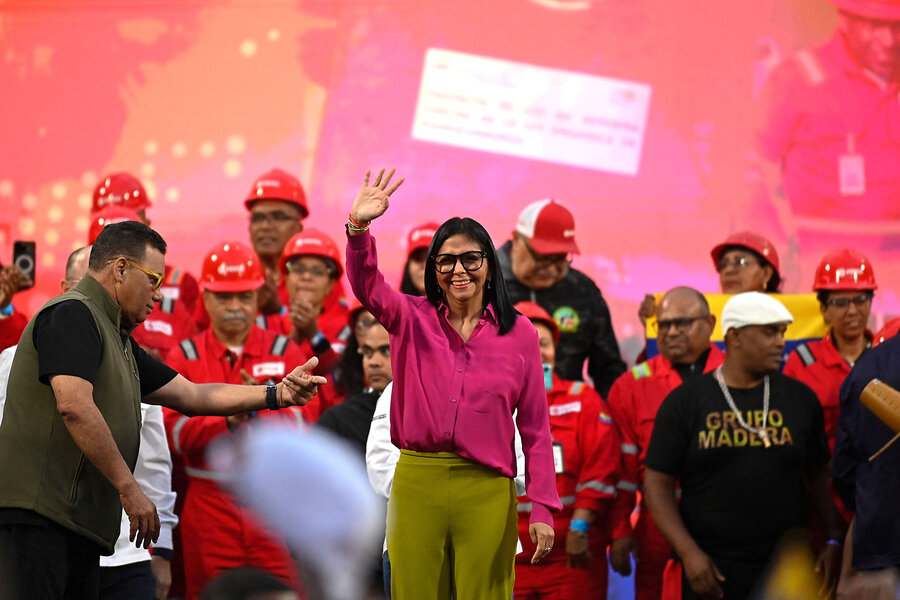
After more than a decade of economic crisis and authoritarian rule in Venezuela, President Donald Trump and Venezuelan interim President Delcy Rodríguez are banking on oil for the success of their political futures. But that may not be enough for Venezuelans who want more than just economic relief.
On Jan. 29, interim President Delcy Rodríguez, who replaced Mr. Maduro after his ouster, announced a broad reform of the hydrocarbons sector that could help facilitate foreign investment. With some U.S. sanctions lifted since the strike, and the U.S. pushing oil majors to invest billions into the Venezuelan energy sector, Venezuela’s oil revenue is expected to grow in a way no one could have projected at the end of 2025.
But, after more than a decade of economic misery and authoritarian rule, the government has a short runway to show Venezuelans that their quality of life will improve under Ms. Rodríguez. Experts see many steps – from democratic strengthening to prioritizing humanitarian relief inside Venezuela – that are needed for an oil-centered solution to the Venezuelan crisis to be successful.
“The population wants a change in the status quo,” says Giorgio Cunto Morales, a Venezuelan economist and lecturer at Andrés Bello Catholic University in Caracas. Nondiscounted oil sales could affect wages, temper inflation, and reestablish public services like water and electricity, but it won’t be a quick transition and likely won’t be enough, he says.
“Venezuelans want improved living conditions, but not to make authoritarianism more tolerable,” Dr. Cunto Morales says of ongoing restrictions on civil liberties and human rights. They want political change, too.
“Food is still expensive”
Venezuela for years struggled with triple digit inflation, making the cost of even basic products like toilet paper out of reach. Venezuela’s gross domestic product has declined by more than 70% since 2013, when Mr. Maduro took over from his predecessor Hugo Chávez. That’s the largest economic collapse in the Western Hemisphere for a country not at war.

On Jan. 20, Ms. Rodríguez, who had been Mr. Maduro’s vice president, said that the country had received $300 million in its first oil sales overseen by the U.S. She said that the cash would be moved into Venezuela’s banking system to cover citizen wages and to help protect the population against inflation.
Under U.S. oversight “the idea has been sold to citizens that we are going to move forward, because [the Venezuelan government] is not going to steal the money anymore, and that the U.S. will administer the funds from oil sales,” says G.S., an educator in Caracas, who asked to be identified by his initials due to ongoing government repression.
But, “food is still expensive,” he says. That reality contradicts an overwhelming sentiment of hope that change is coming, G.S. says. “There are a lot of expectations. … We might be seeing a light at the end of the tunnel” he says, but “it’s a matter of time and patience” before economic recovery becomes a reality.
Since Jan. 3, Mr. Trump has pushed U.S. oil majors to invest $100 billion in Venezuela’s oil sector, home to the largest proven reserves in the world. Also in January, more Venezuelan oil was imported to the U.S. than in any other month since December 2024, according to Bloomberg. China was the largest importer of Venezuelan oil before the U.S. began seizing Venezuelan oil vessels last year.
But one oil company told Mr. Trump on Jan. 9 that Venezuela is “uninvestible” without democratic improvements.
Doing business in Venezuela
Oil was nationalized in Venezuela in the 1970s, but Mr. Chávez took the idea a step further. Foreign oil companies were required to enter into new contracts under his presidency, giving the state-owned oil and gas company PDVSA majority control in all operations. Two U.S. companies declined Mr. Chávez’s terms, and left Venezuela. They weren’t compensated for their equipment or investments there, something that has spooked big oil companies about investing significant money into Venezuela in the short term.

Isaac Urrutia/Reuters/File
Many see the January hydrocarbon reform as simply the first step of many to make investment less risky. The legal changes were fast-tracked through the National Assembly and steps back some of the strict nationalistic regulations at the heart of Venezuela’s oil sector over the past two decades.
“The head of the snake has been cut off, but the system is still in place. And I don’t mean just from a political point of view,” says Jorge Piñon from the Energy Institute at the University of Texas at Austin of Mr. Maduro’s removal. “The rules of the game have not changed” around investment and ensuring money put into the country is safe from risks such as a change in leadership and resulting policy.
Although the U.S. has lifted some sanctions on Venezuela’s oil sector this year, the fact that the Trump administration has alleged drug trafficking and terrorism are funded by oil sales can make doing business tricky.
“PDVSA is perhaps the most corrupt state-owned entity in Latin America. To do energy-sector work, companies are going to have to interact with PDVSA and then beyond that, extortion and bribery requests from local officials is constant,” says Matteson Ellis, Latin America practice lead at law firm Miller & Chevalier. “There haven’t been many international companies in Venezuela for so many years. It’s really an unknown landscape.”
More than just economic change
Only 13% of Venezuelan respondents opposed the U.S. capture of Mr. Maduro, according to a Premise poll conducted for The Economist between Jan. 9-13 this year. The former bus driver and Chávez acolyte came into office at the same time that global oil prices tanked. The economy went into a tailspin, and Mr. Maduro leaned into authoritarian measures to maintain control, imprisoning political opponents, and cracking down on freedom of speech, and other civil liberties.
The gap between the official and unofficial exchange rates has narrowed some since Mr. Maduro’s capture, which signals a level of price stabilization, but “the economic situation remains just as terrible,” says a Venezuelan human rights defender who is not identified due to the high risk of his work. But, he says, “there is a window of opportunity to have political change.”
Roughly 70% of Venezuelans polled by Premise/The Economist said they expect their family’s economic situation to improve by January 2027; more than 75% said the political situation would improve in the same time frame.
Mr. Cunto Morales, the economist, says Venezuela is in a moment where it’s facing a confluence of conflicting priorities. The U.S. administration is focused on stabilization and economic cooperation. But the Venezuelan government, run by a group of powerplayers from a long-standing political regime established under Mr. Chávez, is interested in maintaining control, and possibly buying some time by alleviating economic pain among the population.
“All those economic changes make no sense if there is not, at the same time, a process of freedom and democracy,” says the human rights defender. Ms. Rodríguez announced on Jan. 30 that one of the most notorious detention centers known for torturing prisoners would be shuttered, and that legislation for amnesty for political prisoners has been proposed to the National Assembly.
“This is a window of opportunity for political change” but it requires action now, he says.