The US State Department warned Americans worldwide to exercise increased caution over concerns that groups supportive of Iran may target interests overseas.
Americans around the globe, especially in the Middle East, were advised on Sunday by the State Department to follow the guidance of their nearest US embassy or consulate as tensions with Iran continue to escalate.
US citizens were also warned that travel can be disrupted due to ‘Periodic airspace closures.’
‘US diplomatic facilities, including outside the Middle East, have been targeted,’ the alert stated.
‘Groups supportive of Iran may target other US interests overseas or locations associated with the United States and/or Americans throughout the world.’
The security alert follows a week of heightened tensions, starting when Iran issued a warning on Friday that it would attack civilian targets worldwide, including at luxury resorts, as millions of Americans head off for spring break.
General Abolfazl Shekarchi warned that Israeli and US officials would not be safe after strikes wiped out Iran’s leadership, including Supreme Leader Ayatollah Ali Khamenei.
The FBI and the Department of Homeland Security have already put their counterterrorism operations on ‘high alert’ for possible Iranian retaliation on US soil.
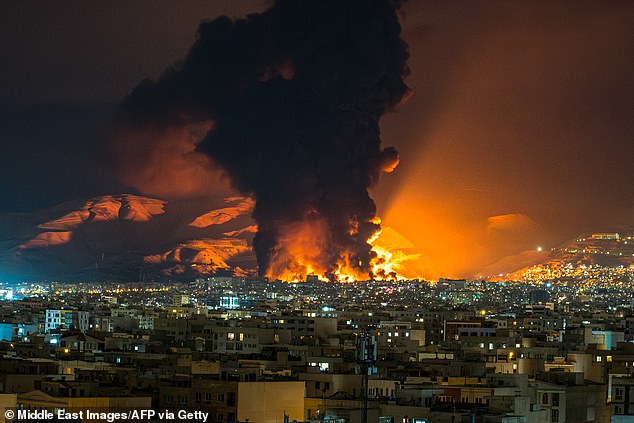
US State Department issued a warning to Americans worldwide to be cautious over concerns that groups supportive of Iran may target interests overseas (Pictured, flames rising from an oil depot struck by airstrikes in Tehran on March 7, 2026)
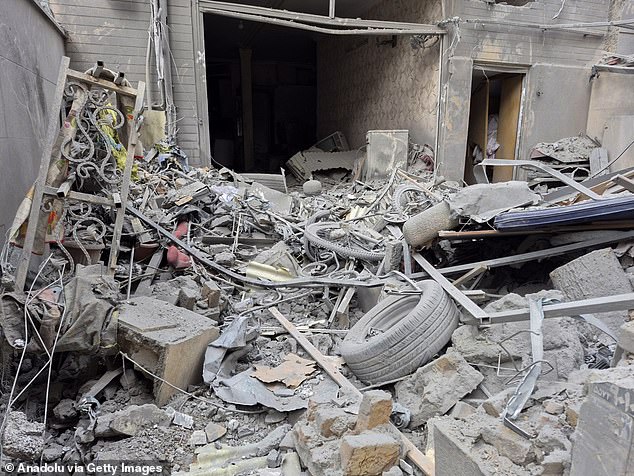
The department also warned that travel for Americans can be disrupted due to ‘Periodic airspace closures’ (Pictured destruction from airstrikes in Iran)
A gunman opened fire at a packed bar in Austin, Texas, killing two people and wounding 14 others on March 1. The shooter, Ndiaga Diagne, 53, a Senegalese-born US citizen, was killed by police after opening fire on patrons before turning his weapon on pedestrians nearby.
In recent days, Iran has escalated retaliatory strikes after Israel hit a major gas field, which has ignited panic across the Middle East.
Now Iran has vowed to ‘completely shut’ the Strait of Hormuz and destroy Israeli and US-linked power plants in the Middle East if Donald Trump follows through on threats to ‘obliterate’ Tehran’s energy facilities.
The vital passageway through which about a fifth of global gas and oil supplies flow has been at the center of contention since the US and Israel launched strikes on Iran on February 28. The struggle over the Strait has driven energy prices worldwide to spike.
Now in its fourth week, the conflict has killed 13 US service members and at least 1,300 Iranians.

A gunman opened fire at a packed bar in Austin, Texas, killing two people and wounding 14 others on March 1. The shooter, Ndiaga Diagne, 53, a Senegalese-born US citizen, was killed by police after opening fire on patrons before turning his weapon on pedestrians nearby

Iran issued a warning on Friday that it is preparing to attack civilian targets worldwide, including luxury resorts, as Americans head off for spring break (stock photo)
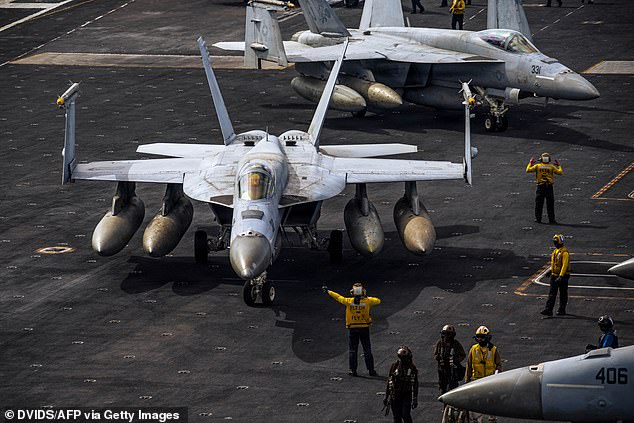
F/A-18E Super Hornet aircraft, attached to Strike Fighter Squadron 31, taxiing on the flight deck of the world’s largest aircraft carrier, USS Gerald R Ford (CVN 78), on Sunday
President Trump said he would destroy the power plants in Iran – ‘starting with the biggest one first’ – if the waterway is not fully reopened within 48 hours.
He issued the stark warning late on Saturday night – just one day after he was said to be thinking about ‘winding down’ the war.
Iran’s Revolutionary Guard Corps warned that if the US targets Iranian energy infrastructure, they will keep the Strait ‘completely shut’ and that Israeli and US energy infrastructure in the region will be ‘completely destroyed.’
The threats follow a fresh wave of missile attacks launched by Tehran towards Israel amid mounting fears about the regime’s ability to strike European capitals.
More than 100 people have been wounded in southern Israel after strikes on buildings in the cities of Dimona and Arad.
Missiles from Iran also took aim at Diego Garcia on Saturday, a key US and U.K. military base in the Indian Ocean, roughly 2,500 miles from Iran.
The two missiles launched did not strike the base but demonstrated that the Iranians have the capabilities to hit Europe.
Israel Defense Forces Chief of Staff Lt. Gen. Eyal Zamir said on Saturday: ‘Just yesterday, Iran launched a two-stage intercontinental ballistic missile with a range of 4,000 kilometers [2,500 miles] toward an American target on the island of Diego Garcia.
‘These missiles were not intended to hit Israel. Their range reaches the capitals of Europe — Berlin, Paris, and Rome are all within direct threat range.’
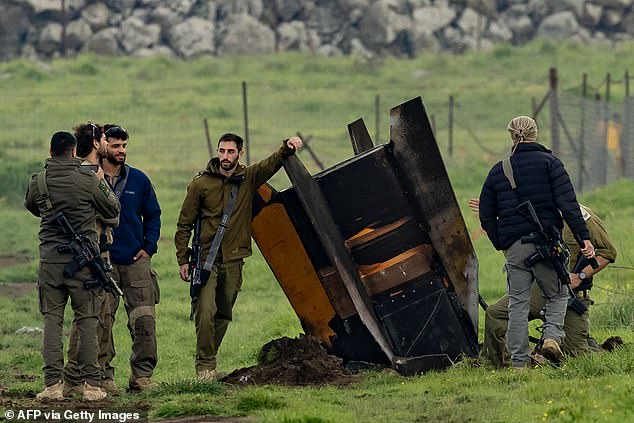
Israeli security personnel secure an area around a rocket partly buried in a field in the Israeli-annexed Golan Heights bordering Lebanon on Thursday
However, amid the discovery of Iran’s capacity to hit Europe, a Royal Navy submarine from the U.K. arrived in the Arabian Sea on Saturday.
The submarine allows British forces to have the capacity to launch attacks on Iran if the conflict escalates.
The news comes after the Prime Minister’s office said on Friday that Sir Keir Starmer had agreed to allow the US to use British bases to launch strikes on Iranian sites that have been targeting the Strait of Hormuz.
Sir Keir had previously allowed US forces to use the bases only for defensive operations, to prevent Iran from firing missiles that put British interests or lives at risk.
However, he has now approved expanding the targets to help protect ships in the shipping channel on the basis of ‘collective self-defense’.