As the United States faces increasing questions about the legality of its military pressure on Venezuelan leader Nicolás Maduro, this week seizing an oil tanker off the Venezuelan coast, Venezuelans inside the South American nation are more focused on personal survival.
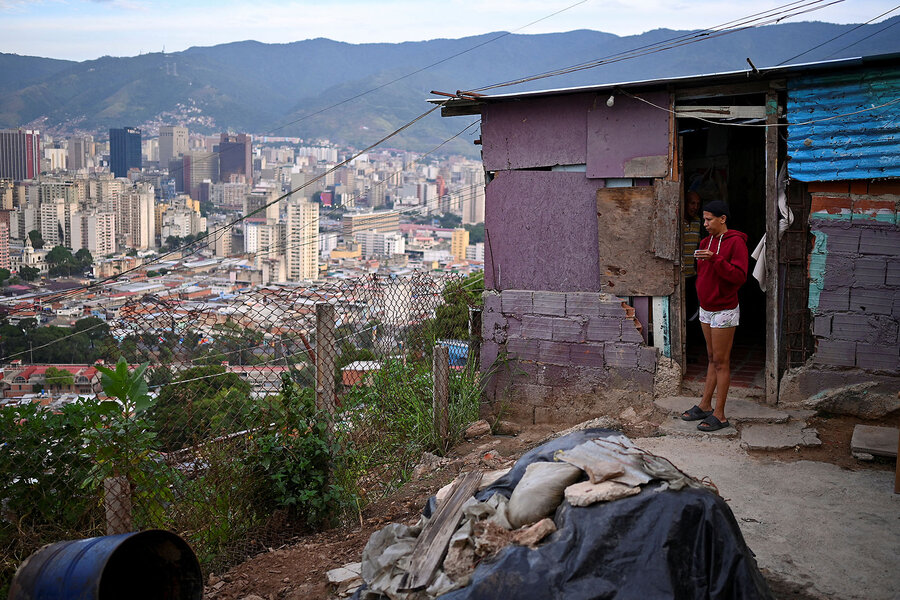
On a spotty video call from her modest tin-roofed home in Caracas, Venezuela, a grandmother describes how her routines have “completely deteriorated” in recent years. The cost of food and transportation are increasingly out of reach for the seamstress, who is being identified by her initials, A.C., for her security. Her siblings and children pitch in to keep the lights, internet, and gas on.
And ever since the introduction of a government telephone application that Mr. Maduro says allows citizens to report “24 hours a day everything they see, everything they hear,” A.C. finds herself worrying about who she can trust on the streets. It’s a fear rooted in reality: She says her niece was detained for four months after the disputed July 2024 presidential election, which Mr. Maduro claimed he won without evidence. It was part of a government crackdown involving door-to-door raids of the homes of suspected government opponents.
Why We Wrote This
Tensions are growing off the coast of Venezuela as the United States pressures Nicolás Maduro to step down. Despite the world watching as U.S. military actions unfold, Venezuelan citizens are focused on survival.
The United States has carried out more than 20 military strikes on suspected drug-trafficking boats in the Caribbean and Pacific since early September, killing more than 80 people. It is building up its military in the Caribbean, with some 15,000 U.S. troops and the world’s largest aircraft carrier now stationed there. U.S. President Donald Trump has directly threatened to strike inside Venezuelan territory and announced on Dec. 10 that the United States had seized a sanctioned oil tanker involved in an “illicit oil shipping network supporting foreign terrorist organizations.” It is the first known action by the administration against a Venezuela-related tanker since the military buildup.

U.S. Attorney General/Reuters
Although direct military action is at odds with international norms of nonintervention established over the past several decades, many in the region – including governments that have taken in the estimated 8 million Venezuelans who have fled growing economic, humanitarian, and political crises since 2014 – are ready for change.
A.C. says she hopes Mr. Trump’s pressure on Mr. Maduro will lead to a democratic transition. For now, she doesn’t have the luxury of daydreaming about what that might look like.
Her family can afford ingredients for basic meals, including meat twice a week, but “there’s no money left for anything else,” she says. She needs dental attention but can’t afford it. “It makes me feel ashamed,” she says.
But A.C. is better off than many around her. Looking down from her living room window in her hilltop home, she can see children playing outside. “After five minutes, they sit down because they don’t have much energy,” she says of the effects of the lack of sustenance. A 2025 study by Caritas found nearly 80% of Venezuelan families exhaust their savings in order to eat and more than half have gone into debt to put food on the table. Some 90% of households lack regular access to drinking water.
Economic downslide
Once a regional beacon of democracy and prosperity, Venezuela began a steep political and economic decline in the 2010s. For years, late President Hugo Chávez concentrated power and expanded military influence over civilian institutions. A a drop in global oil prices exposed years of underinvestment and mismanagement in the state-run oil sector. The crisis deepened under his successor, Mr. Maduro. The economy shrank by roughly three-quarters between 2014 and 2021.
As Mr. Maduro’s popularity slipped, the government grew more repressive, locking up protesters, activists, journalists, defecting military officers, and members of the political opposition. This week, opposition leader María Corina Machado, who has been in hiding in Venezuela since January and has been barred by Mr. Maduro from leaving the country since 2014, took the risk of traveling to Oslo for the Nobel Peace Prize ceremony. Her daughter accepted the award on her behalf, as Ms. Machado reached Norway several hours later.

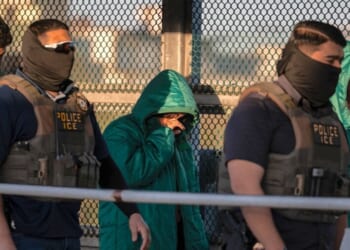
Heightened tensions between the United States and Venezuela have put the Venezuelan government on edge, increasing repression inside the country. And cuts to the U.S. Agency for International Development and other sources of funding this year have created major gaps in humanitarian response for Venezuelans in need, says Ciarán Donnelly, senior vice president of international programs at the International Rescue Committee. Of 38 humanitarian organizations providing services in Cúcuta, a Colombian city at the border with Venezuela, 20 are expected to close by year’s end, when their funding cycle runs out.
Public school teacher D.Y., who asked not to be identified by her full name due to fear of government repression, says her local soup kitchen in northern Venezuela shut down last year.
Daily struggles often overshadow news about U.S. military threats, D.Y. says, partly because quality information about what is unfolding off the coast of Venezuela is limited. “There’s a communication blockade – people outside the country know more than those inside,” she says. “There isn’t real information here, and a lot gets disguised.”
A push for change
A.C. prays for an end to Mr. Maduro’s rule. She’s hopeful U.S. military pressure could bring about change for Venezuela. “I wish it could be right now that we were done with this” government, she says.
For D.Y., U.S. escalation is one of the only remaining pathways to change. Last year, Venezuelans elected opposition candidate Edmundo González president with 67% of the votes, according to reviews of official voting tallies. But Mr. Maduro didn’t recognize the results, claiming he was victorious. “If we [Venezuelans] already did everything we had to do,” she says of voting and taking to the streets in peaceful protest, a military option is “the only way out I see.”
Years of crisis have made Venezuelans resilient, D.Y. says. She keeps a small stock of food in case of an emergency – something past crises have taught her. “Sometimes you have to hit rock bottom to recover and rise again,” she says.
Even if, for Venezuelans, it’s been years of thinking “what more bottom is there for us to hit,” adds A.C.