Three US bombers have returned to Britain after completing the first UK-approved attacks on Iran since Sir Keir Starmer‘s policy shift.
The supersonic B-1 Lancers touched down on a bright morning in Gloucestershire after contributing to what US War Secretary Pete Hegseth had insisted would be the ‘most intense night of bombing’ of the conflict.
Previously the Prime Minister had denied Donald Trump permission to use RAF Fairford and Diego Garcia as part of the campaign – over fears the US’s intentions to cause regime change in Iran were illegal under international law.
Downing Street‘s position shifted after an Iranian drone targeted the British airbase on Cyprus. Following that attack on 1st March, the UK approved the build up of B-1s and B-52s at Fairford.
The base is vital to the United States Air Force due to its extended runway and as it shortens the journey for long-range bombers from the US.
The specific roles undertaken overnight by those B-1s remains highly classified. This morning, neither the Ministry of Defence nor Downing Street was inclined to discuss the missions.
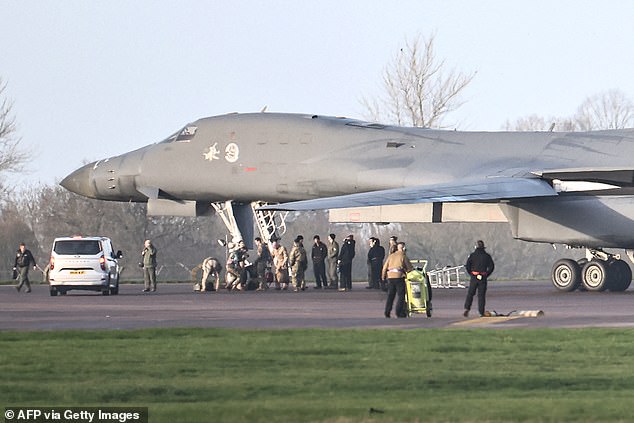
Personnel stand around a US Air Force B-1 Lancer bomber parked on the tarmac after it landed at RAF Fairford this morning after completing attacks on Iran
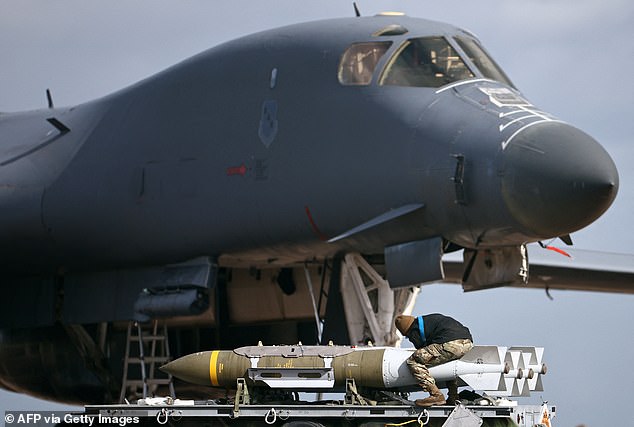
Military ground personnel work on Joint Direct Attack Munitions (JDAM) in front of a US Air Force (USAF) B-1 Lancer bomber at RAF Fairford today
The B-1s, which have a top speed of more than 900mph, touched down around 08.30am after a 15-hour mission. Yesterday these aircraft were ‘bombed up’ with missiles ahead of the raid. The aircraft can carry 75,000lb of ordnance.
Details of their contribution to Operation Epic Fury may be revealed by the White House or the US Department of War.
While the UK has permitted the US to use its bases for so called offensive actions – such as destroying Iranian munitions sites and missile launch pads – British jets deployed to the region can only intercept munitions in the air – a tactic described by Conservative Leader Kemi Badenoch as ‘catching arrows rather than targeting the archer’.
Today, defence minister Luke Pollard was challenged on the apparent contradiction of those two positions.
Appearing on the BBC’s World At One, he said: ‘We have permitted and accepted a request from the United States to use a small number of our bases for very limited actions.
‘The UK is not involved in offensive action. That is the right decision for us. The defensive action that we are taking is to take down missiles and drones that are threatening British bases and are allies in the region.
‘That’s why we have jets in the air all around the clock. And that is why we are deploying additional resources into theatre. Defensive actions have the backing of the British public and are the right step to take.
‘Committing our forces to action is the most important decision you can take as a Prime Minister or a Minister.’
The B-1 bomber was conceived in the 1970s, entered service in the 1980s, lost its nuclear mission after the Cold War, and then built its later reputation in operations over Iraq, Kosovo and
One of the B-1’s defining features is its variable-sweep wing, mounted high on either side of the fuselage.
The wings can move backwards and forwards depending on the phase of flight.
Set further forward, they help provide the lift and control needed for take-off, landing and refuelling.
Swept back, they reduce drag and suit the aircraft for much faster flight.
The result is a bomber whose shape reflects its job: carrying a heavy weapons load over long distances while also being able to fly at high speed.
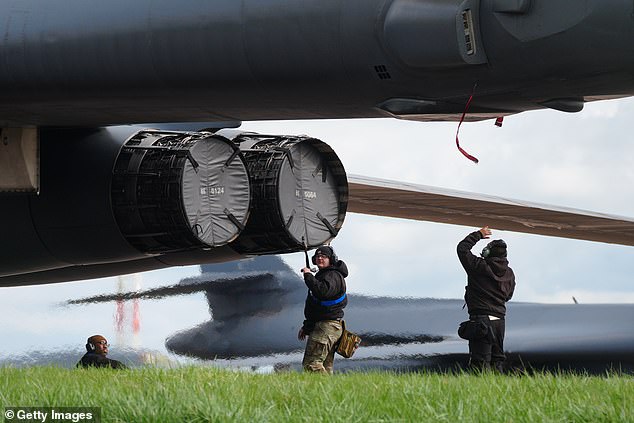
Heat haze from engines warms technicians as US bombers are primed for missions
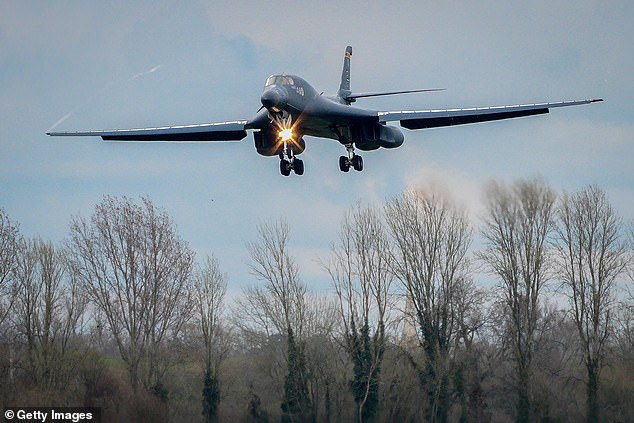
A US B-1 Lancer touches down at Fairford, Gloucestershire, yesterday
The British-based bombers were part of the ‘most intense’ operations according to Hegseth with the ‘most fighters, the most bombers and the most strikes’. Statistics for last night’s missions have not yet been released.
The sorties are understood to have lasted around 15 hours. US aircraft are able to fly over Iranian airspace with what the Chairman of the US Joint Chiefs of Staff General Dan Caine described as ‘relative impunity’. That follows the decimation of Iranian radar and surface to air missile systems.
Footage released by US Central Command showed US bombers striking Iranian missile launchers, causing the warheads to ‘cook-off’ within their underground site.
CENTCOM commander Admiral Brad Cooper confirmed ‘Iranian combat power is declining’ while the last four remaining warships of the Soleimani-class have been destroyed.
CENTCOM also confirmed 16 mine-laying vessels capable of planting mines in the Strait of Hormuz were eliminated.
Admiral Cooper said: ‘We are methodically dismantling them by hitting Iranian missiles and drones. Just last night, our bomber force hit a large ballistic missile manufacturing facility as an example.
‘So it’s not just about what’s shooting at us today. It’s also about eliminating the threat in the future.’
American forces are struggling to locate all of Iran’s missile launch sites, it has been revealed. Defence officials in the US said there was concern that the Pentagon does not have full clarity on all of the Islamic republic’s missile launchers, according to The New York Times.
They also suggested that Iran has held back many missiles to keep them in reserve. It is believed the projectiles are being stored to be able to attack key American infrastructure such as radar equipment at a later date.