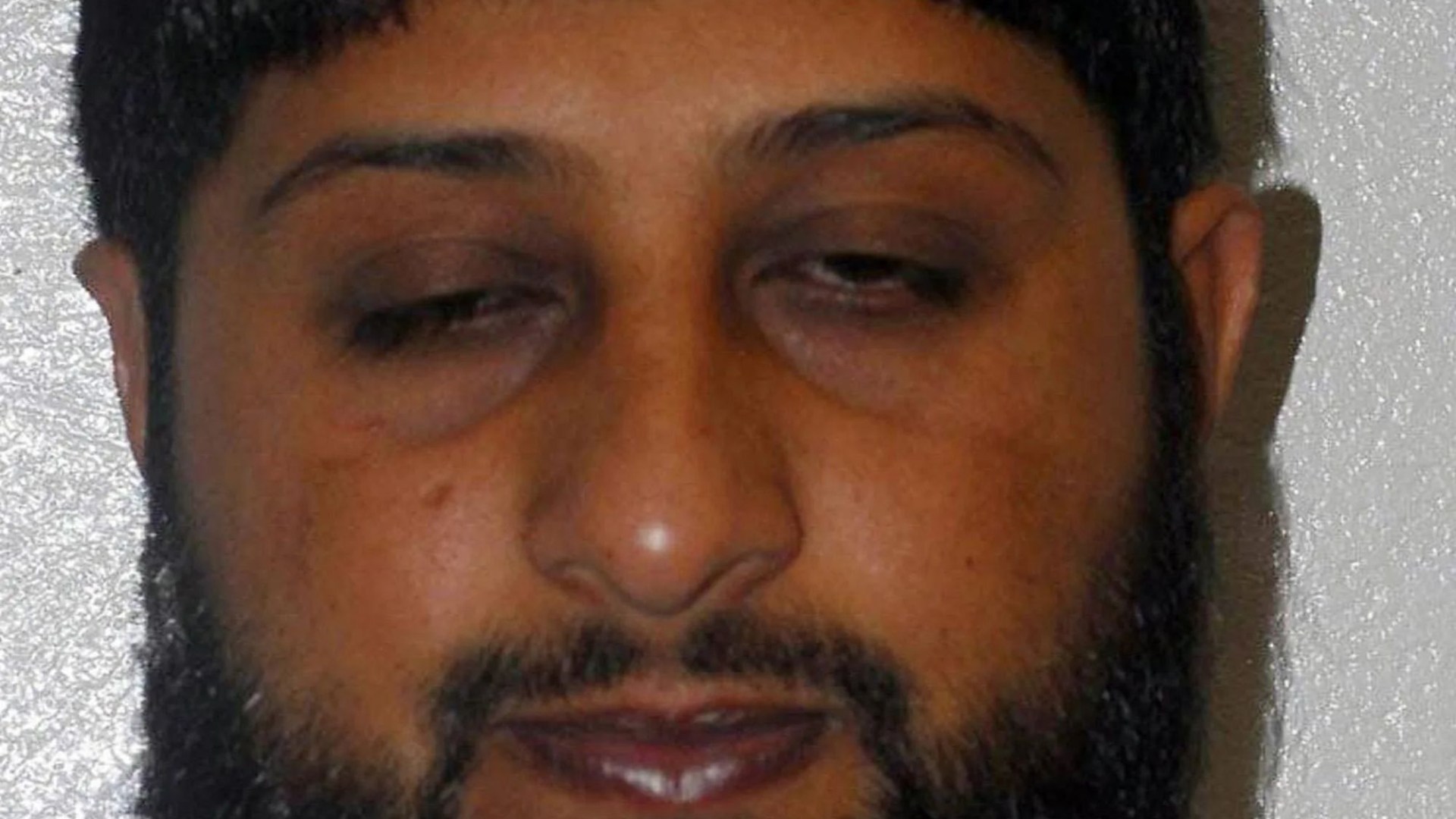
ONE of the country’s most dangerous jailed terrorists with links to the 7/7 bombers could soon be back on the streets of Britain.
The Sun can reveal Rangzieb Ahmed, once described as Osama Bin Laden’s former right-hand man, is to appear before the parole board in a freedom bid.
In a new case, listed for February 18, the Rochdale-born terrorist will argue why he should be released.
Ahmed, 48, was once said to be the UK’s top al-Qaeda commander and Osama bin Laden’s right-hand man in Europe.
The fanatic, responsible for setting up a terrorist cell in Manchester, was the first ever person to be charged with directing terrorism in the UK.
He was also in contact with one of the failed London Underground suicide bombers of 21 July 2005.


He moved to the Kashmir area of Pakistan as a young child and was arrested by the Indian authorities at the age of 18.
The then-teenager was detained for allegedly fighting as a member of the Islamist terror group Harkat-ul-Mujahideen.
Ahmed received money from British-Pakistani terrorist Ahmed Omar Saeed Sheikh while he was in jail.
Terrorist sheikh Saeed ordered the beheading of American journalist Daniel Pearl in 2002.
Ahmed was released in 2001 and rose through Al Qaeda’s ranks before before returning to the UK.
He was put under surveillance when he moved back to Britain in 2005.
His close links with al-Qaeda’s top godfathers in Pakistan were uncovered when officials found his diary containing contacts written in invisible ink.
Ahmed was part of a three-man cell on an unknown terrorist operation in Dubai and Saudi Arabia in December 2005.
It was aborted after a third man, Hamza Rabia, was blown up.
He was once heard telling an accomplice: “We will meet on earth if I’m alive or otherwise in paradise.”
In 2007, he was arrested at Heathrow Airport after being caught carrying a rucksack with explosives traces following another trip to Pakistan.
Anti-terror cops believed he was one of the most dangerous Islamic terrorists ever captured on British soil.
In 2008, he was sentenced to life in prison with a minimum of ten years.
Ahmed began his sentence in maximum security Category A Frankland Prison in County Durham – one of Britain’s toughest jails.
He was caged alongside notorious killers such as Yorkshire Ripper Peter Sutcliffe and Milly Dowler’s murderer Levi Bellfield.
But he was shifted to Category B jail HMP Lowdham Grange after complaining of discrimination when his MP3 player was confiscated.
Ahmed was then moved to an even cushier nick – Category C Wymott Jail in Lancashire – alongside paedophile TV weatherman Fred Talbot.
During Covid, he labelled prison officers racist for ordering him to obey social distancing.
He was later thrown into solitary at HMP Buckley Hall in Greater Manchester after his claims were dismissed.
Over the years, Ahmed – believed to have links to every major British terror cell – has received some £1m in legal aid.
He was rejected for parole in September 2022 after officials judged he was too dangerous to be let out of prison.
A year later, in order to make him safe for release, Ahmed was ordered to take part in a deradicalisation programme.
The danger man was reportedly heard boasting of meeting Khalid Sheikh Mohammed, the architect of the September 11 attacks.
But, at the hearing listed for next month, he is expected to argue that he is a reformed character.
A Parole Board spokesperson confirmed a panel will review “hundreds of pages” worth of evidence before deciding on the terrorist’s future.
They said: “An oral hearing has been listed for the parole review of Rangzieb Ahmed and is scheduled to take place in February 2026.
“Parole Board decisions are solely focused on what risk a prisoner could represent to the public if released and whether that risk is manageable in the community.
“A panel will carefully examine a huge range of evidence, including details of the original crime, and any evidence of behaviour change, as well as explore the harm done and impact the crime has had on the victims.
“Members read and digest hundreds of pages of evidence and reports in the lead up to an oral hearing.
“Evidence from witnesses including probation officers, psychiatrists and psychologists, officials supervising the offender in prison as well as victim personal statements are then given at the hearing.
“The prisoner and witnesses are then questioned at length during the hearing which often lasts a full day or more.
“Parole reviews are undertaken thoroughly and with extreme care. Protecting the public is our number one priority.”