As the scholar and novelist Viet Thanh Nguyen once wrote, “All wars are fought twice, the first on the battlefield, the second in memory.” Ukraine’s war with Russia is not yet over, of course. But a second battle is already underway, about what observers can prudently learn from this shattering history, about the shape of conflicts to come.
One reason for study wars in the first place is educational, after all. Wars, we assume, bequeath us warnings, if not straightforward didactic “lessons.” It is an intellectual minefield to try to learn from conflicts past and present. No two conflicts are identical. Ignoring them can lead to vital signals being overlooked. Yet one can also overlearn and prepare too much to fight the last one. None of that relieves us of the task of trying to separate the signal from the noise.
First, nuclear deterrence remains powerful between so-armed adversaries. It has held, thus far. The glib catch-cry of some nuclear abolitionists, that we don’t have clear cases of deterrence working, only correlations, has never been true. We have long had direct evidence from crises that nuclear escalation weighed on the minds of participants like Dwight Eisenhower, Leonid Brezhnev and Manmohan Singh. And in this case, we know from our own public policy discussion that the dangers of tipping over into hot war with the ultimate weapon have informed the tempo and substance of western policies in Ukraine.
While Russia has pounded Ukraine’s cities and infrastructure mercilessly and remorselessly, it has not yet attacked NATO states directly beyond non-violent peripheral incursions with drones, planes, cyber hacks and spy ships. Until we get evidence to the contrary, the most plausible assumption must be that US, British and French nuclear arsenals help ensure that a homicidal regime in Moscow chooses not to be suicidal. Both NATO and Russia are deterrable at the highest level of violence, at least in cases where they are highly resolved, and certainly where it is a matter of avoiding a direct collision.
Second, and in the other direction, escalation risks are still real. Vladimir Putin’s failure to follow through in some of his more severe retaliatory threats might convince some that his regime with its apocalyptic but vague threats is all bluster, inducing fear as a bluff. As some have argued, the West should draw the conclusion that therefore, we have little to fear, and should step up our involvement in some significantly direct way, with an overt ground presence. Yet while Russia thus far has opted not to do the unthinkable, its behaviour since NATO states began relaxing restrictions on the use of weapons they transferred has still featured non-trivial escalatory moves and sabotage efforts against critical infrastructure, from tracking British undersea cables as future targets, to entering Polish, Romanian and Lithuanian airspace, to (allegedly) blowing up train tracks.
In addition, that nuclear deterrence has held at the highest level thus far is no guarantee that it is bound to work regardless of western and Russian behaviour in future. We still await information about why exactly Moscow kept its nuclear weapons holstered while Ukraine mounted its autumn counteroffensive in 2022 and made initial, significant gains.
But it would be imprudent to assume that the only reason was fear of isolation by Beijing or unspecified threats by Washington, rather than the simpler likelihood that the offensive culminated and fell away, and that Russia stabilised the front. Had Ukraine’s offensive succeeded further, rather than faltering, the odds may have risen of a nuclear use of some kind to shock the adversary into backing off, and preventing a regime-threatening defeat. Nuclear deterrence is powerful but it is never automatic, and increased desperation can upend it. After all, NATO doctrine in the late Cold War also envisaged limited nuclear use to offset larger Soviet conventional forces. This is not unthinkable.
As war has emerged from the shadows, mass scale and attritional combat have reappeared. It is not a replication of the First World War’s western front, to be sure, given the blend of legacy and new technologies. But there are parallels, leading one observer to call it “World War One with ISTAR.” The quantitative elements of war have proven crucial, with a vengeance. Hostilities in Ukraine, and in future, greedily devour food, fuel, people, munitions, vehicles and equipment. The capacity to sustain fighting and regenerate forces at volume is critical.
This was not what some prominent futurologies of modern conflict expected. In 2021, Britain’s Ministry of Defence claimed in its 2021 Command Paper (before this war) that in future, “Capability will be less defined by numbers of people and platforms than by information-centric technologies, automation and a culture of innovation and experimentation.”
This was a half-truth. Satellite reconnaissance is critical to finding, fixing and destroying the invader’s forces. Yet numbers of people and platforms are still at the core of high-intensity, combined arms land warfare. Bodies are needed, as are munitions daily by their thousands. Now that Russia has built dug-in, layered defences, earlier hopes of a decisive and improbable Ukrainian victory have faded, and a more historically typical slugfest took shape. Decisive military victories are historically rare and difficult to achieve, relying on rare conditions of overmatch and morale imbalances, and all today’s innovations have not erased that reality.
This in turn should make us cautious about more deterministic views of single weapons becoming either “game changers” or “obsolete.” Most weapons historically meet countermeasures, sooner or later. Offensive drone supremacy proved to be more a rumour than a fact, before counter-drone capabilities and tactics emerged, from interceptor drones to electronic defence to anti-drone ammunition, to methods of camouflage and armour for vehicles. Missile strike systems, both the HIMARS and the longer range ATACMS, have been important but not decisive, given they have met Russian GPS jamming countermeasures.
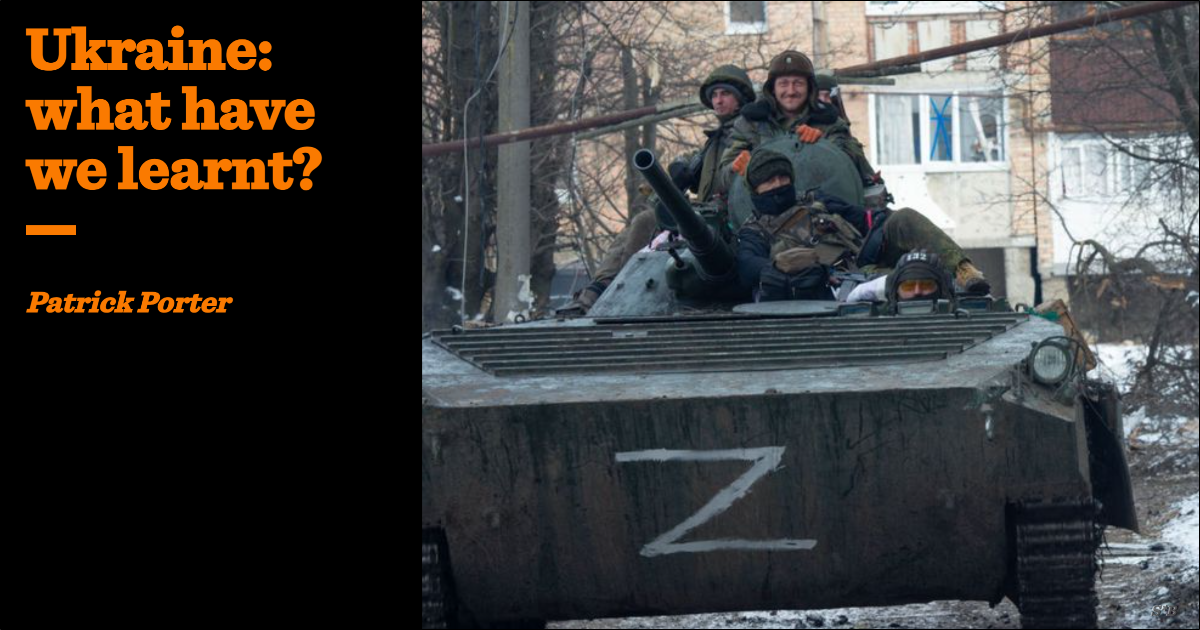
At the other end of the spectrum, cliches abound about the obsolescence of systems like tanks, but they are still in demand on both sides for a reason. A platform that links firepower, armour and movement is still valuable, even if the user must learn to deploy it in different ways. Wonder-weapons are overrated. Combined arms — the orchestration of different weapons and capabilities — lies at the heart of effectiveness, so long as it can be sustained.
Cliches abound about the obsolescence of systems like tanks, but they are still in demand on both sides for a reason
This kind of war is possible. We don’t know how far the Russia-Ukraine war is anomalous. But this war might instead be a minority class of war that could return elsewhere. It could be the case that the current war is completely sui generis, given its vast geography and circumstances, and that future wars are bound to take place in cities, say, or return to the form of hybrid, sub-threshold subversion that so obsessed some analysts for years. Yet we don’t know and it would be imprudent to assume so.
Not only is the future capable of surprising us. The future hasn’t happened yet, and what happens next is not pre-determined but subject partly to wills. It depends partly on how actors choose to respond to one another’s moves. The penalties for being wrong could be steep. Even if we could tell in advance which kinds of wars are most probable, which we can’t with confidence, optimising our ability to wage the most probable war could come at the expense of being prepared for the highest-stakes and worst case ones. Most conflicts don’t resemble this one in scale or intensity. But it is the most consequential one in a generation. The wars that most shape our world need not be the standard-issue typical ones. Ignoring the last war can be as fatal as being intellectually imprisoned by it.
It is hard to isolate large adversaries. The ability to wage war and regenerate forces itself is a product not only of industry, will and innovation, but also of politics and diplomacy. There has been much talk of isolating Vladimir Putin’s regime as a pariah state, and early on, there was even speculation that Russia’s atrocities would repel even is authoritarian partner China. Alas, that’s not how international politics works. Russia has stayed in business, and in the fight, because other countries prioritise their narrow and more immediate material interests above trying to pressure it into withdrawing.
China has an obvious interest in Russia occupying the west on one front, and thwarting NATO’s growing reach and presence, so that it can focus its power in the western Pacific, and besides, Russia is a valuable source of energy, commodities and raw materials, now at a discount. Indeed, democratic as well as authoritarian regimes beyond America’s alliance-orbit have hedged ruthlessly with Moscow, from Brazil to Kenya, from India to Israel. Russia offers agricultural fertiliser to arms sales to energy sector assistance. Ukraine’s welfare and the cause of upholding a Westphalian world order looks abstract compared to pressing concrete problems.
Once the heat is on, as ever, the world is more a power-political universe than a moral one. Should China one day strike Taiwan, it would be rash to expect a global rallying against a power ten times Russia’s size. A sobering thought, though not as sobering as the fact that we need reminding.