What does Director of National Intelligence Tulsi Gabbard actually believe when it comes to Iran? It depends on which version of Gabbard you ask.
Earlier in her political career, when Gabbard served as the vice chairwoman of the Democratic National Committee in the mid-2010s, she backed then-President Barack Obama’s Joint Comprehensive Plan of Action despite repeatedly warning that she viewed Iran as the “world’s leading state sponsor of terrorism.” Gabbard also spoke openly of the important relationships shared between the United States and Israel, a relationship that has animated Washington’s long-running tensions with the Iranian regime.
The JCPOA was Obama’s attempt, alongside Western allies, to wrangle the Islamic Republic’s nuclear threat. By most international monitoring accounts, it succeeded in delaying Iran’s ability to produce a nuclear weapon through strict limits and inspections. Though Israel’s Prime Minister Benjamin Netanyahu and establishment elements of the American right castigated the deal, Iran did not develop a nuclear weapon while the deal remained in force.
By 2016, Gabbard could see clearly where the Democratic Party was headed, and it was moving distinctly away from her. Hillary Clinton dominated the path to the party’s nomination, while Sen. Bernie Sanders (D-VT) ran a long-shot insurgent campaign that threatened to redraw the philosophical map of left-wing politics for years. With her views becoming increasingly antiwar, especially regarding regime change in the Middle East, the former congresswoman from Hawaii stepped down from the DNC and endorsed Sanders for the nomination.
Though Sanders fell to Clinton, and Clinton to Trump, something had changed in Gabbard, and it all had to do with the Middle East. She had grown weary of ideological rhetoric that always pushed America toward a never-ending cycle of cynical, war-first agitprop, and she had a plan to do something about it. After Trump killed Iran’s General Qasem Soleimani, she spoke out in stark disapproval, characterizing the assassination as an “act of war” without congressional approval.
By 2019, Gabbard had her eyes on the Oval Office. During her peak anti-war phase, Gabbard launched an anti-interventionist campaign and suffered the consequences. She was accused of being a favorite of Moscow and had more than 25 yard signs in New Hampshire defaced with hammer and sickle symbols suggesting she was working for the Russians.
Gabbard spoke eloquently about the direct link between U.S. regime-change wars in the Middle East and a strengthened, defiant Iran. Though she never polled higher than a few percentage points in the early-round states, she used her platform to call for troops to withdraw from Middle East conflicts. On X, you can still view a Gabbard campaign post that promoted a T-shirt that stated “No War With Iran.” Though she failed to gain serious traction in the primary field, she made a mark on the discussion about American war powers before exiting the race and endorsing Joe Biden for the presidency.
Though she had aligned with the Democratic establishment by backing Biden, Gabbard was already on the way out of the party writ large. Over the course of Biden’s single term in office, Gabbard’s antiwar stance began to resonate with MAGA voters tired of war and key right-wing influences, including the podcaster Joe Rogan, who welcomed her into the fold. By the time the 2024 presidential cycle rolled around, Gabbard was viewed as a serious, dedicated voice for the anti-interventionist cause.
Through these shifts, Gabbard managed to navigate a tight line between principle and political opportunity, cementing her reputation as a controversial but dedicated voice on restrained U.S. foreign policy. When Trump won reelection, Gabbard was appointed as the Director of National Intelligence. It was seen as a major victory for the anti-interventionist wing of the new Republican movement that had helped push Trump across the finish line. Little did they know what would come next.
The Iran War started as many American wars have started in the 21st century: without a clear endgame. Something about nuclear bombs, something about 47 years, something about protecting Israel, and most recently, something about an “imminent threat.” All the code words were there, and the Boomer pundits on Fox News were eager to deliver them.
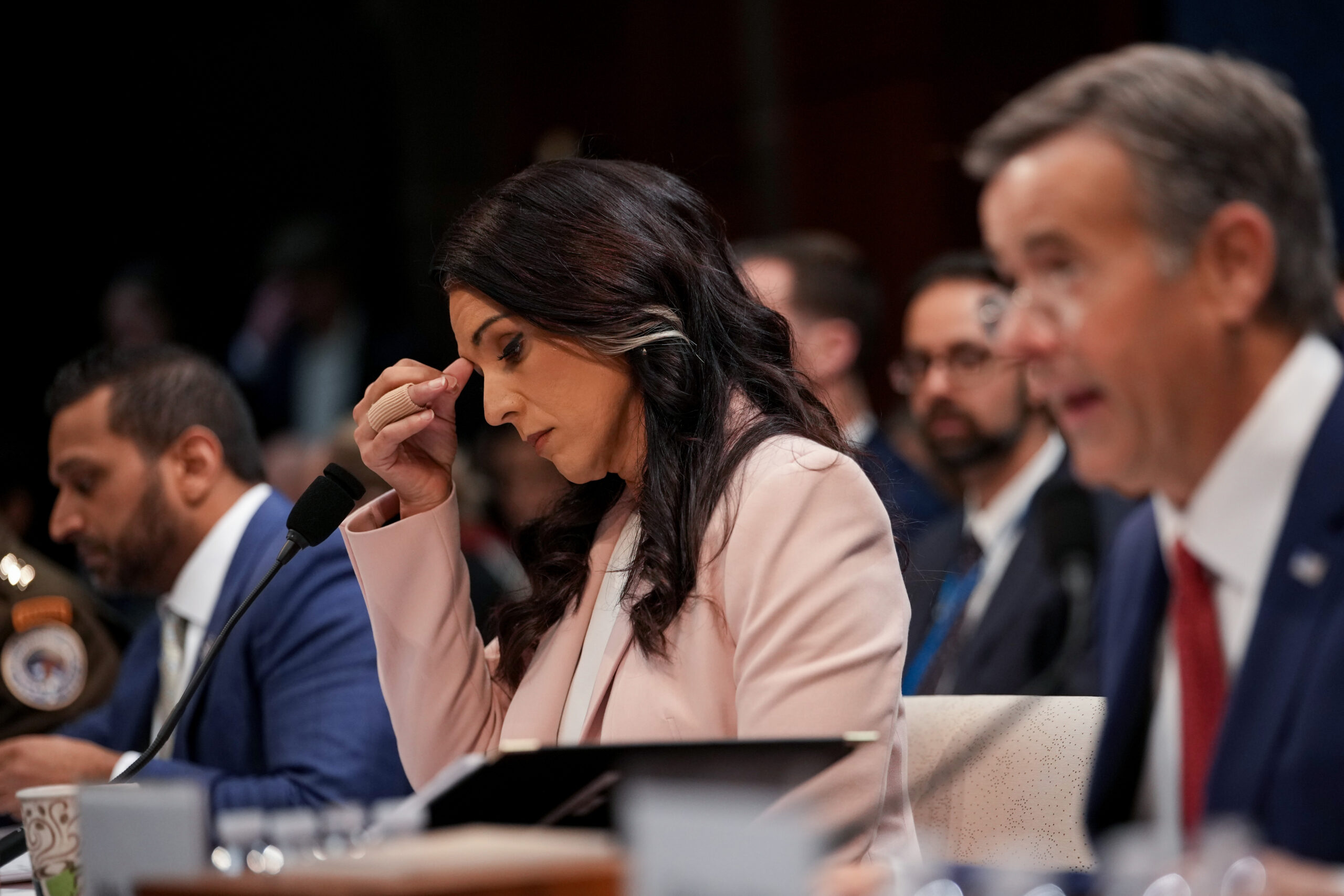
The war, no matter how you characterize it, has put Gabbard and key staff members in a politically and operationally difficult position. Joe Kent, who served as a top aide and acting chief of staff to Gabbard in her role at DNI, recently resigned in protest of the war in Iran. The next day, Gabbard appeared before a Senate hearing to explain the administration’s position on the war.
Gabbard told senators that the Iranian regime “appears to be intact but largely degraded.” When asked whether the Islamic Republic posed an “imminent threat” to the U.S., Gabbard sidestepped a direct answer, stating that only Trump “can determine what is and is not an imminent threat.” When pressed on whether Iran was “weeks away” from achieving a nuclear weapon, as has been suggested by Trump and his most vocal supporters, Gabbard squirmed her way out of a definitive answer, claiming instead that it would be a “disservice” to the American people to give a “yes or no” answer to the question.
Her performance was puzzling. Not just to long-time supporters, but also to senators seeking firm answers in a rapidly evolving war landscape. Especially on the topic of Iran posing an “imminent threat” to the U.S., Gabbard refused to answer confidently. She deflected responsibility to Trump, who had appointed her under the premise of making such assessments.
Subscribe Today
Get daily emails in your inbox
In a hearing with the House Intelligence Committee, Rep. Jimmy Gomez (D-CA) perhaps summarized Gabbard’s underwhelming performance most succinctly when he asked, point blank, why Gabbard was appointed to gather intelligence in defense of the American people if only the president can decide what qualifies as an imminent threat. The truth is that Gabbard is not unlike many of the politicians and administrative cogs who run Washington. They are not there because they hold hard and fast principles—they are there to satisfy ambitions for power, fame, and legacy.
Gabbard’s arc from independent war skeptic to simply another Republican Party apparatchik is not dissimilar to that of Vice President J.D. Vance, who has also spent the last few weeks quietly making excuses for a war that goes against the non-interventionist promises that he and Gabbard and Trump made on the campaign trail. Maturity in Washington often means recognizing that political survival comes first. Many officials will say whatever is necessary to maintain status and influence within a system that rewards loyalty over principle, leaving idealistic supporters disappointed and disillusioned.
So, why is Tulsi toeing the line? What other option does she have? Back to X? Back to the podcast circuit to be fawned over by people with no real power? Tulsi is exactly where she has always wanted to be, at the seat of power, and she’ll do anything to hold onto the whip as long as she can.