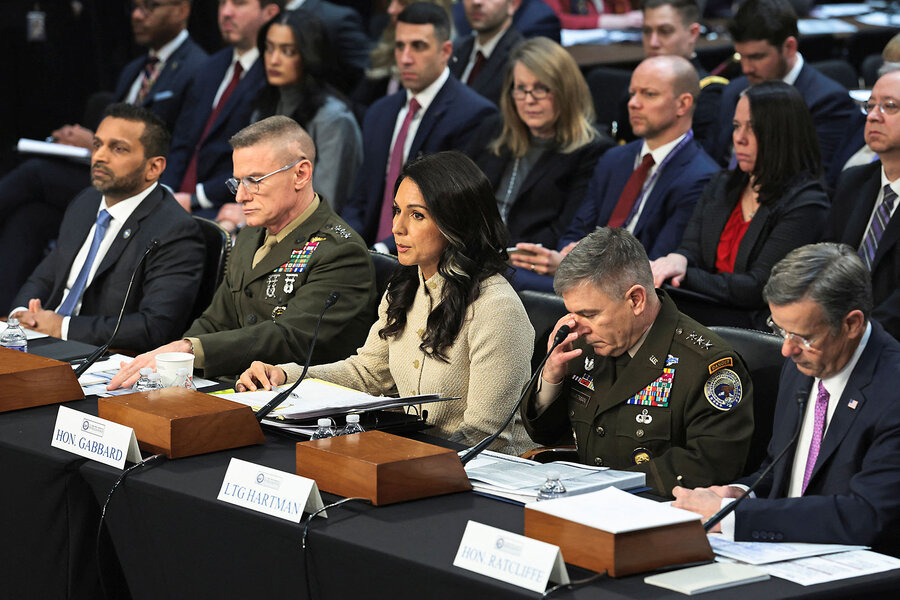
Director of National Intelligence Tulsi Gabbard told Congress Wednesday the Trump administration’s airstrikes have “vastly degraded” Iran’s military capabilities, but she deflected other questions about the war – including whether the administration was warned in advance about the likelihood that Iran would close the Strait of Hormuz and strike neighboring Gulf nations.
Ms. Gabbard testified before the Senate Intelligence Committee alongside FBI Director Kash Patel, CIA Director John Ratcliffe, and other top administration officials, at an annual hearing on worldwide threats.
Ms. Gabbard offered an assessment of the impact so far of Operation Epic Fury, the U.S. military campaign in Iran, citing major successes against Iran’s military capabilities, while noting that the regime is still intact. But she avoided direct answers about whether the intelligence community had briefed the administration in advance on the likelihood that Iran would launch retaliatory strikes against neighboring oil-producing nations that look to the U.S. for protection, or close the Strait of Hormuz, a critical maritime pathway through which 20% of the world’s oil flows. She also declined to answer a question about whether Russia was providing Iran with intelligence, saying that would be more appropriately addressed in the classified, non-public portion of the hearing. The 19-day war has already resulted in the deaths of 13 U.S. service members.
Why We Wrote This
Director of National Intelligence Tulsi Gabbard told lawmakers the U.S. military campaign in Iran had effectively destroyed that country’s military capabilities. But she deflected questions about whether the Trump administration had been warned that Iran would attack its Gulf neighbors and close the Strait of Hormuz, bringing oil shipments to a halt.
Democratic lawmakers pressed Ms. Gabbard on the apparent discrepancy between the intelligence community’s assessment that U.S. airstrikes in June had obliterated Iran’s nuclear program and the White House’s claim that it had launched Operation Epic Fury to address an imminent nuclear threat from Iran. Ms. Gabbard stood by her earlier estimation of the destruction of Iran’s nuclear program – but said it was the president’s responsibility to determine what was and wasn’t an imminent threat.
Ms. Gabbard has a long history of opposing military action against Iran. In her 2020 presidential campaign, she sold T-shirts featuring the slogan “No War With Iran.” During Mr. Trump’s first term, Ms. Gabbard, a Democratic member of Congress at the time, denounced the U.S. operation that killed Iranian military strategist Qasem Soleimani, saying Mr. Trump had “committed an illegal and unconstitutional act of war.”
Since the start of U.S. airstrikes last month, she has stayed largely quiet.
Wednesday’s hearing came one day after Gabbard ally Joe Kent, the Director of the National Counterterrorism Center, resigned his post, saying he “cannot in good conscience support the ongoing war in Iran.” In his resignation letter, which he addressed to President Donald Trump and posted on social media, Mr. Kent stated that Iran had posed “no imminent threat,” and that the U.S. started the war “due to pressure from Israel.”
In the hearing, Mr. Ratcliffe directly refuted Mr. Kent’s assertion. “Iran has been a constant threat to the U.S. for an extended period of time and posed an immediate threat at this time,” he said.
The hearing touched on a number of other topics besides Iran, including Russia’s war against Ukraine, and concerns about election integrity at home. Democratic Sen. Mark Warner, the vice chairman of the committee, grilled Ms. Gabbard over her appearance at an FBI raid of Georgia’s Fulton County election office, in which agents seized ballots from the 2020 election. Ms. Gabbard said she had gone there in an observational role at the “request of the president.”