This article is taken from the April 2026 issue of The Critic. To get the full magazine why not subscribe? Get five issues for just £5.
It was King Alfred who “cleverly” founded the Royal Navy, said Sellar and Yateman in the greatest work of history ever written, 1066 and All That. “From that time onwards foreigners, who, unlike the English, do not prefer to fight against long odds, seldom attacked the British Navy. Hence the important International Law called the Rule Britannia, technically known as the Freedom of the Seas.”
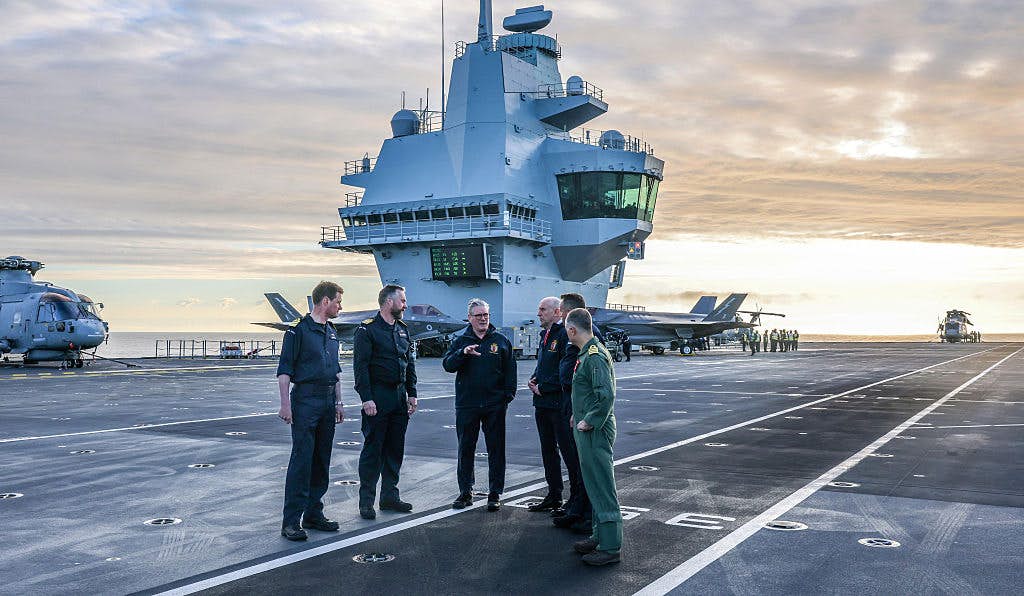
Keir Starmer believes in a very different type of international law. And his name will, I fear, stand forever beside the obituary of the Royal Navy, when we struggled to muster a solitary ship to the Mediterranean Sea to defend British sovereign territory under attack from a well-known and easily-predicted enemy.
That it was left to the Greeks and (I fear they will never forget this) the French to provide for our defence just makes the humiliation of the Senior Service more excruciating. The men and women who bravely volunteer to risk their lives on our behalf do not deserve this.
But here Keir Starmer deserves half a word in his defence. This has been a humiliation long in gestation. Governments have been cutting the fleet since the end of the Cold War — cashing in a so-called “peace dividend”.
John Major’s “Options for Change” review took our frigate and destroyer fleet from 50 to 40. Blair took us to 25; Cameron took us to 19. Between 1996 and 2017 not one new frigate was ordered.
So Keir Starmer might have been present at the bedside, but he cannot be wholly blamed for the death. (I say partially because he did decide to scrap our entire amphibious assault fleet, decommission HMS Albion, HMS Bulwark and HMS Northumberland early, along with two fast fleet tankers. Points should, however, be awarded to May, Johnson and Sunak who collectively ordered 13 new frigates over their times in office.)
Government after government has put their immediate electoral interests above the interests of future generations. Minister after minister did this in the expectation that the chickens would come home to roost long after they had left office.
This is true across the armed forces, and not just in terms of cuts. The catastrophic Ajax armoured personnel carrier, which has cost billions and has now been shown to leave anyone inside vomiting and incapable of action, is another example: the flaws and failings were well known, but senior officers and ministers of the crown ignored them in the knowledge that the problems would only come to light after they were well clear of office.
This problem runs well beyond the armed forces. It affects every aspect of government. Why have we built no new nuclear power plants? Because, as Nick Clegg said in 2010, they wouldn’t come into operation until 2021. By 2021 we were left without adequate power, whilst Nick Clegg had left the country.
It is immoral to bribe today’s voters with money that should be spent on guaranteeing the defence of the country after you have left office
The interests of voters today — and, more to the point, those whom they would elect — always take precedence over the interests of citizens tomorrow, because by definition the latter do not yet have a vote or a say.
The most egregious example of this is so big it is almost blinding. The OBR forecasts the government’s net deficit at £133 billion this year. Every penny of this is borrowed, with interest, against the taxes of those not yet voting. This year we are spending £333 billion on welfare. We are only expecting to collect £329 billion in income tax. This is unsustainable. It is also immoral.
It is immoral to bribe the voters of today with the money you will need to raise from tomorrow’s taxpayers. It is immoral to bribe the voters of today with money that should be spent guaranteeing the defence of your country after you have left office.
But morality holds little sway in public life, whilst the threat of an upcoming election does. So what can be done? Last month, half jestingly, I suggested that if you want to strip peers of their peerage before they have been tried in a court of law, you should resurrect the old Bill of Pains and Penalties. This month I, half-jestingly, suggest that if you want to keep today’s politicians on their toes, bring back another old tool in the constitutional war chest: impeachment.
Right now, the only incentive driving a minister is the threat of the ballot wielded by today’s electors, and they act accordingly. But what if tomorrow’s electors had some power?
New citizens, having woken up to find that they don’t have enough electricity, the fleet can’t sail, that they stand little chance of buying a house and no chance of getting a state pension — a generation expected to pay the debt and the interest for other peoples’ pleasures.
What if this new generation could haul the ministers back to Parliament to justify mortgaging future citizens’ safety and prosperity for their own electoral advantage, and could censure them accordingly?
Maybe strip them of their pension, just as they stripped the next generation of their prosperity? Then, maybe, today’s great officers of State might have the future of their country as much in mind as the future of their career.