In the azure expanse of the Aegean Sea, not far from the Greek mainland, lies the island of Milos – a place that U.S. President Donald Trump, harking back to his days as a deal-making developer, would call “prime waterfront property.”
Yet, 12 months after the election victory that returned Mr. Trump to the White House, Milos has acquired a significance well beyond its undeniable attraction as a tourist destination.
For the island was also on the receiving end of one of history’s most famous lessons in power politics – when it strived to remain neutral in a “great power” war between Athens and Sparta some 2,450 years ago.
Why We Wrote This
President Trump’s conduct of foreign policy – respecting only strong powers and bluntly imposing his will on everyone else – echoes ancient Athens’ behavior 2,500 years ago. That did not end well.
And the short, sharp message with which Athens demanded Milos’s submission has earned it 21st-century relevance, in the wake of recent foreign policy moves spotlighting President Trump’s view of the world, and of America’s place in it.
“The strong do what they can,” Athens told Milos. “And the weak suffer what they must.”
That dictum has been emerging as a clear through line in Mr. Trump’s second-term approach to friend and foe alike, especially on trade and tariffs.
Two contrasting moves in recent days have brought the geography of the “World According to Trump” into even sharper focus.
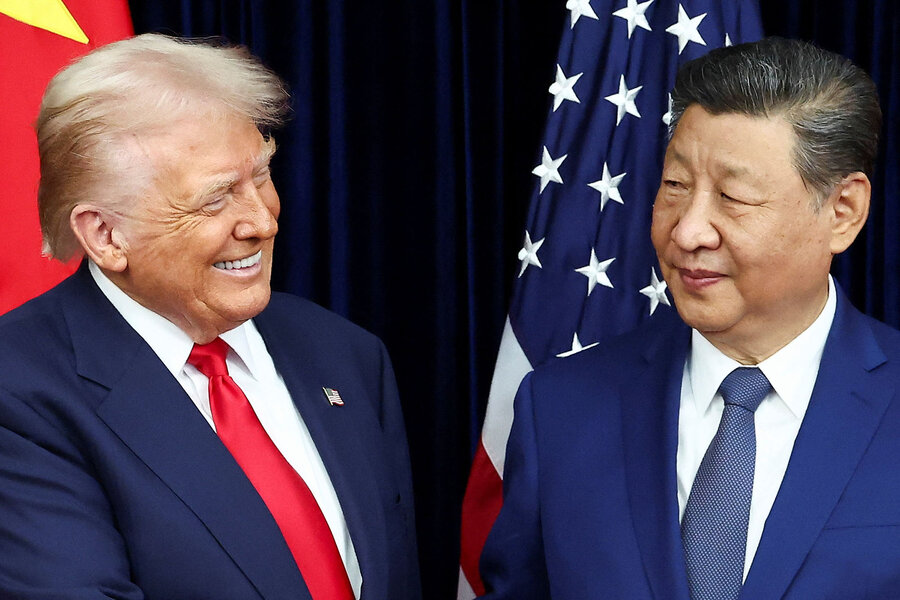
The first was Mr. Trump’s trade truce late last week with President Xi Jinping, in effect accepting that China’s economic heft puts it among the “strong” – countries able to do what they like. In fact, Mr. Trump appears to have concluded that China is America’s sole fellow member of the “club of the strong.”
His second move was a social media threat to order military action, “guns-a-blazing,” against Nigeria, to encourage the most populous country in Africa to take tougher action against Islamists attacking Christians there.
The message was that the ranks of “the weak,” in Mr. Trump’s view, stretch beyond Milos-like geopolitical minnows.
They include America’s near neighbors, too: countries like Canada, which Mr. Trump is still battling over tariffs, and Venezuela, on whose government he appears to have set his sights.

Adrian Wyld/The Canadian Press/AP
In seeking to end the war in Gaza, he has periodically wielded pressure on Israel.
In Ukraine, he first leaned on President Volodymyr Zelenskyy, telling him, in an Oval Office dressing-down with echoes of the Athens ultimatum to Milos, that he held “no cards.”
More recently, he has sanctioned Russia, which, though still a nuclear power, wields nothing like the economic weight China has been able to harness in response to U.S. pressure.
Mr. Trump has also imposed tariffs on regional heavyweights: India, in Asia, and Brazil in South America.
This raw-power approach is a departure from decades of U.S. foreign policy since the end of World War II.
And it’s been a deliberate departure.
The postwar approach was built around partnerships with like-minded, mostly democratic, allies and embraced free trade. The United States played a linchpin role as its allies’ ultimate security guarantor, as well as being the main provider of economic aid to the developing world.
Mr. Trump has long believed this amounted to America being played for a sucker.
In the security realm, he has now told other NATO member states that they will have to spend billions more on their defense. He has made access to the U.S. market dependent on a mix of economic and political conditions he is setting. He slashed America’s development aid within days of returning to the presidency.
Particularly among longtime allies, the shift has been jolting.

Their hope remains that at least some aspects of the old postwar partnership can be revived, and that Mr. Trump might come to accept that it worked to America’s benefit as well.
But, for now, they have accepted “Milos rules” as the new reality.
They have begun ramping up defense spending. They are seeking agreements with the United States to limit tariff increases by offering inducements Mr. Trump might value: investments in the U.S. economy, easier access to their own markets, or the kind of rare earth deposits China has been using for leverage with the U.S. president.
The longer-term effects, and staying power, of this new order could take years to become clear.
And Milos – or Melos, its name in ancient Greek at the time of the Athens-Sparta war – might offer a cautionary tale.
It was the Greek historian Thucydides who wrote of the Athenians’ demand for surrender and tribute, and their threat to crush Melos if it did not submit. He also described Melos’s failed attempt to persuade Athens that brute force would not only be morally wrong, but would alarm and repel other neutral states.
In the event, the people of Melos felt duty-bound to try to resist.
Athens turned out to be right in the short term: The strong had the power and prerogative to act, while the weak had to “suffer what they must.”
Athenian troops devastated the island, massacred its men and enslaved its women.
Athens’ dominance, however, lasted only a few more years before the tide turned. Sparta drew strength from a key new ally, Persia, and Athens overreached in its bid to take Sicily.
The era of Athenian greatness had come to a humiliating end.