The signs had been growing stronger since Inauguration Day. Yet in the early hours of last Friday, the White House website made it official: For President Donald Trump, the main transatlantic threat is not Vladimir Putin’s Russia.
It is Europe’s democracies: America’s closest overseas allies for the past 80 years.
The extraordinary broadside against mostly centrist European governments came in Mr. Trumps’ National Security Strategy of the United States, or NSS – a policy document published by all U.S. administrations that rarely breaks new ground or generates much lasting news interest.
Why We Wrote This
Donald Trump’s new national security strategy turns history on its head, dismissing a Europe it says faces “civilizational erasure” and praising far-right parties that Moscow supports. How will the United States’ transatlantic allies react?
But for European leaders, the shock of being portrayed as an ideological threat, in language that past reports had reserved for countries like Russia, will linger.
Focusing above all on immigration, the NSS warns that non-Europeans might eventually become a majority in some countries. And it accuses Europe’s leadership of allowing this “stark prospect of civilizational erasure.”
Even more unsettling, perhaps, the document singles out far-right populists as the sole cause for U.S. optimism: “patriotic European parties” whose “resistance” Washington would seek to “cultivate.”

That is language that recalls American references to Soviet dissidents during the Cold War.
Its immediate effect has been to lend greater urgency to Europe’s efforts to dissuade Mr. Trump from seeking a Ukraine peace deal that would require Kyiv to cede further territory, or deny Ukraine adequate security guarantees against further Russian aggression.
The NSS accuses Europe of harboring “unrealistic expectations” on Ukraine.
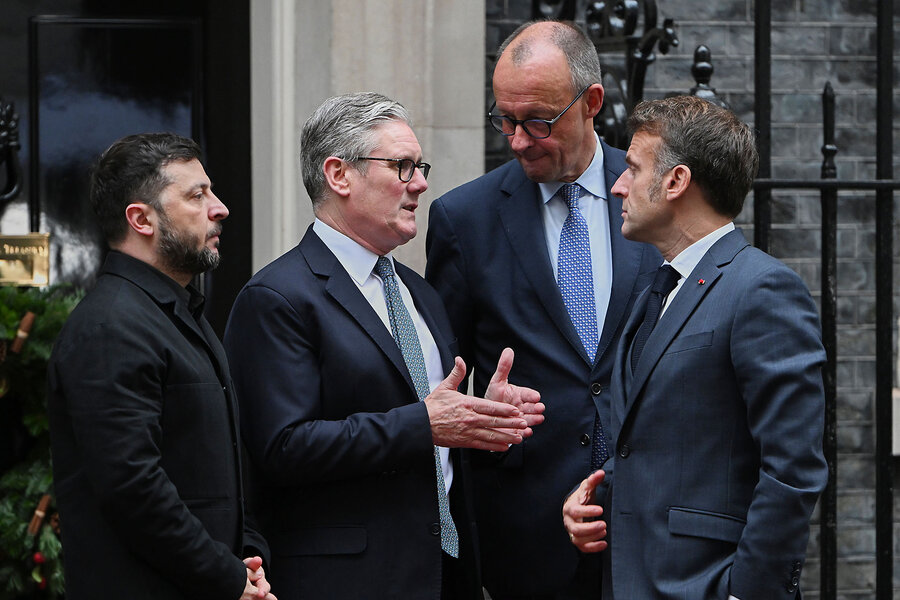
In its shadow, British Prime Minister Keir Starmer launched a new effort Monday to consolidate support for Ukraine, hosting talks with Ukrainian President Volodymyr Zelenskyy, France’s President Emmanuel Macron, and German Chancellor Friedrich Merz.
But even if Mr. Trump decides to back a more balanced Ukraine accord, the NSS raises the prospect of a yet more difficult, and maybe impossible, task for Europe: to quickly find a way to safeguard its own security without American support.
The NSS says Washington aims to “enable” Europe to take “primary responsibility for its own defense.” And just hours after its publication, a news report suggested the Pentagon wanted Europe to manage without its eight-decade-long U.S. security umbrella within the next two years.
Yet it is the underlying thrust of the NSS that has left the deepest wound: the strong suggestion that for the United States, the shared interests, values, and common worldview binding the transatlantic alliance since the end of World War II may no longer hold.
Some of its specific targets are familiar. It attacks the 27-nation European Union as a behemoth stifling its nations’ sovereignty and overregulating businesses. That is an especially sore spot for Washington because Europe regulates online and social media platforms for transparency, accountability, and issues of personal and public safety.

Equally unsurprising is the call for European NATO members to do more for their own security. While they are still far from self-sufficient, they have been pouring billions more into that effort, and adding more troops and weapons, in response to Mr. Putin’s 2022 invasion of Ukraine.
But this NSS, especially regarding Europe, is unrecognizably different.
Not just from decades past, but from Mr. Trump’s own first-term Security Survey in 2017.
His first NSS proudly proclaimed an “America First” approach.
Yet it heaped praise on a European alliance rooted in a joint triumph over “fascism, imperialism and Soviet communism.”
It accused Moscow of challenging “American power, influence and interests,” eroding “American security and prosperity” and seeking to “divide us from our allies and partners.”
Now, all that is gone.
In its place is a root-and-branch revision of America’s alliance with Europe – through the lens of Mr. Trump’s MAGA agenda of assertive nationalism, “traditional” social values, and a clampdown on immigration.
That narrative resonates not only with Europe’s far right, but also with Moscow, where a government official praised the NSS.
The report portrays these new policy priorities as essential – not only to restore American greatness, but to protect the very future of Western civilization.
And it says something more – telegraphed since the start of the administration by Vice President JD Vance and other senior figures, but now boasting the president’s signature: In that battle, America’s true European allies are the far-right parties rising in the polls in a number of countries.

Alexander Kazakov/Sputnik/Reuters
The NSS echoes one of their rallying cries: what’s often known as the “great replacement theory.” That posits an elite conspiracy to supplant native populations with non-Christian, non-white interlopers. “It is more than plausible,” the NSS suggests, that “certain NATO members will become majority non-European.”
It also accuses European governments of subverting democracy: by trying to “suppress” their far-right challengers and, on Ukraine, by ignoring “a large European majority” that wants a peace agreement.
European leaders will take some encouragement from polling, which has consistently shown the opposite: solid support for helping Ukraine, even nearly four years after Russia’s invasion.
They can also hope that the NSS may ultimately have less of an effect on U.S. policy than the day-to-day decisions of President Trump, with whom they will almost certainly be redoubling efforts to reach common ground.
But they may well feel most reassured by another finding of European polls over the past year.
By even larger margins than they support Ukraine, people in most European countries hold strongly negative views of Mr. Trump.