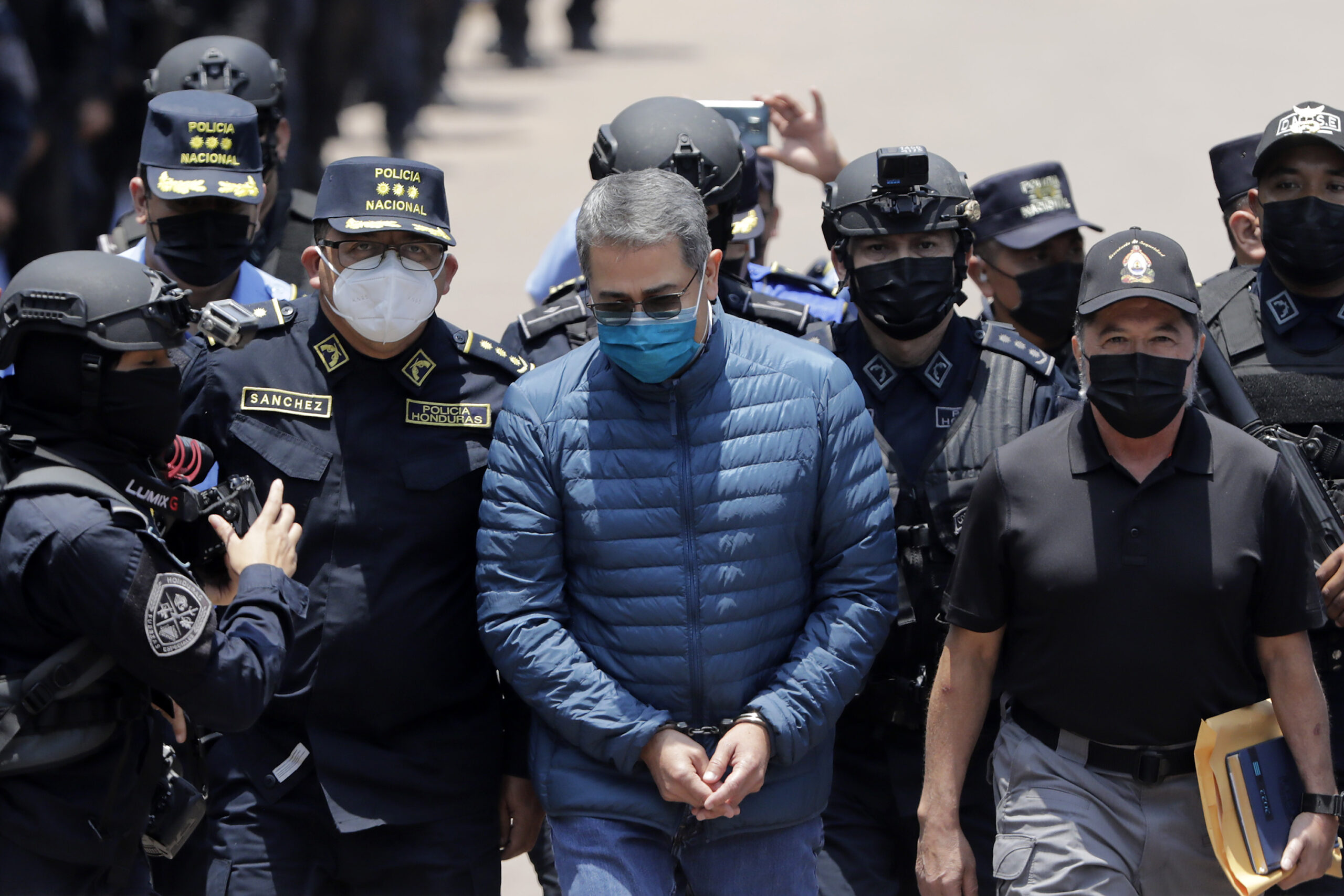
Last week, President Donald Trump pardoned Juan Orlando Hernández, the former president of Honduras who was serving a 45-year sentence for trafficking hundreds of tons of cocaine into the United States.
As the administration targets foreigners suspected of narcoterrorism in an extrajudicial killing program in Latin America, Trump has freed one of the region’s most notorious offenders—someone not merely suspected of narcoterrorism like the victims of U.S. boat strikes but convicted in federal court for it.
The pardon of narcoterrorist Juan Orlando Hernández was nonetheless celebrated by some of the same conservative activists who applaud the Trump administration’s campaign in the Caribbean.
Roger Stone, who argues that “Maduro should be removed in Venezuela because he is a Marxist narcotrafficker” was among them.
Reported to have played a key lobbying role in securing Hernández’s pardon, Stone’s involvement likely explains why an administration otherwise willing to push its drug-war tactics outside the law to project an image of toughness against drug trafficking would carve out such an obvious exception for the former Honduran president.
In a January 2025 article co-authored by Roger Stone titled “How President Trump Can Crush Socialism and Save a Freedom City in Honduras,” Stone argued that Trump should pardon Hernández in order to save “the Próspera experiment” a foreign Zone for Employment and Economic Development (ZEDE), referred to as “a haven for Bitcoin entrepreneurs who are sick of being taxed to death in first-world countries.” Prospera’s governing arrangement was overseen by Hernández, who Stone called “a staunch supporter of the ZEDEs.” When Hernández left office, the Supreme Court of Honduras declared those “havens for Bitcoin entrepreneurs,” to be unconstitutional.
Stone took credit for the release of the former president of Honduras, telling his radio show audience that he sent Trump a letter—dated October 28—hours before Hernández’s pardon was announced.
Hernández’s release is the latest in a series of pardons now attracting serious scrutiny from liberal and Democratic Party-aligned outlets like the Guardian and The New York Times. Calling it, “a classic authoritarian tactic,” the Guardian cited various legal experts to denounce the January 6 pardons as well as “commutations or pardons that seem increasingly aimed at boosting political allies and some Trump family business interests.”
Discounting the editorial decision to fold in the January 6 pardons, the core critique—when applied to some of Trump’s other clemency actions—is accurate, and remains conspicuously absent from conservative commentary.
Just a year ago, a series of pardons signed by President Joe Biden, apparently executed through the “autopen” and seemingly without his direct involvement, rightly became the subject of intense scrutiny from conservative media. Right-wing stars Megyn Kelly and Steve Bannon among others bashed the autopen pardon of a convicted killer from Connecticut, Adrian Peeler, even proposing legal theories for how Attorney General Pam Bondi’s Justice Department might be able to undo Biden era pardons.
Yet one month ago, Trump unwittingly mimicked Biden’s inattentiveness when, after pardoning Binance CEO Changpeng Zhao, Trump told CBS’s 60 Minutes that he did not even know who the crypto exchange founder was.
Zhao is one of various white collar criminals for whom Trump has demonstrated leniency. His pardon is only the latest in a pattern, dating back to Trump’s first term, in which clemency has been shaped by opaque lobbying networks and personal access—much like under Biden, though without attracting comparable scrutiny from conservative media.
For example, the pardon of Philip Esformes, a nursing-home operator convicted in what prosecutors called one of the largest Medicare-fraud schemes in U.S. history, while largely overlooked by the right at the time, provided an early indication for how open the Trump administration’s clemency process could be to private influence.
Esformes’ 20-year sentence was abruptly commuted after an effort routed through the Aleph Institute, a Chabad-affiliated criminal justice nonprofit that had cultivated a direct line into the White House through Jared Kushner and outside advocates such as the lawyer Alan Dershowitz. To secure his release after his indictment, Esformes’s family increased its donations to Aleph in what The New York Times later described as a “study in special access,” noting that petitioners connected to Aleph were allowed to bypass the Justice Department’s formal review process altogether.
Esformes was one of various Chabad-connected criminals whose sentences were commuted on the last day of Trump’s first term thanks to the efforts of what the New York Times labeled “a loose collection of well-connected groups and individuals led by a pair of Orthodox Jewish organizations.” Another beneficiary of that pardon network was the convicted fraudster Sholam Weiss, who had been serving a 835-year sentence for a $400 million insurance fraud scheme.
Also pardoned was Eliyahu Weinstein, who—thanks to lobbying by Dershowitz and the Chabad-affiliated criminal justice network—was released after serving only eight years of a 24-year sentence for running a Ponzi scheme that defrauded investors of roughly $224 million, and for committing additional wire fraud offenses while already under indictment. Just last month, Weinstein was sentenced to 37 years in prison over his role in running yet another Ponzi scheme, this time valued at $44 million.
Of the 238 total pardons and commutations granted by President Trump during his first term, 27 went to people supported by Aleph Institute, its peer organization the Tzedek Association, and/or the lobbyists who worked with them. Those groups first demonstrated their pull with the commutation of Sholom Rubashkin in 2017, an Iowa meat-packing executive convicted of bank fraud and immigration-related offenses, also secured through the help of Dershowitz, as well as Jared Kushner’s father Charles. As CNN reported at the time:
Subscribe Today
Get daily emails in your inbox
According to a source with knowledge, Charles Kushner also started to lobby the New York legal community the moment Trump won the 2016 election. In January 2017, Reade denied Rubashkin’s motion to be resentenced. Soon after, Jared Kushner took up Rubashkin’s cause inside the White House.
Charles Kushner’s attorney said he understood Dershowitz’s lobbying is what deserves credit.
Dershowitz, who successfully lobbied for multiple pardons during the first administration, now says that Ghislaine Maxwell, the confidante of disgraced financier Jeffrey Epstein, should also receive one.
President Bill Clinton’s Marc Rich pardon, long held up as the gold standard for politically connected abuses of presidential mercy, now looks like a modest abuse beside the networks that have shaped clemency under both the Biden and Trump administrations. And while conservatives had no trouble denouncing Biden’s autopen pardons, the same standard of scrutiny is overdue for the clemency system now operating inside this administration.