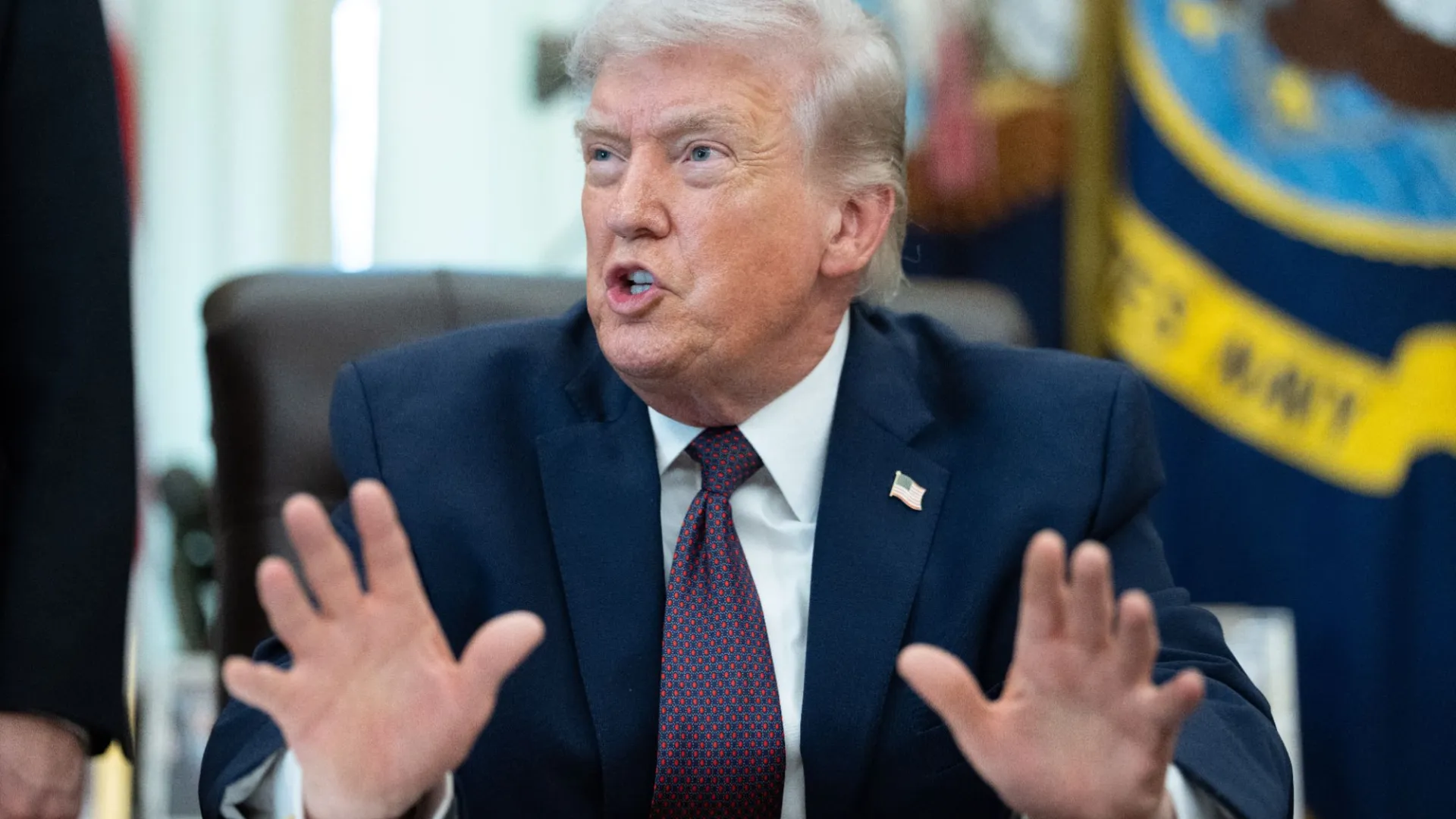
DONALD Trump has warned that the US military “hasn’t even started destroying what’s left in Iran” – as he vowed to hammer the regime’s key bridges and power plants.
Eight people were killed and 95 injured yesterday as America blitzed the tallest bridge in Iran, which connects the rogue state’s largest cities.
Promising to unleash fresh devastation on Tehran, the president wrote: “Our Military, the greatest and most powerful (by far!) anywhere in the World, hasn’t even started destroying what’s left in Iran.
“Bridges next, then Electric Power Plants!
“New Regime leadership knows what has to be done, and has to be done, FAST!”
As the Middle Eastern war rattles into its sixth-week, Trump’s rhetoric has shifted has gotten ever more aggressive.
The president vowed to hit Iran‘s oil facilities “extremely hard” in a fiery 19-minute address to the world on Wednesday evening.
Any capabilities Tehran had to become a nuclear power have now been “obliterated”, Trump assured those watching.
He also called on his allies to “grab and cherish” the Strait of Hormuz – a vital shipping lane handling one-fifth of the world’s fuel supply – from Iran’s iron grip and stop an impending global recession.
The bloodthirsty regime’s control of the 24-mile waterway has caused oil costs to skyrocket and prompted several countries to dip into their national reserves.
The president has denigrated Nato – singling out the UK in particular – in recent days for its inaction in helping to free the strait.
He even suggested that America’s withdrawal from the military alliance is “beyond consideration”, branding it a “paper tiger”.
A proud Trump hailed Operation Fury as a “swift, decisive and overwhelming” success.
He added: “America is winning, and winning bigger than ever before.”
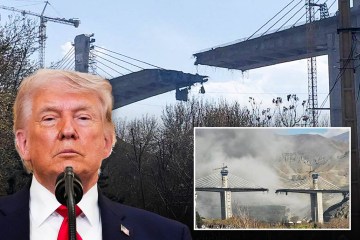
One day later, the president posted footage on social media of smoke rising from the B1 bridge in Karaj, around 20 miles southwest of Tehran.
The 136-metre-high and 1,000-metre-long bridge links two of the rogue nations largest cities.
“The biggest bridge in Iran comes tumbling down, never to be used again – Much more to follow!”, Trump wrote.
Adding: “IT IS TIME FOR IRAN TO MAKE A DEAL BEFORE IT IS TOO LATE, AND THERE IS NOTHING LEFT OF WHAT STILL COULD BECOME A GREAT COUNTRY!”
But the reeling regime has responded to the strike with fury, insisting they will continue to fight.
Iranian Foreign Minister Abbas Araghchi said in a post on X: “Striking civilian structures, including unfinished bridges, will not compel Iranians to surrender.
“It only conveys the defeat and moral collapse of an enemy in disarray.”
His address came after huge bombing raids targeted an IRGC missile base in Baharestan, Isfahan.
A nearby ammunition depot was also hit earlier this week, with dramatic video showing a wall of fire lighting up the night sky.
The latest round of strikes come as Trump and Defence Secretary Pete Hegseth wield the axe internally against senior Cabinet and military officials.
General Randy George – the highest-ranking officer in the Army – was forced to step down and retire immediately after Hegseth‘s orders.
The Pentagon confirmed that two further senior members of the Army had been fired.
These are General David Hodne, head of the Army Transformation and Training Command, and Major General William Green Jr, the head of the Army’s chaplain corps.
Meanwhile, Trump is also reportedly “angry” and looking to fire additional members of his Cabinet.
“He’s very angry and he’s going to be moving people,” a source told Politico.
Commerce Secretary Howard Lutnick and Labor Secretary Lori Chavez-DeRemer are said to be on the chopping block, reported the outlet.
There are also “active discussions” about FBI Director Kash Patel and Army Secretary Daniel Driscoll, reported The Atlantic.
Meanwhile, warships the size of football fields equipped with hospitals and drone lasers have been deployed as Trump gears up to seize Iran’s key islands.
The largest American aircraft carrier in service – the USS Gerald Ford – sailed out of Split, Croatia, after some repairs and remains poised for full mission, the Navy’s 6th Fleet announced.
Thousands of marines have been arriving in the war-torn region as the US president mulls whether to unleash a ground invasion.
The Sun told how plans had been drawn up for Trump’s 31st Marine Expeditionary Unit to storm vital island fortresses to unlock the Strait of Hormuz.
But now the Pentagon has given its clearest sign yet of invasion intentions after ordering prefabricated bunkers for island occupations, sources say.
Trump has had his crosshairs firmly set on Iran‘s main oil terminal on Kharg Island – where 95 per cent of its oil is shipped.
He last week hinted he could be on the precipice of unleashing his crack squad of marines, saying: “I am considering taking Kharg.”
Other small islands with outsized importance under Tehran’s control also have a red ring around them – as seizing them would break the regime’s stranglehold over the Strait of Hormuz.
How invasion of islands would unfold
by Katie Davis and Martin Arostegui
PLANS have been drawn up for Donald Trump’s marines to storm Iran’s vital island fortresses to unlock the Strait of Hormuz, insiders told The Sun.
Despite being no more than flecks on the map, these tiny Tehran-controlled territories have outsized importance – pulling the strings on critical oil trade.
Furious Trump last month deployed Apache helicopters and low-flying jets to blitz Iranian ships near the waterway.
But now a crack squad of US marines trained to seize and fortify small islands could be gearing up to take the Iranian bases dominating entrances to the key waterway.
B-2 strategic bombers pounded IRGC missile bunkers on the barren islands of Larak, Kish, Qeshm and Abu Musa and launch sites dug into mainland coastal cliffs, dropping 5,000lb GBU-72 deep penetrator bombs.
In operations that usually precede ground assaults, low-flying Apache helicopters and A-10 Warthogs strafed IRGC fortifications, firing Hellfire missiles and forward-mounted 30mm chain cannons to eliminate any resistance.
CENTCOM commander admiral Brad Cooper said: “The United States aims to end Iran’s ability to project power and disrupt shipping in the straits of Hormuz.”
Following any capture, a stay-on force may be required to set up fire bases – temporary military facilities.
They would be equipped with missiles, sophisticated radar and drones to protect the strategic waterway and provide staging areas for ground raids on IRGC naval bases, intelligence sources told The Sun.
An ex-Marine officer and career intelligence official, speaking on the condition of anonymity, told The Sun: “They will take the Hormuz island missile and drone sites.
“Plans are drawn up for that.”
V-22 Osprey rotor-wing aircraft that take off and land like helicopters but fly like planes would initially airlift Marines from the amphibious landing ship USS Tripoli to island points.
The Tripoli was recently converted into a pocket aircraft carrier for airborne operations that can be launched from up to 200m offshore.
This reduces the mothership’s exposure to anti-ship missiles and danger to landing craft from sea mines.
Space on the Tripoli that once held hovercraft – such as giant inflatable landing boats – has been turned into a hangar for aircraft maintenance and extra storage for parts, ammunition and supplies.
Covered by missile-firing Viper attack helicopters off the Tripoli, CH-53 Sea Stallion helicopters armed with .50 chain guns would insert advance teams of Force Recon units to conduct in-depth reconnaissance and set up sniper positions to cover the main force.
The advance teams would call in air strikes by F-35 Stealth aircraft flying off Tripoli to flatten pockets of resistance that may have survived the heavy B-2 bombings before the main force lands.
With their beachheads secure, the marines would install air defence and radar systems to closely track air and sea traffic, and fuel weapon resupply posts for continuous helicopter re-provisioning and support.
Carefully camouflaged HIMARS batteries firing lethally accurate long-range ATACAMs would be erected to neutralise IRGC threats within a 300-mile radius.
And covert marine firebases could also operate from the coasts of Oman facing Iran across the narrow Hormuz straits.