An official warming of ties and cooperation is on the horizon for Israelis and Syrians after only ever knowing one another as bitter foes.
But the evolving connection is a complicated one – pushed aggressively by Washington while still questioned by some in Israel.
Despite reports that Israeli and Syrian representatives might soon meet face to face, possibly in Paris, to finalize a security and cooperation agreement, getting them there is a tricky dance.
Why We Wrote This
President Donald Trump is pushing hard for a security deal between longtime U.S. ally Israel and emerging partner Syria. But suspicions about President Ahmed al-Sharaa and concerns over the status of Syrian Kurds and Druze are giving many Israelis pause.
Most notably, Israelis are wary that President Ahmed al-Sharaa, a former Al Qaeda-linked jihadist who took power with the sudden fall of the Assad regime nearly 14 months ago, might not truly have made the pragmatic transformation his supporters claim.
Compounding the mistrust, government forces and Arab militias aligned with Damascus have attacked both Kurds and Druze communities in the north and south of the country in the name of national unity. Israel has historic ties with and sympathies to the minority groups, who seek continued autonomy within Syria.
Washington is hoping Syria’s rebel-turned-president pivots his country away from Russian and Iranian influence and instead boosts its ties with Turkey and Israel, analysts say. Mr. al-Sharaa was in Moscow on Wednesday, his second visit in four months, to discuss the future of Russian bases in Syria with President Vladimir Putin.
The United States is deeply invested in this Israel-Syria cooperation working, says Eyal Zisser, a Syria expert and a professor of Middle East history at Tel Aviv University. The Syrian government is anxious to sign an agreement that will help secure stability on its southwestern border, Professor Zisser says. This would stop the Israeli airstrikes against Iranian-linked groups and their weaponry. By contrast, he says, “Israel is more cautious … more skeptical.”

Ties to Kurds and Druze
A security deal would be a major victory for America’s strategic interests in the Middle East, as well as good cover to pull 1,000 U.S. troops from Syria, who until now had been deployed to support Kurdish-led forces fighting the Islamic State.
Syria’s Kurdish minority is under intense pressure by Mr. al-Sharaa to give up their arms and become part of a united Syria. He has set out new ceasefire terms for the Kurds to integrate their Syrian Democratic Forces and civilian institutions into the Syrian state – terms the Kurds see as giving up their autonomy. Israel has long supported the Kurds, seeing them as strategic, fellow non-Arab allies against Iran and the Islamic State.
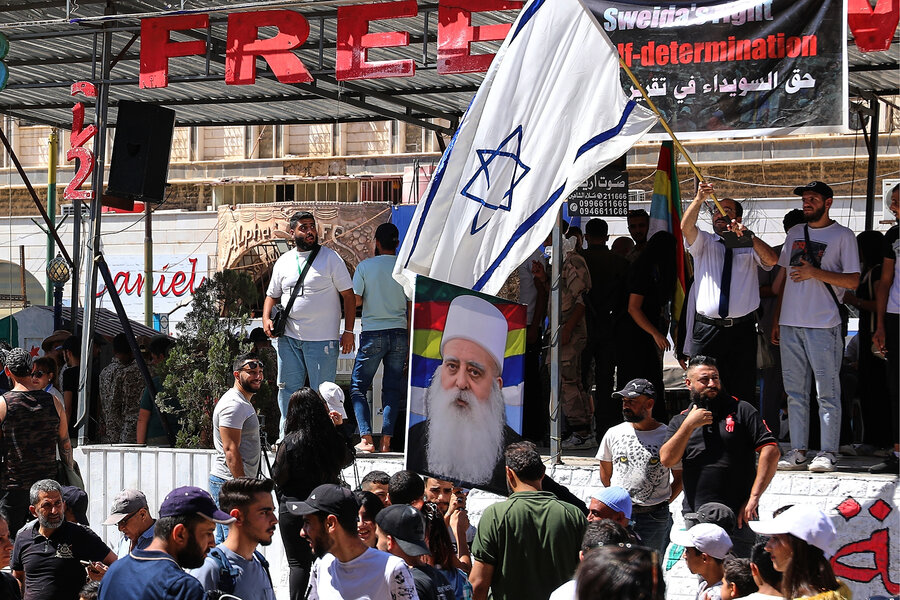
Israel has an even stronger commitment to Syria’s Druze. Israel’s own Druze community is seen as integral and loyal, “blood brothers” who serve alongside Jewish Israelis in the army. Israel’s rescue service recently sent five decommissioned ambulances to Druze villages in southern Syria in solidarity with that community, which is also holding out for autonomous status within the new Syria.
Israel intervened militarily in July to defend Druze militias in the southern Syrian province of Sweida from deadly clashes with Bedouin tribes and government forces.
And though Israel stayed on the sidelines when Mr. al-Sharaa deployed his forces against the Kurds in the north, it should not be expected to do so if the same happens to the Druze, says Ron Ben-Yishai, a columnist for the Yedioth Ahronoth newspaper and a veteran war correspondent.
“The Kurds are our allies, but the alliance with the Kurds is sort of a mutual interest,” he says. “We have the same enemies, so we help each other, but we are not obliged to save them.”
The Druze are a different matter, he says.
Suspicion of al-Sharaa’s intentions
Nevertheless, “reducing hostility and reaching a security agreement could pave the way for further, deeper, and broader cooperation” between Israel and Syria, even if it takes more time to get to such a rapprochement, says Amal Hayek, a researcher at the Institute for National Security Studies (INSS), a Tel Aviv think tank.

A secure northern border with Syria is essential for an Israel still traumatized by the Oct. 7, 2023, Hamas-led attack along its southern border with Gaza.
But Mr. Hayek cautions that a security deal might not be imminent, “given the realities on the ground.” Some in Israel’s leadership and security establishment are struggling with deeply ingrained suspicion of Mr. al-Sharaa’s neighborly intentions, he says, and wonder whether they should back Syria’s minorities instead in a bid to counter the new leader’s growing power.
“Within Israel’s security establishment,” he says, there are those “who prefer Syria remaining divided, with the regime preoccupied by internal strife.”
For his part, Mr. al-Sharaa wants to ensure “relations are conducted between the two states rather than between Israel and armed non-state actors inside Syria,” Mr. Hayek says. “A hostile Israel would mean Syria would probably continue to suffer from internal instability.”
A security arrangement would likely require Israel to abandon the buffer zone in Syria that the army occupied after the fall of President Bashar al-Assad in December 2024.
As a first step toward this security agreement, on Jan. 6, Israel and Syria agreed to set up a communication mechanism under U.S. supervision to coordinate intelligence, security, commercial opportunities, and diplomacy. It is intended to manage disputes and avoid misunderstandings.
The first agreement reached between Israel and Syria’s new leadership will be significant, says Professor Zisser. “It’s the beginning. That’s how we start,” he says.
In addition to seizing the buffer zone after the Assad regime’s fall, Israel destroyed a good portion of Syria’s military inventory to prevent it from falling into rebel hands. Israel also occupies the Golan Heights, territory it captured in the 1967 Middle East war and later annexed.
Erdoğan and Trump
Mr. Ben-Yishai, the Yedioth Ahronoth columnist, notes that Mr. al-Sharaa does not yet have full control of all the players he has recruited to help run Syria. “It is a gathering of jihadist militias, some of them ex-ISIS, most of them ex-Al Qaeda” who continue to see minorities as “infidels.”

Also fueling Israeli skepticism: Mr. al-Shaara’s main supporter is Turkish President Recep Tayyip Erdoğan, a perennial thorn in Israel’s side, who is seeking greater influence in Syria.
Yet U.S. President Donald Trump’s backing of Mr. al-Sharaa leaves Israel, already treading lightly with the White House over the Gaza war ceasefire, with limited room to maneuver in the Syrian arena.
Einav Halabi, an Israeli Druze reporter for Yedioth Ahronoth, says meanwhile that a rapprochement between Israel and Syria could be a “win-win” for all sides, as Israel will make sure to protect the rights of the Druze minority in Syria as part of any deal it strikes with Mr. al-Sharaa.
“We don’t think Israel will abandon the Druze to an unknown fate,” says Ms. Halabi. It is in Israel’s interest, she says, to keep the Druze as a trustworthy ally along its “dangerous and wide northern border.”
In the end, it is the Trump White House that will determine the outcome in Syria, says the INSS’s Mr. Hayek.
“It will be the position of the Trump administration that prevails and forces a political settlement on the parties,” he says. “But I think that all the parties involved want to settle the matter politically, because any nonpolitical solution will lead to violence that will hurt everyone.”
Special correspondent Dina Kraft contributed to this report from Washington.