President Donald Trump floated the prospect of a ‘friendly takeover’ of Cuba on Monday night, injecting fresh geopolitical shockwaves into an already volatile briefing where he also sent mixed signals about the nearing end of the war in Iran.
‘It may be a friendly takeover. It may not be a friendly takeover. It wouldn’t matter. They’re down to as they says “fumes.” They have no energy. They have no money,’ Trump said of the Caribbean nation.
‘They’re in deep trouble on a humanitarian basis. They’re going to make a deal or we’re going to do it – just as easy anyway,’ Trump said during a press conference.
The remark came as as he updated reporters on military developments in Iran.
It marked one of his most direct and provocative comments yet about the communist-run island just 90 miles from Florida.
Trump framed Cuba as the next major focus of American foreign policy once the Iran conflict subsides, describing the island’s leadership as weakened and economically desperate.
He suggested Washington could press for sweeping political change with or without Havana’s full cooperation.
Secretary of State Marco Rubio could soon play a central role, Trump indicated, portraying the Florida Republican as uniquely positioned to influence events.
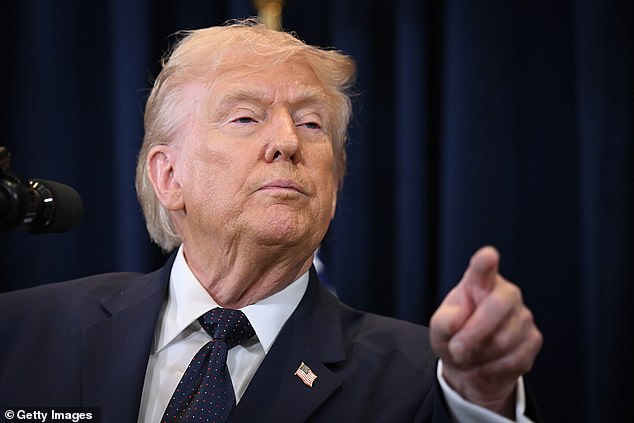
President Donald Trump said the US could pursue a ‘friendly takeover’ of Cuba during a Monday night press conference.
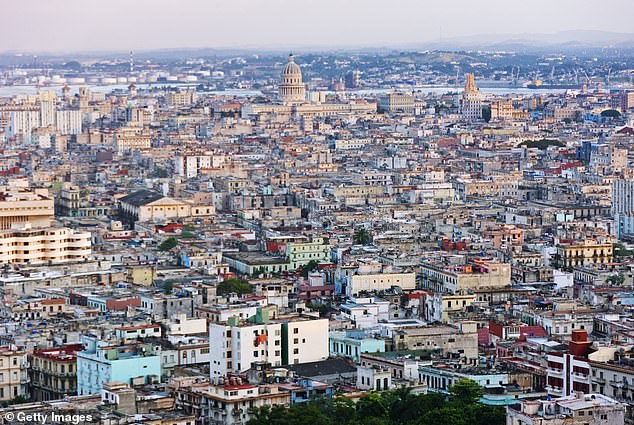
Trump warned that Cuba would ‘make a deal’ with the United States or face American action regardless. Pictured, a view of the Cuban capital, Havana from above
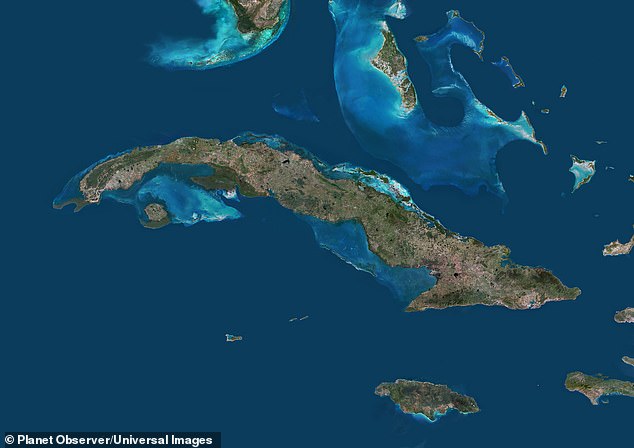
Cuba sits just 90 miles south of Florida at its closest point and can be seen at the top of this satellite image
Trump said Rubio could help guide Cuba away from communist rule and toward what he described as a more pro-US system, adding that Cubans ‘trust’ him and noting that he speaks Spanish, ‘which is always nice and always helpful.’
Trump also tied the issue to domestic politics, saying support from Cuban-American voters also carried weight with him.
‘Those people are very important to me,’ he said, referencing backing he received from the community.
The comments came as Trump also suggested the conflict with Iran was nearing its conclusion, though his timeline appeared fluid.
‘I think the war is very complete, pretty much. They have no navy, no communications, they’ve got no Air Force,’ Trump said.
At the evening press conference, he said the war would end ‘soon,’ though likely not within the coming week.
Cuba’s government has said it is not engaged in any high-level talks with the United States, but it has not directly denied press reports that American officials may be holding informal discussions with Raul Guillermo Rodriguez Castro, the grandson of former Cuban President Raúl Castro.
The island nation has long occupied a fraught place in US foreign policy.
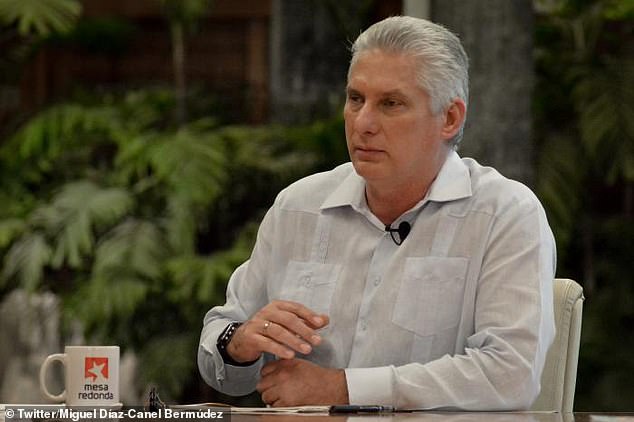
Miguel Díaz-Canel Bermúdez serves as Cuba’s president and first secretary of the Communist Party, succeeding Raúl Castro as the country’s top leader
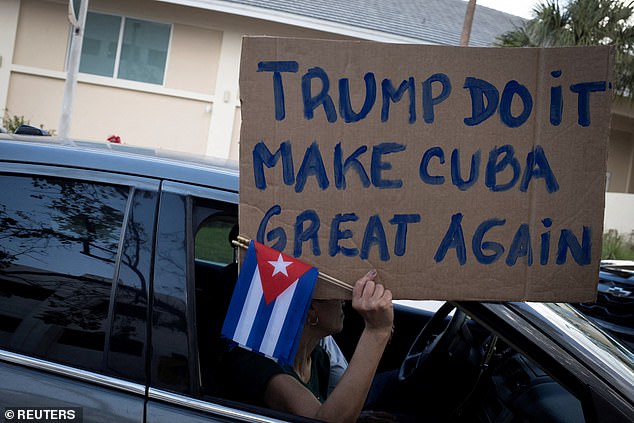
A woman holds a sign and Cuban flags as supporters of Trump participate in a protest against Cuba’s government, in Miami, Florida, last month
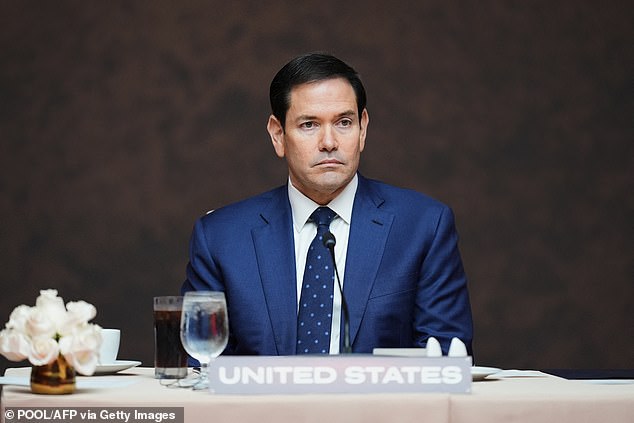
Trump suggested Secretary of State Marco Rubio could help lead US efforts involving Cuba
A decades-old American trade embargo first imposed during the Cold War after Fidel Castro’s communist revolution remains in effect, shaping economic and diplomatic relations to this day.
In recent years, Cuba has endured severe economic strain, large-scale migration and periodic public protests as shortages and financial pressures mounted.
US policy has shifted sharply between administrations. The Biden administration eased some restrictions, while Trump during his earlier term tightened sanctions and re-designated Cuba as a state sponsor of terrorism.
Trump has recently taken a more confrontational tone toward Havana’s leadership.
He has previously raised the possibility of a ‘friendly takeover,’ arguing that Cuba’s government was eager to strike a deal with Washington.
‘They want to make a deal so bad,’ Trump said of Cuba’s leadership earlier this year.
Cuba may no longer dominate national security debates in Washington, but it remains a central issue in South Florida, where political, economic and cultural life is heavily influenced by Cuban-American exiles.
Many exiles, largely concentrated in Miami, have long hoped to see the communist government fall and, in past decades, some plotted against the regime established by Fidel Castro.
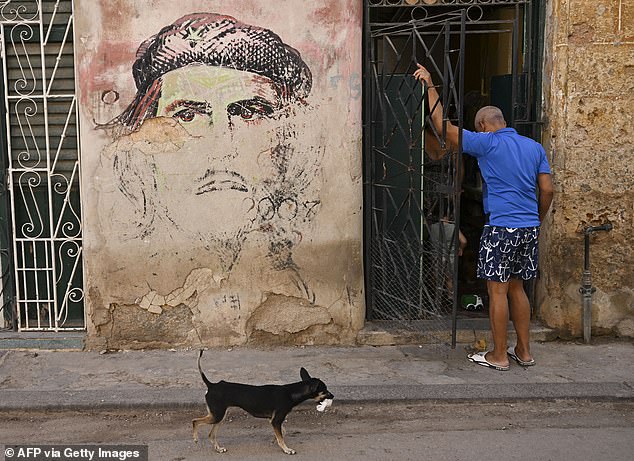
A man enters his home next to a mural depicting Argentine-born revolutionary leader, Ernesto ‘Che’ Guevara, after a power outage in Havana last week
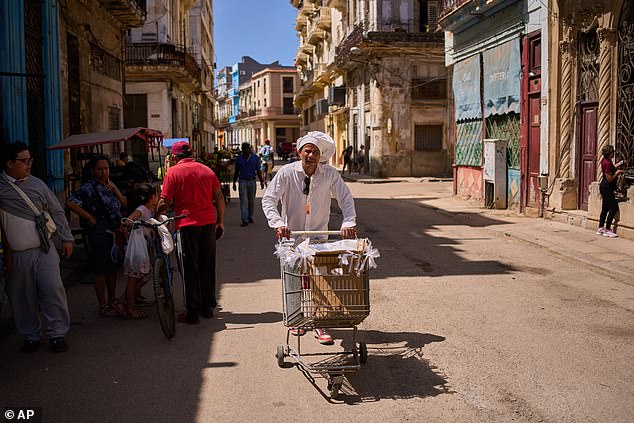
A baker hawks his baked goods through the streets of Havana, Cuba on Thursday
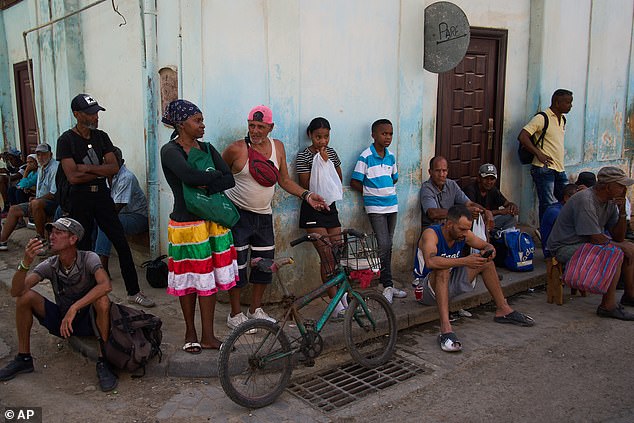
People wait their turn to buy bread during a blackout in Havana. The powercut hit two-thirds of the beleaguered communist nation and stemmed from a lack of fuel under US pressure

Students gather to protest educational disruptions caused by the ongoing energy crisis at the University of Havana. Students denounced the ‘educational blackout,’ citing broken infrastructure, lack of water in dormitories, and the inability to study due to internet and power failures
Federal law enforcement continues to devote significant attention to Cuba-related matters.
The FBI’s Miami field office maintains a dedicated Cuba group and in 2024 helped secure the arrest of former US Ambassador Victor Manuel Rocha on charges alleging he acted for decades as a secret agent for Cuba.
Cuba policy has also resurfaced in Congress. Several Miami-area Republicans, along with Florida Senator Rick Scott, have urged the Trump administration to reopen its criminal investigation into the 1996 shootdown of two civilian planes operated by anti-communist exile groups.
In a February 13 letter to Trump, lawmakers including Reps. Maria Elvira Salazar and Carlos Gimenez cited historical reports indicating that Raúl Castro – then head of Cuba’s military – ordered the attack.
‘We believe unequivocally that Raúl Castro is responsible for this heinous crime,’ the lawmakers wrote. ‘It is time for him to be brought to justice.’
No indictment has been announced, though Florida’s attorney general has said a state-level investigation will proceed.
The Trump administration has also accused Cuba of failing to cooperate with US counterterrorism efforts, citing the country’s harboring of American fugitives and refusal to extradite certain Colombian rebel leaders who had been involved in peace negotiations.
Those concerns underpin its designation of Cuba as a state sponsor of terrorism – a label it shares with a small group of nations including North Korea and Iran.