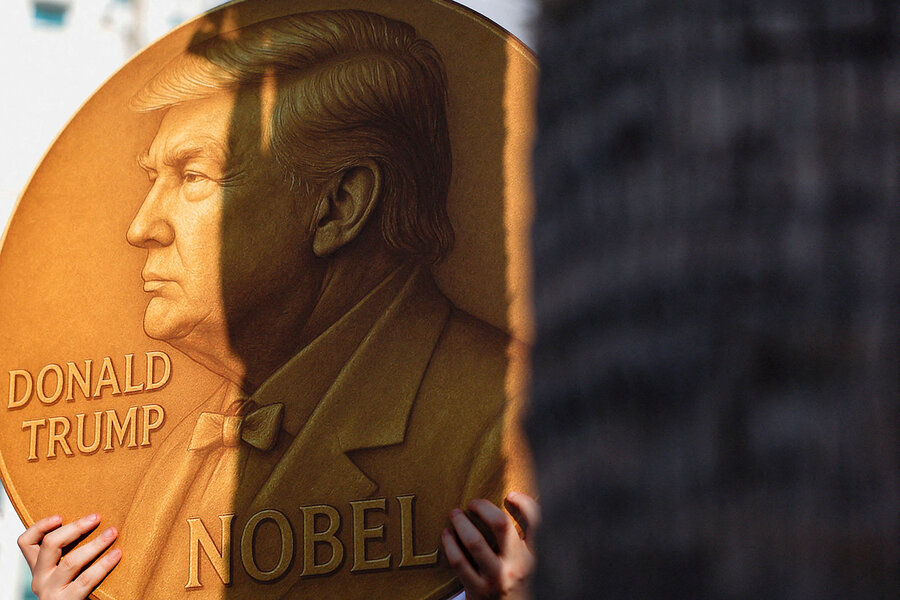
President Donald Trump has reached the mountaintop of global political power – twice – but another quest still looms: the Nobel Peace Prize.
The president has been openly campaigning for the prize, which will be announced this Friday, since his first term. Nominated multiple times by supporters (the official list of nominees, which typically runs in the hundreds, is not released), President Trump recently said it would be “an insult” to the country should he fail to win.
Observers – and indeed, Mr. Trump himself – have mostly discounted his chances of receiving the award. But the news Wednesday evening that Israel and Hamas have agreed to the first phase of an ambitious peace plan, brokered by Mr. Trump, may cast the subject in a new light. Under the deal, Israel and Hamas have agreed to exchange remaining hostages and prisoners, and Israel will pull back its troops.
Why We Wrote This
The president has been openly campaigning for the prize, which will be announced this Friday, since his first term. And while his contention to have ended seven wars in seven months strikes observers as a stretch, recent signs of progress in Ukraine and especially Gaza may give him a legitimate claim.
“BLESSED ARE THE PEACEMAKERS!” Mr. Trump wrote in his announcement.
This is not to say he’s now a lock for this year’s prize – which almost certainly has already been decided. But the idea seems a bit less far-fetched.
Long before this week’s developments, Mr. Trump was lobbying on his own behalf, which may be unprecedented in the prize’s 124-year history. In July, he called Norway’s finance minister and former NATO secretary general, Jens Stoltenberg, to talk tariffs, then threw in a pitch for the peace prize.
“Trump is a transactional president,” says Theo Zenou, a historian and fellow at the Henry Jackson Society, a London-based think tank. “He’s also obsessed with winning this prize.”
The fixation seems driven in part by the fact that his predecessor, former President Barack Obama, won the peace prize just eight months into his first term – undeservedly so, in Mr. Trump’s opinion.
He’s hardly alone in that view. The head of the Nobel committee that awarded President Obama the peace prize in 2009 later wrote in a memoir that the prize was meant to boost the new president’s diplomatic standing in the world, but that it did not have the intended effect. Mr. Obama himself said he didn’t deserve it.

Mr. Trump also has a well-documented love of objects and honors that bear his name. His two turns as Time magazine’s “Person of the Year” (in 2016 and 2024) were points of pride. He’s hung pictures of himself on federal agencies in Washington and at the Kennedy Center. Controversially, his administration is planning to mint $1 coins with his image for the nation’s 250th anniversary next year.
But the Nobel Peace Prize stands apart – an award bestowed on only four other U.S. presidents, and a potential validation of his ability to broker deals and wield power globally.
Allies and interested parties are well aware of Mr. Trump’s desire to win. Multiple foreign governments, including Israel, Pakistan, Cambodia, Rwanda, and Azerbaijan, have voiced support for Mr. Trump’s selection – as have members of Congress and other public figures. The deadline for nominations was Jan. 31, but that’s almost irrelevant. These messages aren’t really for the Norwegian Nobel Committee. They’re aimed at an audience of one: Mr. Trump.
“It’s free flattery,” Dr. Zenou says. Those hoping to curry favor with Mr. Trump recognize that if they give a speech saying “how amazing he is, and how he brought peace to Pakistan or wherever,” they may get more weapons or a better deal on tariffs.
At the United Nations last month, Mr. Trump told fellow leaders that he’s ended seven wars in seven months, a highly contested claim.
“Trump had a hand in ceasefires that have recently eased conflicts between Israel and Iran, India and Pakistan, and Armenia and Azerbaijan,” reports the fact-checking site PolitiFact. “But these were mostly incremental accords without a strong likelihood of long-term peace.”
Still, recent developments may give Mr. Trump more substantial achievements to tout. He has invested considerable effort toward bringing the wars in Ukraine and Gaza to an end – and now the initial stage of a Gaza deal has been announced, with the president saying he may fly to the Middle East this weekend. Israeli Prime Minister Benjamin Netanyahu and families of hostages taken during the Oct. 7, 2023, attack on Israel by Hamas have made direct appeals to the Nobel committee on Mr. Trump’s behalf.

Brett McGurk, a former senior national security official in both the Trump and Biden administrations, argues that progress on both of those conflicts would give Mr. Trump a strong claim to the prize – if not this year, then possibly next year.
“Trump inherited two of the worst conflicts of this new century, the wars in Gaza and Ukraine. On both fronts, the outlines of a settlement are now in view,” Mr. McGurk says in a CNN piece, written before Wednesday’s announcement of a Gaza deal. “It’s less clear whether Trump and his team can deliver peace. But if they do, the Nobel committee can and should recognize the achievement and award Trump its coveted medallion.”
Perhaps that bodes well for a Nobel at some point. For now, however, other factors likely weigh against Mr. Trump. He does not support efforts to mitigate climate change, an issue the Nobel committee reportedly holds dear.
He also rebranded the Department of Defense as the “Department of War,” bombed Iranian nuclear facilities, and attacked alleged Venezuelan drug boats. He’s militarized law enforcement, sending National Guard troops to American cities in the name of fighting crime.
It’s all part of the “warrior ethos” Mr. Trump and Defense Secretary Pete Hegseth laid out in remarks to generals at Marine Corps Base Quantico last week. But it seems a far cry from the stated criteria of the peace prize – which say that it shall go to the person “who shall have done the most or the best work for fraternity between nations, for the abolition or reduction of standing armies and for the holding and promotion of peace congresses.”
Some suggest the open campaigning could also backfire, if it strikes the Nobel committee as distasteful.
“Most winners don’t set out to win the prize, they just set out to solve a problem or do good or relieve international tension or feed people,” says Jeffrey Engel, a presidential historian at Southern Methodist University and a former senior fellow at the Norwegian Nobel Institute. “It has historically been the kind of thing that no one would have ever thought of campaigning for.”
But with Mr. Trump, the saying goes, never say never.