The Trump administration has revealed its latest plans for its sweeping overhaul of the White House grounds.
The blueprint released Friday outlines a new underground security hub for screening visitors to the Washington DC landmark.
The project envisions a massive 33,000 sq ft subterranean center beneath Sherman Park, just southeast of the White House and south of the Treasury.
Construction may kick off as early as August, with the White House determined to have the facility ready by July 2028, six months before Trump leaves office.
‘The permanent facility will strengthen campus security and enhance the overall visitor experience,’ the overview reads.
For years tourists and visitors were screened ahead of entry in a series of temporary trailer structures before gaining access to the East Wing entrance.
But October saw the East Wing flattened as Trump cleared the way for a $400 million private ballroom, a move that sparked fierce controversy.
Today, visitors wait in line by Lafayette Park to get in, just steps across Pennsylvania Avenue from the White House.
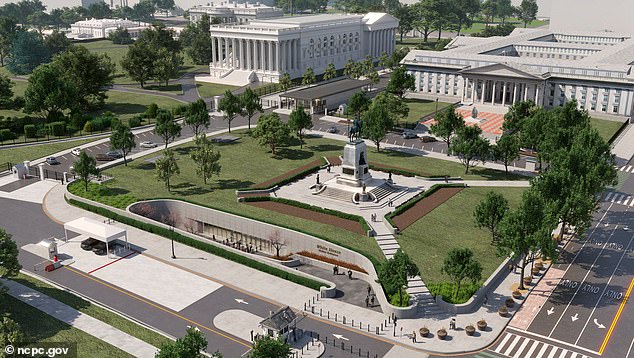
On Friday, the Trump administration revealed plans for an underground security hub to screen visitors (pictured: White House is seen Feb. 24, 2026)

The preliminary agenda is the latest step in the Trump administration’s sweeping overhaul of the White House grounds
Under the new plans, visitors will begin to enter the facility via an exterior ramp leading to a sunken plaza, where tickets and identification will be verified.
The 5,000 sq ft recessed entry will act as a gathering area for visitors, allowing them to queue along the ramp instead of crowding the adjacent 15th Street sidewalk.
Per the White House agenda, the facility will be equipped with the necessary security systems, technology and support space to satisfy US Secret Service (USSS) requirements for handling large crowds of visitors at tours and events.
Once fully in the facility, visitors will go through two security steps: pre-screening and primary screening.
The seven-lane primary screening area is intended to cut down wait times while handling current security procedures and easily adapting to future upgrades.
After passing through security, guests will move through a tunnel lined with displays from the White House tour office and the Executive Office of the President.
From there, visitors will take an elevator up out of the underground facility and exit inside the secure area of the White House complex, where they’ll begin their visit.
A single escalator will return visitors to ground level north of the secure fence along East Executive Avenue.
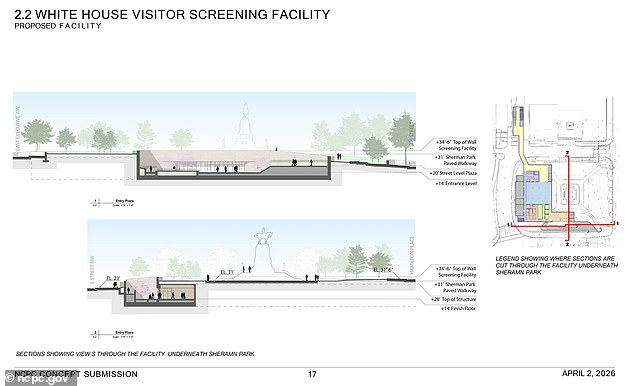
Visitors will begin to enter the facility via an exterior ramp leading to a sunken plaza, where tickets and identification will be verified
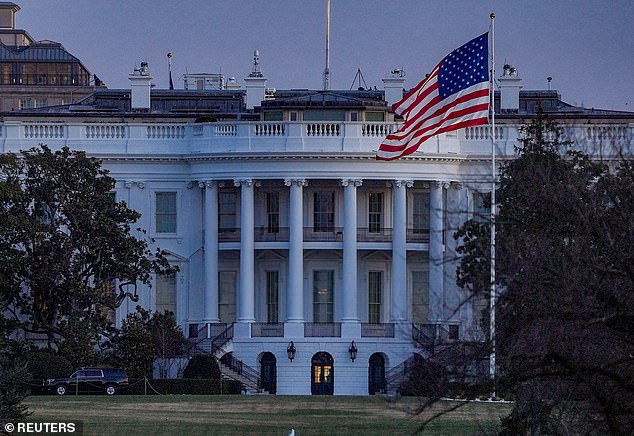
Construction could begin as early as August, with the White House determined to have the facility ready by July 2028
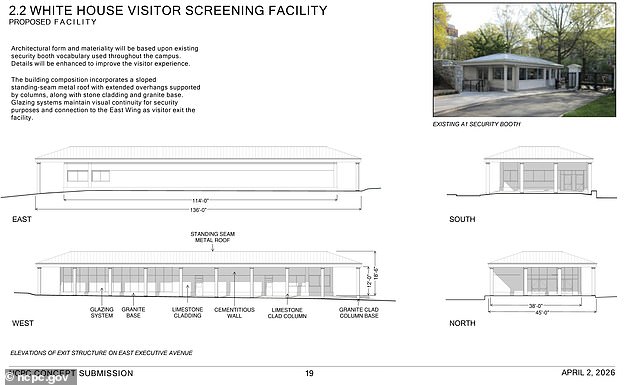
The plan envisions 33,000 sq ft underground center beneath Sherman Park, just southeast of the White House and south of the Treasury
According to the outline, the monument of Union General William Tecumseh Sherman at the heart of Sherman Park will stay put.
‘Landscape restoration, including new tree plantings, will be provided within all impacted zones to reinstate and enhance the park’s character,’ the agenda reads.
Placing the screening center underground will ‘reduce visual impact’ and avoid conflicts with infrastructure in the southeast corner of the park, according to the plans.
Also highlighted in the agenda were environmental considerations, with the site selection ‘carefully considered to ensure new elements blend with the park’s historic fabric and the city’s architectural character.’
‘The project has been designed to minimize cultural, visual, and environmental impacts to the extent practicable,’ the plans read.
‘While approximately six trees would be removed, these would be replaced with suitable native species,’ it added.
The Executive Office of the President, the USSS and the National Park Service – which manages the White House grounds – are all collaborating on the ambitious plans.
The National Capital Planning Commission, responsible for federal construction, is set to review the proposal on April 2.
The agenda also includes discussion and a final vote on Trump’s proposal to erect a 90,000-square-foot building featuring his massive ballroom where the East Wing once stood.
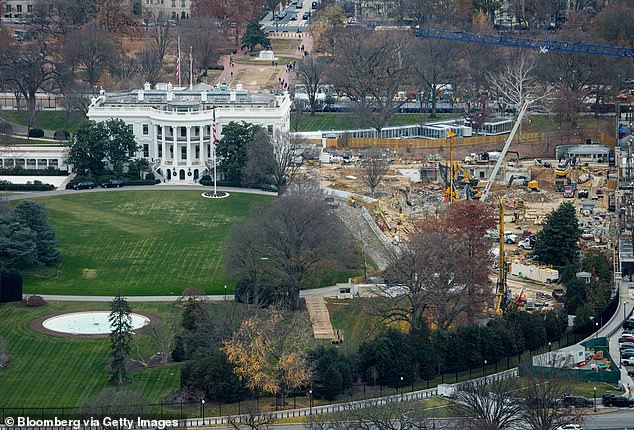
October saw the East Wing demolished as Trump cleared the way for a $250 million private ballroom in his temporary home
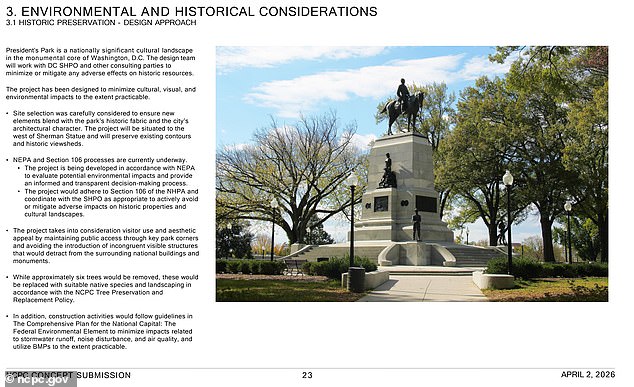
The site selection was ‘carefully considered to ensure new elements blend with the park’s historic fabric and the city’s architectural character’

Last month, Trump installed his 26-year-old executive assistant Chamberlain Harris (pictured) as the latest member of the panel meant to oversee his White House ballroom project
Last month, Trump installed his 26-year-old executive assistant as the latest member of the panel meant to oversee his controversial White House ballroom project.
Chamberlain Harris, deputy director of Oval Office operations, was sworn in to the Commission of Fine Arts, one of two bodies required to approve the plan.
Harris didn’t study art or architecture in college, instead majoring in political science at the University of Albany, SUNY, with minors in communications and economics, according to a Washington Post report on the pick.
Her appointment came after Trump hurriedly named seven members to the commission in January, having fired everyone remaining on the panel the previous October.
The National Trust for Historic Preservation is suing the president, arguing he should have allowed the ballroom project to go through the CFA and the National Capital Planning Commission before demolishing the East Wing.
A ruling is expected soon, with the Washington Post reporting that the federal judge keyed in on private donations being used to fund the estimated $400 million project, as a way to bypass Congressional authorization.
In January, the architect helming the design for Trump’s ballroom project revealed new plans for a West Wing expansion.