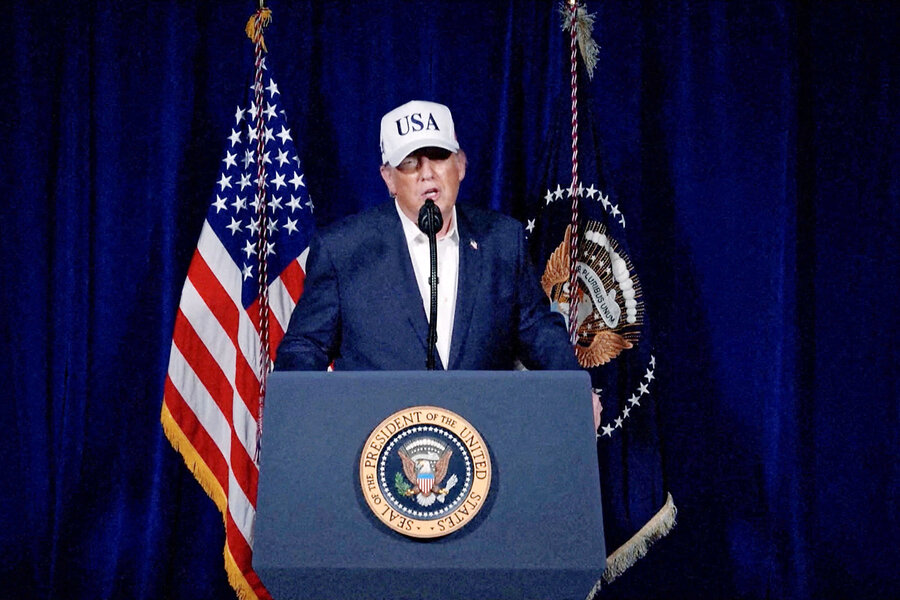
By launching a U.S. military operation against Iran this weekend, President Donald Trump has taken an action with potentially far-reaching consequences – and he has done so without explicit backing from Congress and without public opinion on his side.
The move carries political risks. Nearly half of Congress firmly opposes President Trump’s actions. Recent polling from YouGov and from the University of Maryland show only around one-quarter of Americans support the United States initiating an attack on Iran.
After Mr. Trump announced the strikes Saturday, many members of Congress said they had not been consulted ahead of time. The Constitution gives Congress authority to declare war – a word Mr. Trump has used to refer to the strikes.
Why We Wrote This
Some lawmakers pushed for Congress to have a role in President Trump’s decision on whether to attack Iran. Now that the U.S. military operation is under way without congressional backing, the political risks are coming to the forefront.
House Democrats will gather for a virtual caucus meeting Sunday night to discuss the strikes. The military action is generally supported by Republicans and opposed by Democrats, although there has been some crossover on both sides.
On Saturday morning, the United States and Israel launched joint airstrikes against military and civilian targets in Iran. Mr. Trump called the U.S. military action “massive and ongoing,” and acknowledged American lives may be lost, saying “that often happens in war.” He said the United States’ objective is “eliminating imminent threats” from the regime and preventing it from obtaining nuclear weapons. He urged Iranians to overthrow the regime once the attacks are over.
Katherine Thompson, a senior fellow in defense and foreign policy studies at the libertarian-leaning Cato Institute, says members of Congress could see “retribution” in the November midterm elections if they don’t vote to oppose Mr. Trump’s military action.
“This idea that Congress is sort of left out and that a unilateral executive can take us into war – it’s antithetical to what the founders intended, but more to the point I think the American people are sensitive to this,” she says.
Political risks
Trump ran on a platform that included a pledge to end “the failed policy of nation-building and regime change.” But he has now pursued regime change in both Venezuela and Iran, raising questions of whether he could see backlash from his base.
“We thought the victory won in 2024 would be finally time to put America First,” wrote former Republican Rep. Marjorie Taylor Greene on the social platform X, criticizing the strikes.

Many Republicans have been quick to show public support for Mr. Trump’s actions. Iran’s regime is “a clear and unacceptable threat” to the U.S. and its own citizens, wrote Senate Majority Leader John Thune in a statement on Saturday morning.
As of midday Saturday, two Democratic senators have called the U.S. strikes an illegal war.
“The American people want lower prices, not more war – especially wars that aren’t authorized by Congress,” wrote Democratic Sen. Tim Kaine, who’s co-sponsoring a resolution to block the president from further military action in Iran without congressional sign-off.
Ms. Thompson says the political environment for Republicans in the midterms is “not very good if we continue down this path of more foreign interventions, which is exactly what ‘America first’ promised not to do.”
In a video announcing the strikes, Mr. Trump framed them as necessary to U.S. national security, saying Iran’s “menacing activities directly endanger the United States.” He cited examples of Iranian aggression dating back to the 1979 hostage crisis.
Republican Roger Wicker, chair of the Senate Armed Services Committee, called the strikes “a pivotal and necessary operation to protect Americans and American interests.”

Mr. Trump’s actions could also force Congress to make weighty decisions. Some Republican lawmakers say the risks posed by a conflict with Iran heighten the imperative for Congress to fund the Department of Homeland Security, which is partially shut down, with only essential employees working. Democrats have said they will not fund the department without significant reforms to immigration enforcement.
Congress “on the back foot”
Democrats – and a handful of Republicans – are calling for more transparency on the Iran operation. “We need specific public objectives, legal rationale, and clear justification for the president’s military actions,” wrote Rep. Suzan DelBene, chair of the Democratic Congressional Campaign Committee, in a statement. Democratic Sen. Mark Kelly, a member of the U.S. Senate Select Committee on Intelligence, wrote in a post on X: “What’s the plan for what comes next?”

Republican Rep. Thomas Massie and Democratic Rep. Ro Khanna have co-sponsored a bill in the House to block U.S. hostilities against Iran unless Congress signs off or there is an imminent attack on the U.S. Both say they will try to force a vote next week. Only two House Republicans have publicly supported the bill, which faces tall odds for passage.
The House is scheduled to be in recess until Wednesday.
According to a 1973 law, the president is required to notify Congress within 48 hours of military action and may not deploy armed forces for more than 60 days without congressional permission. Mr. Trump has claimed the law is unconstitutional.
Secretary of State Marco Rubio on Tuesday gave a briefing on Iran to the “Gang of Eight,” a group of congressional leaders authorized to receive sensitive intelligence. Secretary Rubio reportedly called those eight to notify them before the strikes.
Senate Minority Leader Chuck Schumer, a Democrat who was part of the classified briefing, criticized the administration’s approach, saying Americans haven’t received enough details.
“Iran must never be allowed to attain a nuclear weapon but the American people do not want another endless and costly war in the Middle East when there are so many problems at home,” he said in a statement.

The fact that Congress hasn’t debated whether the U.S. should initiate conflict “makes Congress look weak and … like they are truly on the back foot in these really important questions,” says Ms. Thompson.
Congress’ role in military operations has been hotly debated in 21st century conflicts. In 2002, Congress passed an authorization for use of military force to allow President George W. Bush to send armed forces into Iraq. In 2011, many Republican members criticized President Barack Obama’s decision to conduct strikes in Libya without congressional permission. The Obama administration argued those military operations were limited enough that they did not constitute traditional “hostilities.”
On Wednesday, before the strikes took place, Democratic Rep. Gregory Meeks, the ranking member on the House Committee on Foreign Affairs, told the Monitor that when President Bush was considering strikes on Iraq, Congress was given a much more active role.
“All of his administration was accessible to me,” he said, contrasting that with the scant information he says members received from the Trump administration regarding Iran.
Although Congress did hold debates and briefings leading up to the Iraq War, much of those were based on information that later turned out to be inaccurate or misleading.