‘A horrible sight greeted us, with frozen dead bodies,’ recalls mountain rescuer John-Erik Olofsson.
Nearly 50 years later, the now 88-year-old still cannot erase the haunting image of that doomed rescue mission.
In February 1978, he was alerted by fishermen to a terrifying incident up in the Anaris mountains in Jämtland.
Just days earlier, the peaks on Sweden‘s border with Norway had been battered by a freak storm, unleashing hurricane-like winds and temperatures below minus 20.
He knew that anyone caught up in that blizzard stood little chance of survival. But nothing could have prepared him for the horror that he was about to encounter.
On February 23, two groups of cross-country skiers set off from the Lunndörren mountain lodge and into the white mountainous wilderness.
One of the groups was made up of Eva Eriksson, Carina Axelsson, both 17, and Christer Almqvist, Urban Falk, Sven-Gunnar Svahnström and Curt Hermansson, aged between 22 and 37.
All six, from Vaxjo in southern Sweden, were part of a local sobriety group and had embarked on their cross-country skiing trip the night before, excited for their adventure.
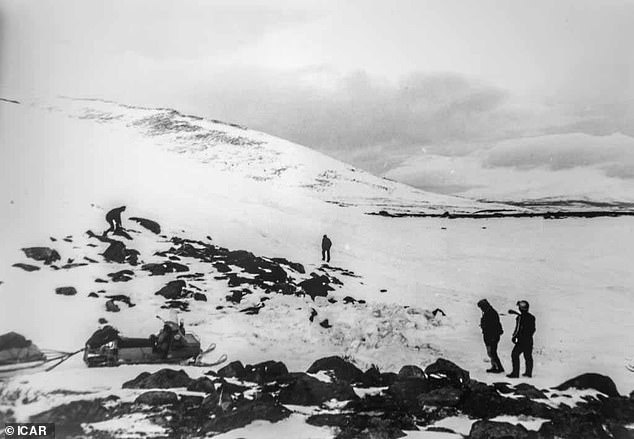
Pictured: The site where rescuers recovered the bodies of a group of cross-country skiers who got stuck in a snow blizzard
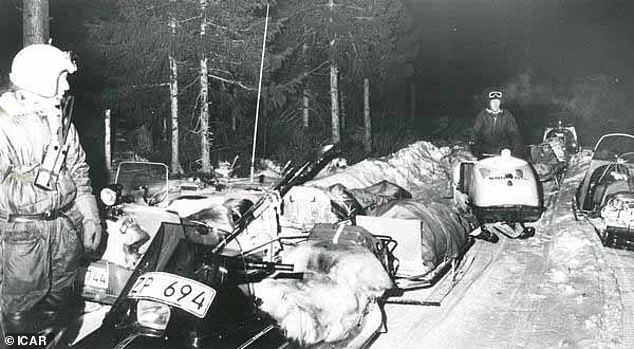
Rescuers transport the bodies down the mountain on sledges pulled by jet skis
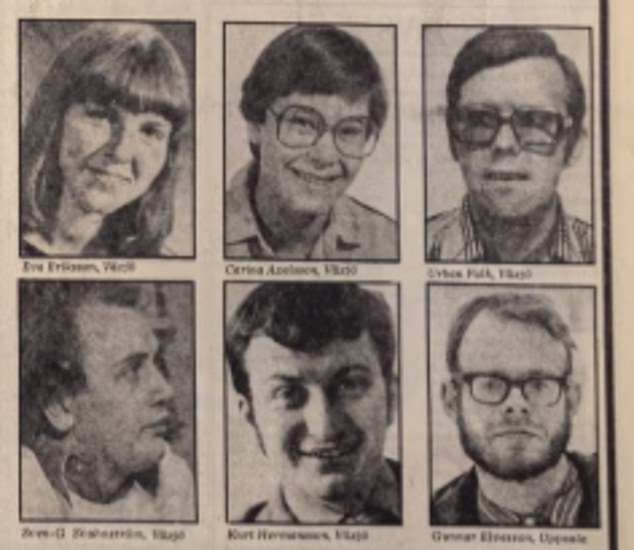
Pictured: Six of the victims of the tragedy in the Anaris mountains in Sweden
At the lodge, they met three men from Lunndörrsstugan. The next morning, the two groups said goodbye and set off into the snow.
But little did they know they would be reunited in the most tragic of circumstances.
At first, everything seemed to be going to plan. It was a clear and bright day with light wind – the perfect conditions for cross-country skiing.
The group from Vaxjo glided along the mountain, stopping for breaks and soaking in the wintery landscape.
But by afternoon, snowdrifts began to form as a violent storm was brewing nearby.
Snow started to swirl as ferocious winds roared at 25 miles per hour, making it difficult for them to stand upright.
Within moments, the skiers were fighting for their lives.
They managed to reach a small hollow, where they tried to set up a windsack for shelter.
But the storm was too fierce, and the visibility too poor, that the group were unable to get into the windsack.
Desperate to find shelter, they dug a snow pit in a ravine and set up a bivouac, huddling together in an attempt to keep each other warm.
As the brutal cold gnawed at their cheeks and ears, frostbite began to set in. Radio calls for help failed, and there was nothing left for them to do other than wait.
Then, the three men from Lunndörren, whom they had met the night before, emerged from the snow.
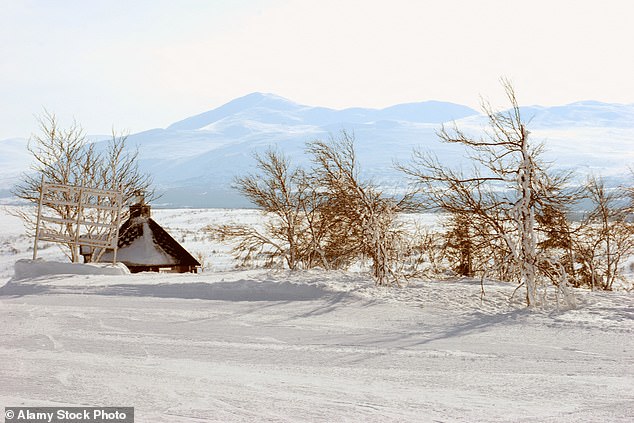
General view of the Anaris mountains in Sweden
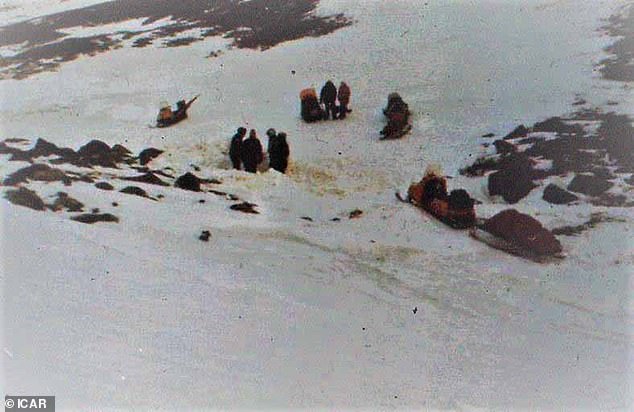
Only one man survived the disaster. Picture shows rescuers at the scene of the incident
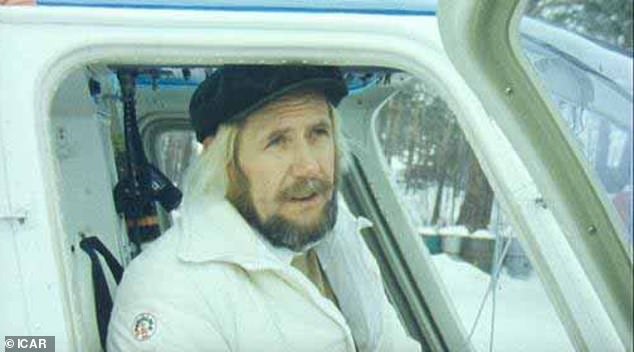
One of the five mountain rescuers is pictured at the site of the tragedy
Seven of them managed to squeeze into a tent, but the other two had to shelter outside in a windsack.
The blizzard raged through the night. Then, the tent’s roof was torn away by the wind.
The storm continued into the next day, and only on the third morning, on February 25, did the winds finally die down.
But by then, most of the group were dead, buried beneath the snow.
Miraculously, 22-year-old Christer Almqvist was still alive.
With bleeding, frozen hands, he clawed through the snow and managed to dig out two people who still showed signs of life.
Somehow, he staggered back to Lunndörrsstugan, where he encountered some fishermen, Kjell-Urban Näs and Lars-Erik Forsbergh, who rushed to help him.
Talking confusedly and pointing with his bloody fingers towards a trail, he tried to tell them he needed help, but before he could finish his sentence, he collapsed into their arms.
Mr Näs recalled: ‘He acted drunk and at first we didn’t know what to believe. Eventually, he started telling stories and pointed out on the map where the others were.’
Snowmobiles and a helicopter were dispatched to the mountains. Rescuers Mr Olofsson and Hans Ottendahl were among the crew who joined the mission, while the fishermen volunteered too.
Once they got to the site, they found a blown-up bivouac. Inside, people sat frozen in various positions.
A little further away, a man was lying face down in the snow.
‘A terrible sight. It looked as if a grenade had hit. The eight were lying in heaps in the pit, more or less buried in the snow,’ fisherman Mr Näs said.
Two people showed signs of life and were immediately airlifted to the hospital, but both were pronounced dead mid-flight.
‘The other six were dead. We didn’t find one of them at first. He was almost buried under the snow that had fallen from the side of the bivouac,’ the fisherman added.
At the site, rescuers also found unused equipment – unpacked backpacks with sleeping bags and thermoses.
Speaking to Swedish newspaper Östersunds-Posten shortly after his rescue, Mr Almqvist described how he and his peers frantically tried to call for help using their emergency radios, but to no avail.
He said the snow blew the tent they tried to set up, and that there was no room for everyone inside.
‘I lay outside until midnight. I couldn’t fit in there. I walked around. In the end, it was almost only me who could move,’ he said.
Once the storm subsided, he said he mustered all his strength to find his way to the closest village to ask for help.
‘I was convinced that two were alive. They were moaning and moving. I was terribly thirsty and hungry, and was going extremely slowly.’
Mountain rescuers had to load the six dead bodies onto sledges to transport them down the mountain.
Mr Oloffson said: ‘We tied them down, stiff as sticks. [We tried] to do it nicely and respectfully, and we put blankets over them.
‘Then I remember we sat down and had a coffee for a while before we went down. I think it was very useful to take a moment to talk through everything. We talked a lot about what had really happened to them in the mountains.
‘The bivouac was destroyed, and the backpacks were all around, completely untouched. It surprised us a lot,’ he said.
Mr Almqvist said he was forced out of the bivouac after the three men they had met in Lunndörrsstugan joined. ‘It became too crowded… It was impossible for nine people to fit.’
The young man stayed outside and took shelter behind a boulder, moving the whole time to keep warm.
He said everyone survived the first night, but on the second day, the skiers began to die, one by one.
As snow covered their weakened bodies, Mr Almqvist said he frantically tried to dig his friends out, in the hope of keeping them alive.
But two of his peers could not take the agony any longer, and went out into the snowdrift and lay down on the icy ground and waited to die. By nightfall, only four of them were alive.
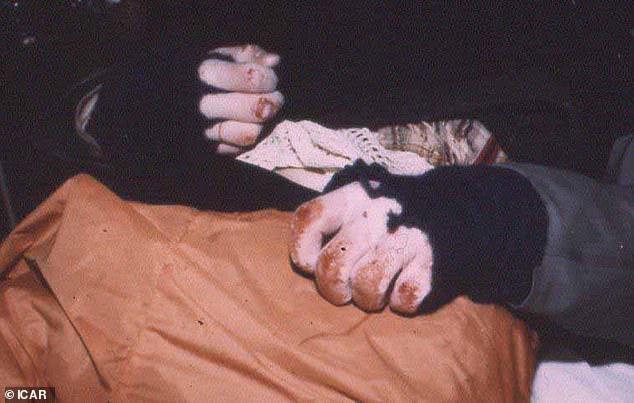
Mr Almqvist’s hands, which suffered from frostbite, ended up having to be amputated
It was not until the following morning that Mr Almqvist was able to find help.
Despite his account, the tragedy has largely remained a mystery, with investigators questioning why the group of cross-country skiers didn’t use their equipment.
Börje Rehnström, a doctor at Östersund Hospital, where Mr Almqvist was treated, believes that the storm ‘simply came as a shock to them’ and the sudden drop in temperatures to which they were exposed prevented them from thinking rationally.
‘Despite the fact that the six-man group was very well equipped and had planned their route carefully, this did not help when the wind threw itself at them,’ a police report said.
Mr Almqvist is believed to have survived because he never stopped moving to keep himself warm.
But his life still greatly suffered after he was eventually forced to have parts of his hands and feet amputated due to frostbite, and was unable to return to his job at a local post office for three years.
Local media reported that his mental well-being also suffered massively after the incident, and he chose to live a quiet life, declining to give any further interviews to the press.
His peers, who died frozen in the snow, are remembered on a mountain in Gröndalen, where there is a silver-grey wooden cross with the engraved words: ‘In memory of the eight who died from the storm and cold on 24 February 1978’.