EU trade policy faces mixed signals from parliament and new agreements.
Just before Trump sparked the crisis over Greenland, European Commission President Ursula von der Leyen signed the historic free trade agreement with Latin American trade bloc Mercosur in Paraguay, after a quarter of a century of negotiations. However, the European Parliament has now thrown a spanner in the works by narrowly supporting a proposal to have the European Court of Justice rule on the agreement. At the same time, the EU just managed to conclude a trade deal with India.
Just when the EU wanted to use the Mercosur agreement to show that it is serious about diversifying trade, it shot itself in the foot with this vote. However, it remains to be seen whether this will actually lead to a delay, because according to the European Commission, at least, it is perfectly legally possible to allow the agreement to enter into force provisionally. The German government is already pushing for provisional implementation. A diplomat told Reuters that the agreement is likely to come into force provisionally “once the first Mercosur country has ratified it.” Apparently, that would be Paraguay, in March. According to the diplomat, the vote in the European Parliament may have ultimately accelerated the entry into force for that reason.
European farmers who oppose the trade agreement certainly have a point in saying that the many burdensome EU agricultural regulations to which they are subject do not apply to their competitors outside the EU. However, the conclusion should not be to forego the major economic benefits — including for many farmers — of the Mercosur agreement. On the contrary, in exchange for the provisional application of the Mercosur trade agreement, farmers should be granted a round of extensive deregulation. This would combine the advantages of greater trade openness with support for the European agricultural sector.
There are also many misconceptions about the impact of the Mercosur agreement on the agricultural sector. Substances that are already banned in the EU, such as colourings or pesticides, are not allowed to be imported via food. European food safety controls are reportedly very strict in this regard, with 15 to 30% of all meat imports into the EU being effectively checked. In addition, import licences are also required. Of the 2.5 million cattle farms in Brazil, only 234 have an import licence in the EU. On top of that, a maximum of 100,000 tonnes of beef may be imported from South America at reduced tariffs, which represents only 1.5% of total EU production. The EU already imports more than 200,000 tonnes.
Yet another crisis
Failure to implement the Mercosur agreement would cause yet another crisis in trade relations between the EU and the rest of the world. Earlier in January, Euractiv’s Eddie Wax pointed out the following: “In the space of a single day, I heard top EU politicians and officials call for sanctions against Russia, China, India, Israel, Iran and the US.”
This really says it all. A much more cordial relationship between the EU and the rest of the world is needed. Yes, the rest of the world deserves blame here, given America’s tariff wars and Russia’s actual wars, but the EU certainly also has been undermining global trade openness. It has mostly done so by abusing trade relationships and trade negotiations to try to impose its policy choices on its trading partners.
The EU’s new corporate sustainability rules, laid down in its corporate sustainability reporting (CSRD) and corporate sustainability due diligence (CS3D) directives are the most obvious example. Following an outcry, certainly from the U.S. — but also EU industry — the EU has been watering those down somewhat, as it has also reduced its reporting duties and other bureaucratic requirements for companies.
Also the new EU deforestation rules have been undermining good trade ties with the rest of the world. This new EU regulation requires exporters of cocoa, coffee, soy, palm oil, beef, and related products to demonstrate that the land used in production has not been subject to deforestation since the end of 2020. It angered Brazil and the United States, but it also badly soured the relationship between the EU and South-East Asian trading partners like Malaysia and Indonesia — economic powerhouses that should be a priority for the EU in its quest for diversifying its trading partners.
Following complaints by European businesses, another postponement of the implementation of this regulation was agreed at the end of last year, this time until the end of December 2026. A review clause, focusing on simplification and to be carried out by April 2026, is foreseen.
Last year, US President Trump managed to secure a partial exemption for American products, but countries like Indonesia and Malaysia, which are great exporters of palm oil, want the same. Malaysia thereby considers it particularly unfair that its imports are classified by the EU as ‘standard risk’, as opposed to the American classification of ‘low risk’, given that Malaysian deforestation has improved significantly, with NGOs acknowledging a reduction of 13% in 2024. Malaysia only lost 0.56% of its remaining primary forest in 2024, according to Global Forest Watch. That is less than Sweden’s 0.87% loss.
The EU as a ‘global regulator’
Sabine Weyand, the European Commission’s Director General for Trade, remarked herself in 2024 that trading partners were increasingly questioning EU’s use of trade policy to act as a “global regulator”, as she stated: “The Global South and the emerging and developing economies, they do not simply want to copy our legislation and they say, who has appointed you world regulator?
Still, a real change of course is not yet visible. The EU is not only watering down green bureaucratic trade barriers, it is also throwing up new green protectionism. At the beginning of January, its controversial “Carbon Border Adjustment Mechanism” (CBAM) went into force. Thereby, tariffs are imposed on trading partners that do not follow the EU’s suicidal climate policy, as well as a lot of bureaucracy, even for European companies
Here as elsewhere the U.S. has managed to secure concessions, which led to a demand by South Africa to also be exempted, given the cost to African economies as a result of CBAM. There is also fierce opposition within the EU. France and Italy want fertiliser to be exempted, which causes fears that the CBAM scheme will be further dismantled, after it was already watered down somewhat last year. At some point, European industry may perhaps start demanding to scrap the original rationale for CBAM, which are the EU’s costly climate policies — starting with the climate taxation scheme ETS which is keeping EU energy prices artificially high.
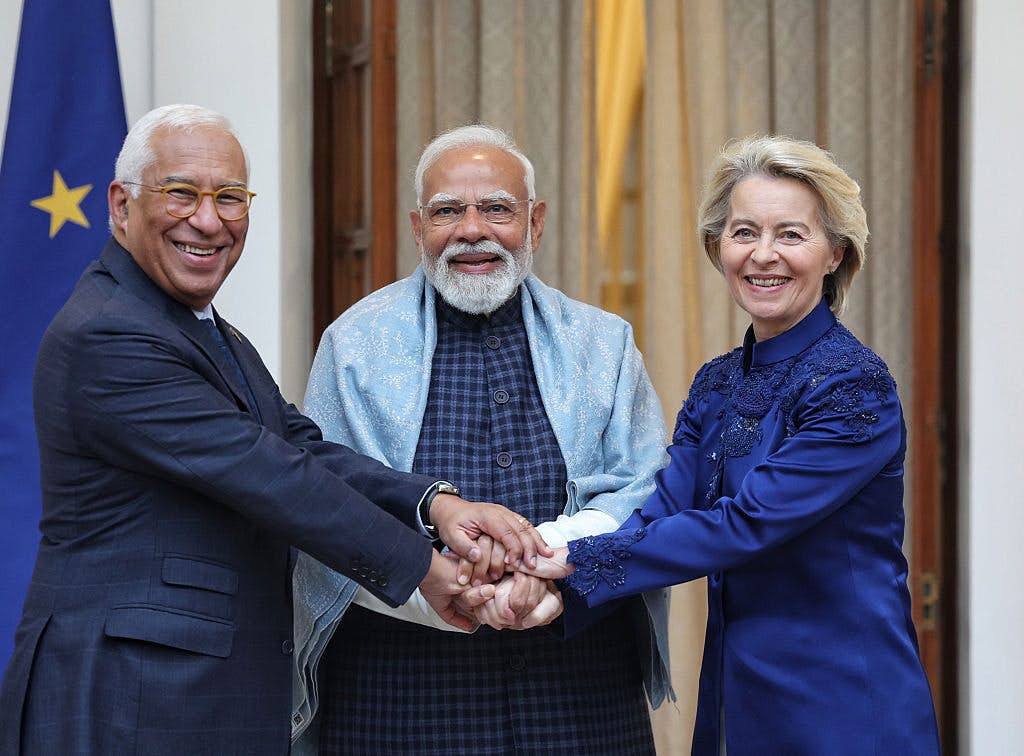
Just this week, the EU managed to conclude a major trade deal with India. This was a key priority for the EU, after securing the Mercosur deal and the trade agreement between the EU and Indonesia. Here too, CBAM served a significant obstacle. India considers this to be outright protectionism. The sensitive migration aspect is likely to trigger some more debate in the EU, as there is an “agreement on mobility,” whereby the “first EU Legal Gateway Office in India” to support Indian talent moving to Europe.”
Then, when it comes to the economic aspect, only the European steel lobby, which has been pushing hard for CBAM, is worried. Perhaps it may now direct its focus to questioning the EU’s climate policies instead.
The new trade deal still needs to be signed and ratified, and major topics were left out — for example most of agriculture. Still, it represents a great success for EU trade policy. Tariffs will be gradually eliminated in for more than 90% of EU goods, which should lead to savings equivalent to about 4.8 billion US Dollars each year. There is a relatively long phase-in of tariff elimination — up to 10 years — but given the size of the Indian market, this is worthwhile. India has agreed to give European automakers a quota more than six times larger than any it has offered before.
The European Parliament’s vote in favour of attempting to delay the Mercosur deal is a worrying sign, but there are some hopeful signals too. The jury is still out as to which side will prevail.