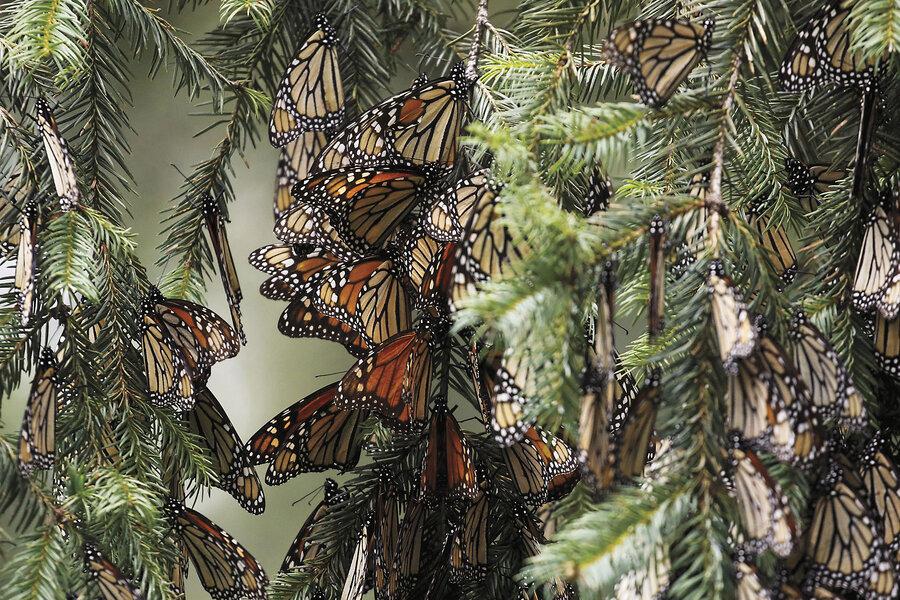
In the hush of a fir-tree forest inside the Sierra Chincua Monarch Butterfly Sanctuary, a cellphone vibrates and an eight-character code appears on the screen.
The alert means that one of the thousands of butterflies weighing down the upper branches of these oyamel firs is outfitted with a solar-powered Bluetooth transmitter the size of a grain of rice. The relatively new technology allows scientists and butterfly fanatics to follow the migration of the monarch in real time across North America.
This particular monarch is a male, tagged No. D80B49C0. It was tracked from Oklahoma earlier this year, before weaving its way down through Texas and flying in a slight “S” shape through northern Mexico to the central state of Michoacán, where monarch butterflies have wintered for millennia.
Why We Wrote This
The beloved monarch butterfly has been at risk for decades. But local activists and experts have been able to help preserve some of the species’ natural habitat, which has boosted the population of monarchs in the short term.
Despite decades of scientific research, many unknowns remain regarding monarch butterfly migration, especially as the insects adapt to a changing climate. Scientists and activists from across the monarch’s migratory path in Canada, the United States, and Mexico understand that protecting habitats – like milkweed and fir trees – is key to the survival of the species. They also know changes in temperature can affect where and when the monarchs start reproducing, which has knock-on effects for an entire generation of butterflies.
“But there are factors we haven’t figured out, and we’re on the verge of answering those questions,” says Orley “Chip” Taylor, professor emeritus at the University of Kansas and director of Monarch Watch, a conservation and research program based there. Dr. Taylor runs a project to track butterflies with simple stickers that launched in 1992. The Bluetooth transmitters were introduced in 2021, as a collaboration between Cellular Tracking Technologies and The Cape May Point Arts and Science Center in New Jersey. This migratory season, the radio tags were placed on more than 400 butterflies.
“Because there are so many people with cellphones out there, as soon as the butterfly is released we can pick up where they are in time and space,” says Dr. Taylor.

The forest is home
On a February afternoon, a band of horses ambles across a hillside not far from where the monarchs are gathered in the verdant Chincua sanctuary. Simon, in his early 20s and wearing a sideways baseball cap and red winter jacket, grew up in this area helping his father lead visitors up the steep forested slopes of the preserve on the family’s horse, Grillo, or Cricket.
“I was taught that protecting the forest protects life,” Simon says, declining to share his last name out of concern for his family’s safety in an area where the presence of organized crime has grown in recent years. He describes the forest as, “the butterfly’s historic home, and also it’s our home.”
The monarch population in North America is unique, because of the millions of butterflies that travel some 2,400 miles over the course of three-to-five generations each year.
“Welcome to monarch country,” a sign in the town of Ocampo, Michoacán, reads en route to Chincua.
In 2022, the International Union for the Conservation of Nature listed monarch butterflies as endangered because of a population decline that kicked off in the early 2000s. In the U.S., the loss of habitat, namely milkweed, played an important role, aggravated by residential development projects and the use of herbicides. In Mexico, shrinking forest cover – due to illegal logging, drought, and infestations of competing insect species – has contributed to population decline.
There is some good news,though.
Recent population boom
Over the past two years, the butterfly population in overwintering sites has shown signs of recovery. It nearly doubled between the 2024 and 2025 seasons, covering roughly 4.4 acres of forest in Michoacán and bordering Mexico state last year. This year, the population in the five sanctuaries that make up Mexico’s Monarch Butterfly Biosphere Reserve grew by 64%, covering 7.24 acres of forest.
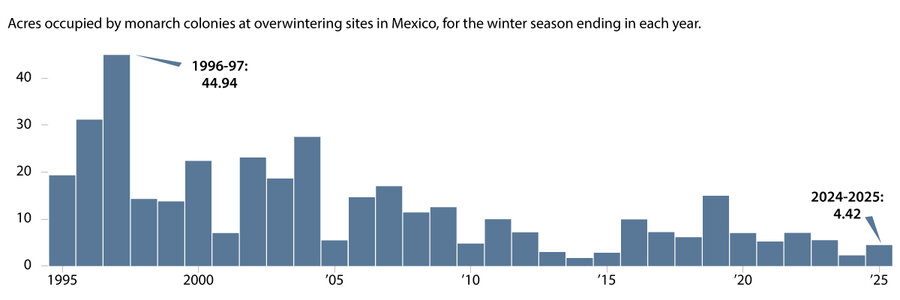
“We believe there’s been a recuperation of monarchs,” says Eligio García Serrano, director of the Fondo de Conservación del Eje Neovolcánico, a Mexican environmental nongovernmental organization. But compared with the 1990s, the improvements are minuscule.Forest cover in Mexico reached more than 44,000 acres back in the mid-90s.
Mr. García says he is still feeling hopeful about community-based efforts. FOCEN, where he works, operates the Monarch Fund, a public-private partnership that uses direct financial incentives to support local conservation efforts inside the Monarch Butterfly Biosphere Reserve.
In recent years, the health of the biosphere forests have improved, Mr. García says. “It reflects the efforts our country has made and, more than anything, the efforts the communities, who are the guardians of the forests, have made” to conserve water and protect the forests.
Between 10% and 20% of Bluetooth-tagged butterflies arrived in Mexico this year, according to Mike Lanzone, CEO of Cellular Tracking Technologies. Mr. García says scientists and volunteers will tag new butterflies before they migrate back to the U.S.
Investigators say they need another two or three years worth of data from the Bluetooth tracking to reach conclusions, but people in the field are already encouraged by what they’re seeing. At least one butterfly was detected flying from Florida, across the Bahamas, and then through Cuba, before arriving in Mexico via the Yucatán. That route is much further south than monarchs are typically thought to travel.
“For years, people have talked about the possibility that monarchs cross the Caribbean toward the Yucatán peninsula” and lay eggs, says Mr. García. “With this technology, we’ll be able to see … a migratory route that’s been such a mystery.”
Back at the sanctuary, guide Vicente Moreno has just finished leading a tour. Groups walk the narrow, dirt path that cuts a one-way, circular route through the dense trees, and Mr. Moreno reminds them to whisper when they get close to where the monarchs have concentrated on the upper branches.
The butterflies were “active” today, he says, flying off the trees in bursts each time the sun peeked out from behind the clouds. Mr. Moreno, who typically works as a guide alongside his brothers at a preserve in Mexico state, says he has heard of the electronic tracking devices, but hasn’t downloaded the application. He supports “anything that means helping” the monarch population, he says.
“If this [migration pattern] ends, we’d lose something incredibly important,” he says. “The end of the monarchs would signal the end of so much that’s important to this world. It would mean a human failure – humans failing nature.”