When Czech tourist Dan Frolec travelled to Croatia more than two decades ago with a group of friends, he was expecting a week of sun, sea and scuba diving in one of Europe’s most idyllic coastal regions.
The plan was to spend breezy afternoons aboard sailing boats, enjoying deep dive excursions in the Adriatic Sea and beachside dinners in the evening.
However, instead, the trip ended in tragedy, with the mysterious deaths of two divers.
Dan was quickly cast into a nightmare, accused of the murder of one of them and held for five weeks while the case was investigated.
Now 55 and living in Bali with his wife and their two children, he’s revisited the trauma of that fateful scuba diving trip in 2002 in a new book, The Cave, which is released online this week.
In it, Dan, who was 31 at the time of the deaths, details how a routine dive led to an international investigation, widespread media attention and a legal ordeal that nearly cost him his freedom.
The eight-strong group had travelled to Croatia in high spirits, with all of the travellers in the party experienced divers to varying degrees.
The underwater excursion that would end in the loss of two lives had been organised by a friend who owned a sailing boat equipped for scuba diving.
Dan says each member of the group was confident in their experience prior to the dive.

Dan Frolec, 55, revisits a fateful scuba diving trip in Croatia in 2002 that ended with the mysterious deaths of two divers – one of them a close friend – and a five-week detention
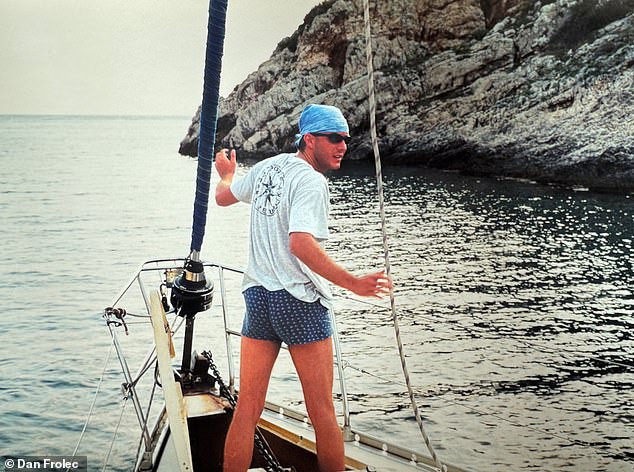
Pictured: Dan, originally from the Czech Republic, aged 31 on the very boat he and his friends explored the Adriatic Sea from in 2002

Dan’s new book, The Cave, details how a routine dive led to two deaths, an international investigation and a legal ordeal that nearly cost him his freedom
He explains: ‘One guy who was a scuba diving instructor and cave diving instructor, another person who was scuba diving instructor… then there was me and my friend who’d done maybe 50–100 dives.’
After spending a number of days along the coast, they anchored overnight in what Dan remembers as a ‘beautiful bay’ – Poganica bay – where they’d enjoyed “afternoon sun and meals by the sea”.
But while studying their charts, they noticed a circled marking on the seabed.
The boat’s owner explained it was believed to be a hole – though no one knew exactly what it was.
Curious, the group agreed to explore it the following afternoon.
The day itself passed with no issues, but everything changed once the group entered the water.
Four divers descended first, exploring near the boat before returning, while another member of the group and Dan’s friend, Miroslav, opted to snorkel near the surface.
Once the group arrived back on the boat, they announced they had discovered an underwater cave, and shortly returned to the sea to further explore.
Intrigued by what lay below, Miroslav announced he would also join the others underwater.
Dan recalls Miroslav saying at the time, ‘I don’t want to die… I will go snorkeling just with you to see what it is’.
He observed the area was close to the boat and shallow, around 10 metres deep – nothing appeared out of the ordinary or dangerous.
What no one realised at the time was that Miroslav narrowly missed the others.
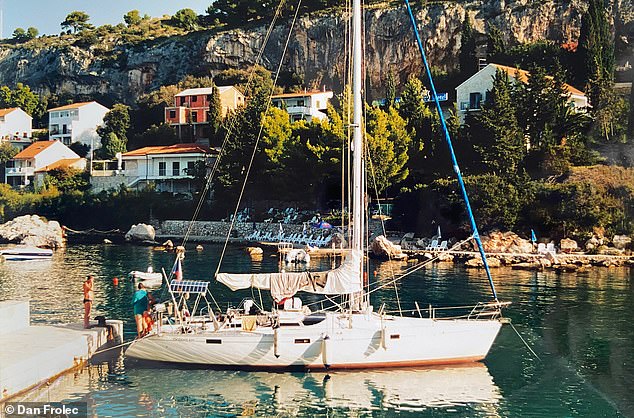
Pictured: The boat Dan and his friends sailed on to get to their diving spot. Here, they enjoyed afternoon meals and lapped up the sun before their trip took a turn
Dive computer data would later show he arrived at the cave entrance just four minutes after the group had exited. Believing they were still inside, he entered alone.
According to Dan, the cave itself was a deception.
From the seabed, it appeared as a dark opening around two metres wide – yet, in reality, it dropped like a chimney from 10 metres to roughly 22 metres, branching into a system of caverns and corridors.
When the four divers resurfaced and spoke about the cave, Dan asked where Miroslav was. They hadn’t seen him.
Around 40 minutes after he went into the water, the group quickly realised Miroslav must have gone in alone.
By that point, time was critical, as his air supply would already have been running low. After widely searching the area, they were unable to find him.
Dan shares what they believe happened next, as he explains how underwater caves often contain fine silt that clings to ceilings and floors.
Visibility isn’t normally an issue – until the cave is disturbed. As Dan describes it, ‘When you exhale bubbles… the sand starts kind of falling… visibility drops to zero’.
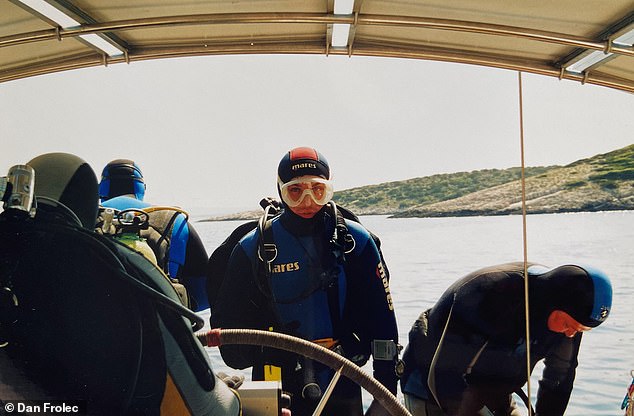
Pictured: Dan and his friends before the dive in Croatia
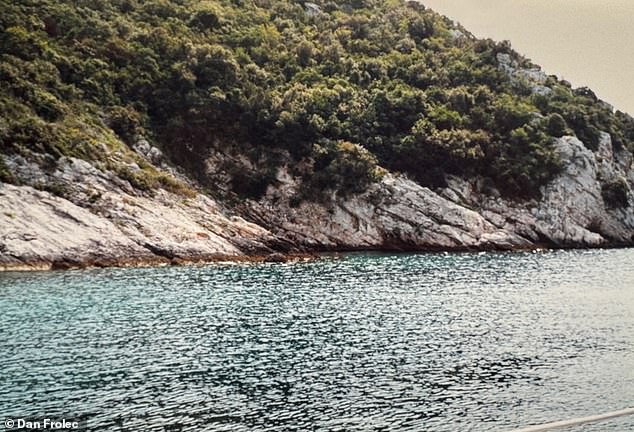
Pictured: Poganica bay, where the accident happened
He believes Miroslav became disoriented, unable to tell whether he was still inside the cave or back in open water.
After an hour of searching, the Croatian Navy was called to assist, but their divers were not trained in cave diving, and searches were delayed until the following morning.
During the rescue operation, one Navy diver became lost but resurfaced, while another died below the surface.
Still unaware of Miroslav’s fate, Dan and the rest of the group were taken in for questioning at the local police station – but what followed was an intense interrogation, with Dan soon becoming the focus.
He was subjected to a polygraph test and repeatedly asked whether he had killed his friend. During questioning, police revealed for the first time that Miroslav had been found with a knife in his chest.
Dan recalls, ‘They attached me to the polygraph… “Do you know how Miroslav died?”… “Do you know it was a murder… that he had knife in the chest?”‘
He believes the tactic was designed to exhaust and bamboozle him into admitting ‘the truth’.
The investigation continued for weeks. Outside of the station’s four walls, scuba diving forums filled with speculation and theories.
However, data from dive computers and smart watches showed Miroslav had reached the cave floor long before Navy divers entered the water, ruling out any foul play or outside involvement.
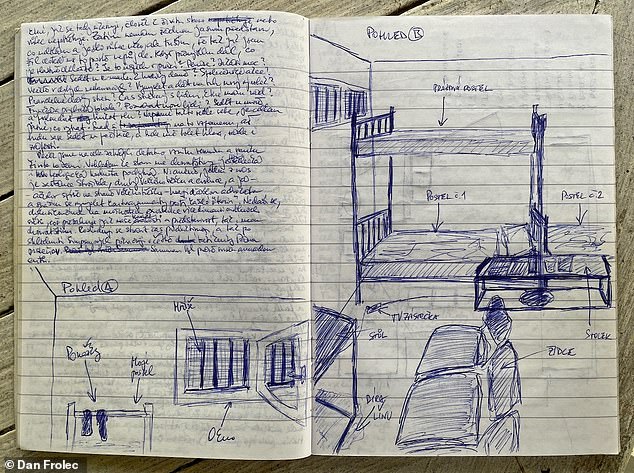
During the investigation, Dan spent five weeks in detention as Croatian police accused him of murdering his friend, who was found dead in the sea with a knife in his chest
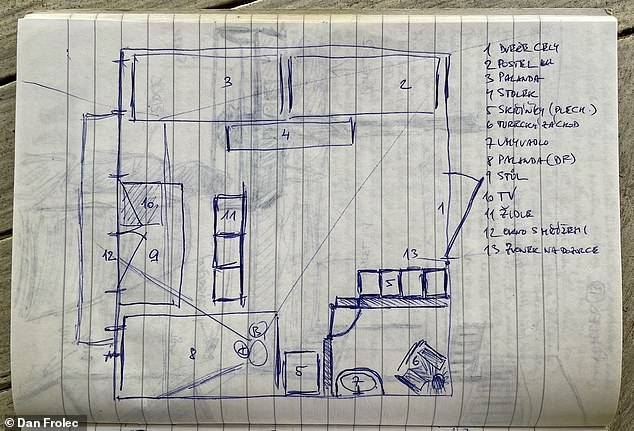
Pictured: Custody cell drawings he spent his time doing while being held
As for what may have truly happened to his friend, Dan believes Miroslav may have taken his own life when he realised he was running out of air.
He explains: ‘There are many people who get lost in the caves and then basically drown.’
In extreme conditions, panic and oxygen deprivation can influence a person’s decision to end their own life.
Dive computer data showed Miroslav swimming beneath the cave ceiling at around 22 metres, likely searching for an exit.
Suddenly, the data recorded a quick descent to 54 metres – the bottom of the cave. Dan believes this marks the moment Miroslav lost consciousness or died.
The autopsy was inconclusive, showing signs of both drowning and a fatal knife wound.
All the while, Dan says authorities focused on the knife, and evidence of drowning was largely ignored.
After five weeks, Dan and his friends were released due to lack of evidence, with an investigating judge dismissing the police’s claims, concluding the death was most likely an accident followed by suicide.
Dan believes the case was driven by a need to assign the blame on someone, to potentially divert attention from internal failures during the Navy rescue that resulted in the death of a senior officer’s son.

Pictured: At the airport after arrival to Prague in 2002
The incident dominated headlines in both Croatia and the Czech Republic, though Dan found himself portrayed very differently across borders, with his home country showing support while Croatia’s media maintained an accusatory stance.
Beyond the legal ordeal, Dan speaks most painfully about loss, as he describes taking a photograph of Miroslav on the boat shortly before the dive, where he ate his last meal and soaked up the rays.
The image was later printed onto a canvas, framed and given to Miroslav’s mother, as Dan recalls: ‘Our life was damaged and impacted… but not like for her’.
It took Dan around a year to adjust after his release, and though the experience has never left him, it stopped feeling actively ‘threatening’ and ‘scary’ after a while.
For Dan, writing The Cave became a way to process what happened and reclaim control of the narrative.
Looking back, Dan still replays one moment in his mind – the instant Miroslav decided to dive alone.
He says: ‘He is going underwater alone… which is against the rules. Many times I thought to tell him: “Hey, but you’re going on your own? Are you sure?”
‘He was quite tough, and he was kind of also experienced… so, maybe he would have gone anyway.’

Pictured: Dan with his then-girlfriend (now wife) as he arrived to Prague in 2002
What he remains proud of is how the group responded once they realised Miroslav was missing, and how his management role at work allowed him to naturally lead in the moment.
He explains: ‘I was leading a multi-national, you know, team in my job. In that moment, I said, “Hey guys, hold on. No panic. We need to now make a plan and try to find him and do everything the best we can.”‘
As for fellow travellers and adventurers who hope to embark on similar trips abroad, Dan stresses the importance of preparation and respecting unfamiliar environments.
He advises: ‘Get local intelligence, in terms of somebody who’s been there – who has been to the mountain, who has been in the cave. Talk to them, then follow their advice. Ask yourself: Am I equipped for that? Do I have enough training?
‘Because those kind of things are super important. Don’t just go and find out.’
Dan’s new book, The Cave, is available to buy now here on Amazon (Paperback is £11.09 and the Kindle version is £0.99).