Skepticism about climate change has resurfaced, as some experts claim the exact causes of global warming remain unclear and that the policies addressing it are motivated more by money than by science.
Richard Lindzen, Professor Emeritus of Meteorology at the Massachusetts Institute of Technology (MIT), has spent decades studying atmospheric science. He told the Daily Mail that the public hysteria surrounding global warming isn’t actually based on realistic data.
Climate change is the term used to describe Earth’s warming, mainly as a result of human activity, such as burning coal, oil and gas.
Scientists and climate activists have warned that this extra warmth could cause more extreme storms, rising seas that flood cities, and hotter summers that make it harder to grow food worldwide – all within the next 25 years.
However, Lindzen said the financial implications of controlling the multi-trillion-dollar energy industry have been the true motivation for politicians to support flawed research that argues small temperature increases will lead to immediate disasters.
‘The fact that you have a multi-trillion dollar industry and you have an opportunity to completely overturn it had a great appeal to a lot of politicians,’ he explained. ‘They go wild on it. Another half degree and we’re doomed, and so on. The public knows this is nonsense.’
Lindzen explained the basic math behind what he called ‘climate alarm.’ He said the emphasis on lowering specific emissions like carbon dioxide (CO₂) simply doesn’t produce the worldwide temperature changes advocates say it will.
The scientist noted that the planet’s temperature has fluctuated significantly throughout recorded history and science still can’t definitively prove what the exact cause of both extreme warming and cooling events has been.
‘We don’t understand the glaciation that occurred in the 15th century. You know, so what was going on then? Inadequate CO₂?’ Lindzen said of the event in the Northern Hemisphere known as the Little Ice Age.

Lindzen claimed that the chief motivating factor for lawmakers supporting climate change initiatives is the control it gives politicians over the energy industry (Stock Image)
According to the International Energy Agency (IAE), the global energy industry is currently worth between $6trillion and $7trillion, with over 80 percent of the energy being consumed worldwide still relying on fossil fuels.
Despite clean energy alternatives making up only a small portion of the industry, IAE noted that governments and private companies invested a record $2.2trillion into solar, wind and electric initiatives this year – double the amount going into fossil fuels.
In the US, policymakers have pushed billions into funding climate change projects, including the Biden Administration setting aside $27billion in a Greenhouse Gas Reduction Fund to finance clean energy projects and climate-related causes.
Lindzen claimed that CO₂ has been painted by lawmakers as one of the biggest climate villains that energy companies produce, but it’s actually a minor greenhouse gas that is beneficial for plant growth.
The researcher contended that the worldwide trend of demonizing certain greenhouse gases gave many scientists a ‘free pass’ to study and support climate change theories, resulting in large financial grants being awarded to their universities.
In recent years, federal agencies in the US have been spending up to $5billion annually on climate research, with the White House’s 2024 budget sending $1.6billion to universities and non-governmental organizations (NGOs) for climate change studies focusing on the imminent natural disasters global warming could cause.
Additionally, Lindzen has repeatedly claimed, including on the Joe Rogan Experience podcast, that scientists who challenged the inconsistent data on climate change have often had their research rejected by academic papers, or the editors that published their findings were later fired.
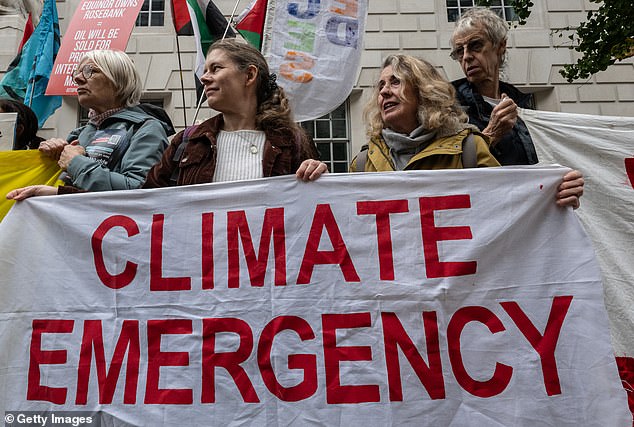
Climate protesters demonstrate outside London’s Department of Energy Security and Net Zero, however, Lindzen said net zero policies will only prevent a tiny amount of warming

Professor Richard Lindzen (Pictured) spent decades studying atmospheric science and said the math supporting extreme climate change warnings doesn’t add up
‘I think it’s hopeful that people are beginning to at least question this. It’s an anomaly, historically, and it’ll be an embarrassment to our era,’ Lindzen said of climate change’s legacy.
Judith Curry, former chair of Earth and Atmospheric Sciences at Georgia Tech, was another scientist who claimed that studies finding flaws in climate change models were ‘filtered’ and rejected by academic papers.
In 2011, she alleged to the Daily Mail that one of her own study co-authors had cherry-picked results to emphasize a tiny rise in global temperatures decades ago, while hiding data that warming had stopped for at least 13 years starting in the late 1990s.
Published studies have warned that if governments worldwide fail to keep global average temperatures from rising by 2.7°F above pre-industrial levels by 2050, it could trigger unstoppable melting of ice sheets, crop failures and deadly heat waves.
Despite the fear, Lindzen calculated that doubling CO₂ in the air would only raise the world’s temperature by about half a degree on its own.
However, many of the studies predicting a climate apocalypse also assume that every bit of warming automatically adds more water vapor to the atmosphere, which is a much stronger heat-trapper than CO₂.
Lindzen called this assumption wrong, noting that nature typically fights major planetary climate swings, instead of making them worse.
His theory, called the Iris effect, suggests that when the tropics get too warm, powerful thunderstorms punch holes in the clouds, opening an ‘iris’ that lets extra heat escape into space.
This directly counters water vapor’s heat-trapping power by reducing the blanket of moisture-rich clouds that would otherwise trap more warmth.
Lindzen added that even if every country hit international agreements for ‘net zero’ emissions by 2050, meaning no more CO₂ from fuel, it would only prevent a tiny fraction of a degree of warming.
The global financial cost of complying with strict environmental regulations, however, could run into the hundreds of trillions of dollars, Lindzen warned, calling it a terrible trade-off for almost no gain.
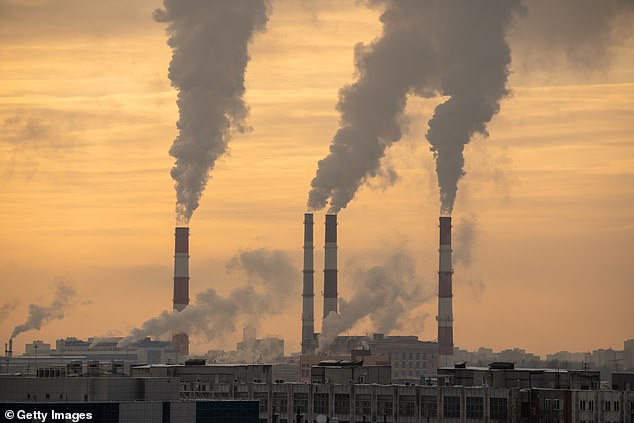
Climate advocates have targeted carbon emissions as a leading cause of global warming, but Lindzen said carbon dioxide actually helps plant life (Stock Image)
Meanwhile, today’s CO₂ levels help plants grow and need less water, making more food possible for billions of people.
‘I think we’re low in CO₂. In the geological sense, it’s much too low. Even the increase in CO₂ we’ve seen so far has probably increased arable land by 30 to 40 percent,’ Lindzen argued.
‘We are not causing the imminent crisis that we think that we are,’ he claimed.
Other experts, including Bill Gates and environmental think tank leaders, have also questioned some climate alarm assumptions.
Despite having reportedly spent roughly $2billion on climate change initiatives over the last decade, the Microsoft founder has reversed course and said world leaders should focus on other global threats, such as nuclear war.
Another former climate activist, Ted Nordhaus, also spoke out against what he called the shifting bar for climate alarmism.
The writer and co-founder of the Breakthrough Institute, a nonprofit environmental think tank, revealed that old models predicting global warming disasters this century were often based on the planet warming by roughly 9°F by 2100.
When those estimates no longer seemed realistic, largely because of countries adopting cleaner energy policies over time, climate scientists began to warn that only 5°F of warming would cause the same catastrophes.
‘The amount of warming that is conceivable even in plausible worst-case scenarios, is not remotely consistent with the sorts of catastrophic outcomes that I once believed in,’ Nordhaus wrote in The Free Press in October.