There’s nothing worse than a blocked toilet – and it seems even astronauts can’t escape Earthly plumbing issues.
Within hours of the Artemis II launch, the toilet on board the Orion spacecraft appeared to malfunction.
According to flight controllers, sensors in the waste management system displayed readings they did not expect.
Astronaut Christina Koch reported issues with the toilet seconds after starting it up.
‘The toilet shut down on its own, and I have a blinking amber fault light,’ she told Mission Control.
The titanium toilet, which uses air suction to remove waste, is located in the ‘floor’ of the capsule, with a door and curtain for privacy.
The system collects urine and solid waste separately – urine is vented into space and ‘number twos’ are stowed for the return trip.
The astronauts were advised to use a handheld bag–and–funnel system called a Collapsible Contingency Urinal (CCU) while flight controllers pondered how to deal with the lunar loo.
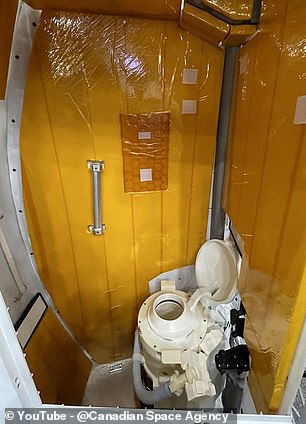
Within hours of launch, astronauts on-board Artemis II noticed issues with their toilet. Pictured (right): A training mockup of the toilet used to practice on Earth
Luckily, several hours after troubleshooting the issue, the toilet was fixed.
‘Happy to report that toilet is go for use,’ Mission Control said. ‘We do recommend letting the system get to operating speed before donating fluid.’
The loo is an upgraded version of an experimental toilet that launched to the International Space Station in 2020.
Compared to the toilet on the ISS, Orion’s lavatory has been modified to be more practical for female astronauts.
NASA also found enough space on Orion to fit the toilet in its own tiny room.
On Apollo, astronauts had to simply float in a corner while doing their business, but Artemis II’s crew have the luxury of a tiny cabin in the ‘floor’ of the capsule.
Artemis II astronaut Jeremy Hansen previously described this as ‘the one place we can go during the mission where we can actually feel like we’re alone for a moment.’
Another new feature is the automatic start of air flow when the toilet lid is lifted, which also helps with odour control.
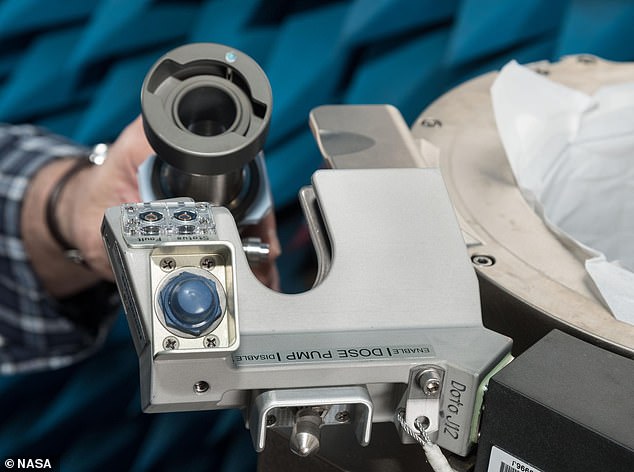
The crew will use a similar toilet to the one found on the ISS, known as the Universal Waste Management System (pictured), that uses ‘air flow to pull fluid and solid waste away’
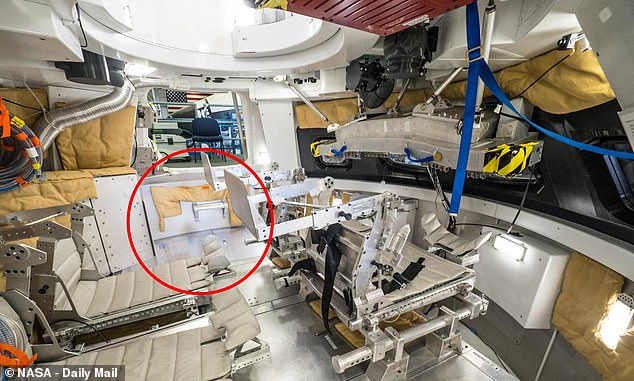
In the biggest upgrade over Apollo, Orion features a separate toilet compartment hidden behind a panel in the floor (circled in red)
It also includes foot restraints and handholds for astronauts to keep themselves from floating away, as consistent astronaut feedback indicated that traditional thigh straps were a hassle.
Toilet paper, wipes and gloves are disposed of in water–tight bags, while solid waste in individual water–tight bags is compacted in a removable storage canister.
While some are returned to Earth for evaluation, most are loaded into a cargo ship that burns up on re–entry through Earth’s atmosphere.
The hygiene bay the toilet is location in also offers the crew a place to wash in relative privacy using liquid soap, flannels, and rinseless shampoo to remain clean.
Despite a few minor hiccups the mission – humanity’s first lunar voyage in more than half a century – is on track after successfully launching late last night.
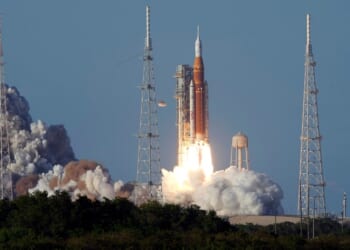
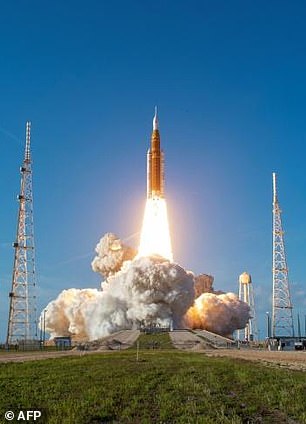
With a thunderous roar that reverberated far beyond the launchpad, the enormous orange and white rocket carried three Americans and one Canadian away from Florida’s Kennedy Space Center at approximately 6:35 pm local time (11:35pm UK time).
The team, who donned bright orange suits with blue trim as the mission began, includes Americans Reid Wiseman, Victor Glover and Christina Koch along with Canadian Jeremy Hansen.
‘We have a beautiful moonrise,’ Mr Wiseman, the mission commander, said as they soared into the air. ‘We’re headed right at it.’
The astronauts are currently orbiting Earth, performing various checks to ensure the reliability and safety of a spacecraft that has never carried humans before. Later tonight, they will fire Orion’s main engine and catapult towards the moon.
On flight day six, Orion will reach its farthermost point from Earth as it sails 4,000 miles (6,400 km) beyond the moon.
That will surpass Apollo 13´s distance record, which would make Artemis astronauts the most remote travellers.
The crew have already successfully completed ‘proximity operations’ demonstrations, which tested how their Orion capsule can move relative to another spacecraft.
This included various manoeuvres that mimic what would be needed to dock with a lunar lander.
Following a momentary communication dropout after the rocket took off, NASA head Jared Isaacman said the issue had been resolved. The astronauts were ‘safe, they’re secure and they’re in great spirits’ he said.
Mr Isaacman also emphasized the historic nature of yesterday’s launch, adding: ‘NASA is back in the business of sending people to the moon.’
The voyage should last approximately 10 days in total and aims to pave the way for a moon landing in 2028.