A mountain headquarters might seem a curious choice for a marine biologist. But to Sara Almabruk, it’s the ideal base from which to work on saving one of the most endangered species in the Mediterranean: the angel shark.
Wearing a sky-blue bracelet painted with images of sharks, Ms. Almabruk enthusiastically shows off the new home of the Marine Biology in Libya Society, where the walls are decorated with fish models and handmade fishing nets. Ms. Almabruk is the general director of the group, which also includes a team of bright young researchers.
“This is where we’ll have the training halls,” she says, smiling as she gestures. “Here’s the office overlooking the balcony so the youth can relax. And here’s the lab – it still needs organizing, but you can see it’s taking shape.”
Why We Wrote This
Mediterranean angel sharks are critically endangered. This biologist’s plan to protect them involves dialogue with fishers, not condemnation.
From this new headquarters, to which the group moved this summer, Ms. Almabruk is strategizing how to ensure the survival of Mediterranean angel sharks. She describes the bottom-dwelling sharks as “custodians of the seafloor” whose robust presence can indicate a healthy ecosystem. But they are endangered in Libyan waters because of overfishing, bycatch, habitat loss, weak enforcement of environmental laws, and the species’ low reproduction rate of only six to seven young in a lifetime.
Through information reported by divers and commercial fishers on social media and collected from coastal field visits, Ms. Almabruk and her team monitor data on the species and raise awareness among fishers that their trawling nets could inadvertently drag up large numbers of sharks. The team’s project focuses on building trust with fishing communities through dialogue and education rather than condemnation.
“When angel sharks disappear, it often signals deeper ecological stress,” Ms. Almabruk says. “Protecting angel sharks means protecting the foundation of coastal livelihoods and ecological integrity.”

Abdelghani Al-Kalloush/EGAB
An unlikely interest
The sea was never part of Ms. Almabruk’s childhood in the rugged Shahat region of northeastern Libya, and she didn’t plan to become a marine biology researcher. In 2003, she enrolled in medical school but left three years later and joined the zoology program at Omar Al-Mukhtar University in Al-Bayda. By 2014, she had completed her master’s degree in fish biology.
It wasn’t until 2018 that sharks captured Ms. Almabruk’s research interest. A diver reached out to her inquiring about the identity of a group of sharks he had photographed. The image prompted her to contact a friend in Greece, who identified the three fish as Mediterranean angel sharks and expressed amazement that they were sighted in Libyan waters.
“This is where my learning journey about this creature began – its environment, behaviors, and classification on the Red List of endangered species,” says Ms. Almabruk, referring to an inventory maintained by the International Union for Conservation of Nature.
She discovered that three types of the shark exist in Libya. Fishers refer to them as shakatli, spotted shakatli, and thorny shakatli. They are also called safin in some areas.

Though she lacked financial support or an established formal partnership with other researchers, Ms. Almabruk took her first steps documenting the presence of angel sharks in Libya. “I used social media to connect with fishermen, asking them to share photos and experiences with the species when they encountered it in their nets,” she explains.
In 2019, Ms. Almabruk attended a regional workshop on angel sharks in Tunisia, where she met members of the Angel Shark Conservation Network. A year later, she helped start the Marine Biology in Libya Society. This enabled her to secure initial funding from the Save Our Seas Foundation, a prominent nonprofit, to conduct what she says was Libya’s first comprehensive research project on angel sharks.
Assembling a team of six researchers and marine field enthusiasts, Ms. Almabruk then formed partnerships with organizations throughout Libya to study the shark’s populations. Facebook groups became treasure troves of information as divers and fishers posted images and footage of fish they encountered.
Ms. Almabruk’s team then expanded its data collection to the ports of Benghazi, Tripoli, and Misrata. She says that the data has shown notable concentrations of the species specifically in the Gulf of Sidra. “This finding completely contradicted the prevailing belief before 2020 that this species was nearly extinct in the Mediterranean,” she adds proudly.

After five years of persistent work, Ms. Almabruk and her team identified the gulf as a vital breeding ground for angel sharks and documented more than 50 individuals between 2020 and 2021. A national database has been created to track the sharks.
The project also has taught fishers how to recognize the species and how to release the sharks caught in their nets.
Community engagement
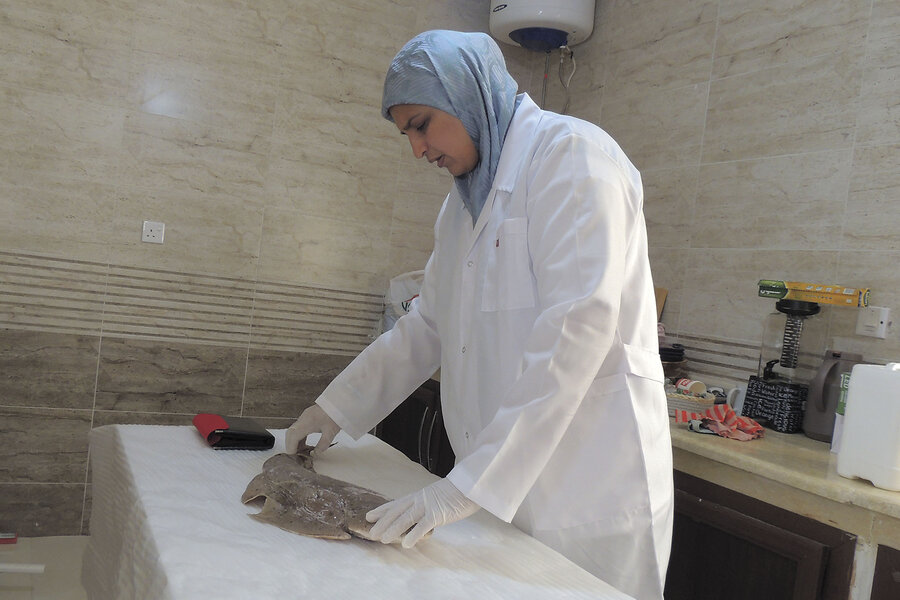
At her Al-Bayda headquarters in the Green Mountains, about 20 kilometers (12 miles) from the Mediterranean coast, Ms. Almabruk places an angel shark specimen on a table and begins examining it carefully, describing its parts with obvious affection, turning it gently, and then lifting it up with a broad smile. She knows every detail of the specimen by heart. With flattened bodies and winglike fins, angel sharks resemble rays but are truly sharks – ambush predators that lie buried in sandy seabeds, waiting to surprise their prey.
Local fishers have embraced Ms. Almabruk’s conservation message. Ali Qanabi, a fisherman from Misrata, says that angel sharks have reappeared after years of absence and that local fishers have stopped selling them because of awareness campaigns led by Ms. Almabruk and her team. “Fishermen no longer deliberately target the species, and it’s lost its commercial value due to reduced market demand,” he says.
Fawzi Dahan, from the nonprofit Bado Environmental Association for Marine and Wildlife Protection, notes an active partnership that developed with Ms. Almabruk’s team after a seminar. “We’ve made strides in raising awareness, like fishermen throwing back sharks they caught,” he says. “But amateur fishermen continue to use destructive fishing tools.”
Ms. Almabruk retains hope, despite the challenges.
“We achieved a lot with only social media,” she says. “I’m confident we’ll protect those angel sharks.”
This article was produced in collaboration with Egab, a media startup.