Every quarter, the Home Office releases immigration statistics, covering the number of visas issued, people claiming asylum, numbers granted settlement or citizenship and more. The latest release covers the year ending December 2025 and can be viewed here.
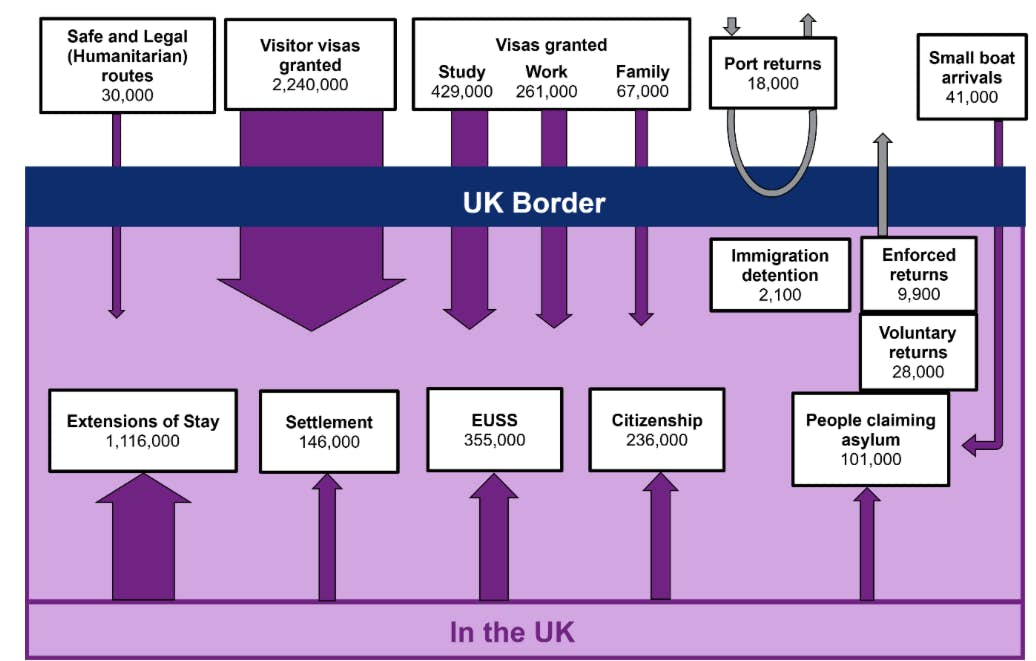
The Home Office provides a useful infographic on the summary page that gives a nice overview of the statistics for all the major headline points.
I won’t cover all the data tables, as I could exhaust your time. Instead, I want to focus on the figures that will have the most impact long-term and are the most salient — these being citizenship, settlement and asylum statistics.
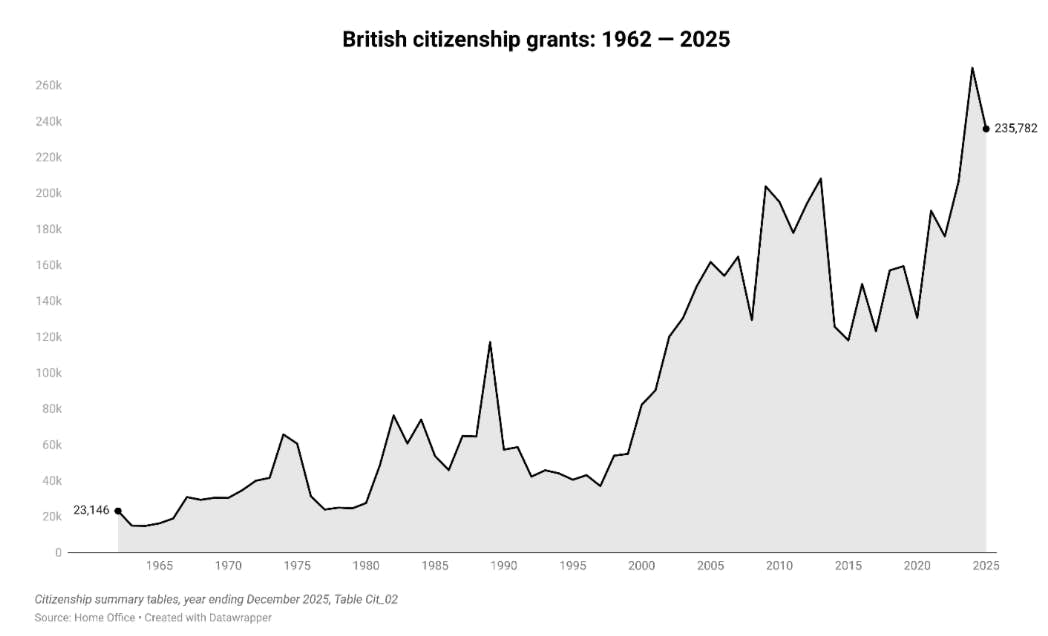
235,782 British citizenship grants were issued by the Home Office in 2025, with 78 per cent of these grants (182,778) going to non-EU nationals, with the top three nationalities being India, Pakistan and Nigeria. You might assume the spike in grants post-2020 are EU nationals acquiring British citizenship post-Brexit, however this is not the case, most grants have gone to non-EU nationals.
British citizenship grants are down from their peak in 2024, where 269,806 British citizenship grants were issued, the highest since records began. Britain has issued more citizenship grants in the last three years (2023-2025) than Japan has issued since 1967.
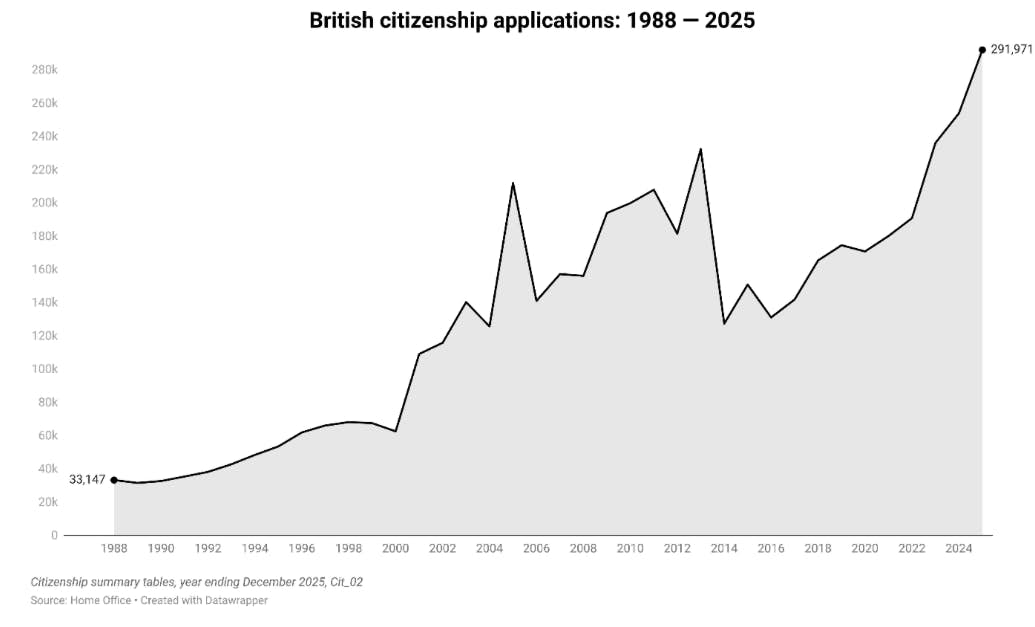
Applications for British citizenship have been rising since 2020. There were 291,971 applications for British citizenship in 2025, the highest on record. For some comparison, there were 170,692 applications for British citizenship in 2020.
This is not the Boriswave acquiring citizenship, as they won’t have yet met the residency requirements, and pending Labour’s implementation of the Earned Settlement proposals, the bulk of the Boriswave will be prevented from acquiring Indefinite Leave to Remain and subsequently British citizenship until sometime in the 2030s.
I suspect one of the reasons British citizenship applications are up in 2025 is a response to Reform UK’s announcement that they would abolish Indefinite Leave to Remain (ILR) if they win the next general election.
Below, I have plotted British citizenship applications by quarter, from Q1 2020 to Q4 2025. In Q3 2025, there were 62,928 applications, increasing to 90,555 applications in Q4 2025, an increase of 44 per cent.
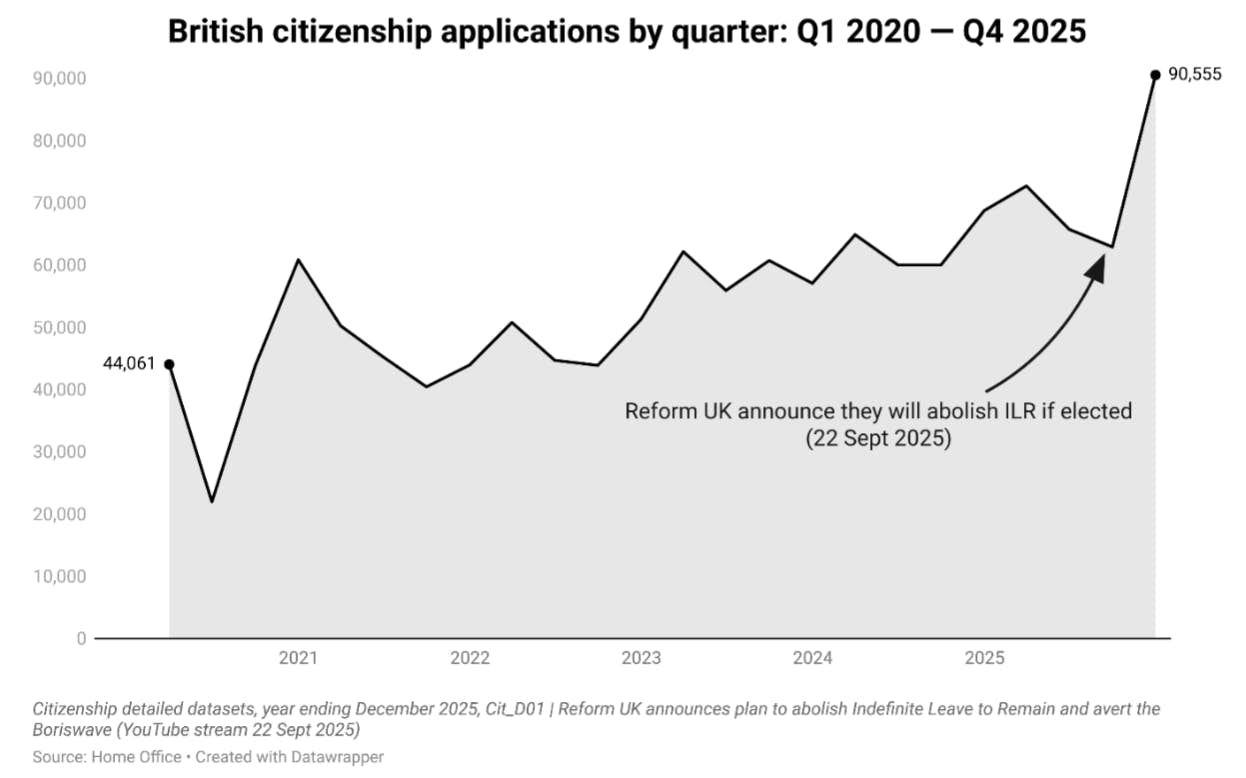
Many migrants with ILR may be applying to become British citizens, in anticipation that Reform UK will win the next general election and abolish ILR. This is corroborated by the Financial Times. If this suspicion is true, we could see elevated British citizenship applications for many upcoming quarters.
Reform UK have said while they would abolish ILR, they will not review British citizenship grants — something which I covered for The Critic many months ago. As such, applying for British citizenship is a sound move from any migrant looking to mitigate any risks from a Reform UK Government.
British citizenship applications can take three to six months, on average, so it will take some time for the increase in applications to filter through into grants or refusals.
146,405 settlement (Indefinite Leave to Remain) grants were issued in 2025; this is a decrease from the 163,242 grants issued in 2024 and remains below the current all-time peak of 241,192 grants in 2010.
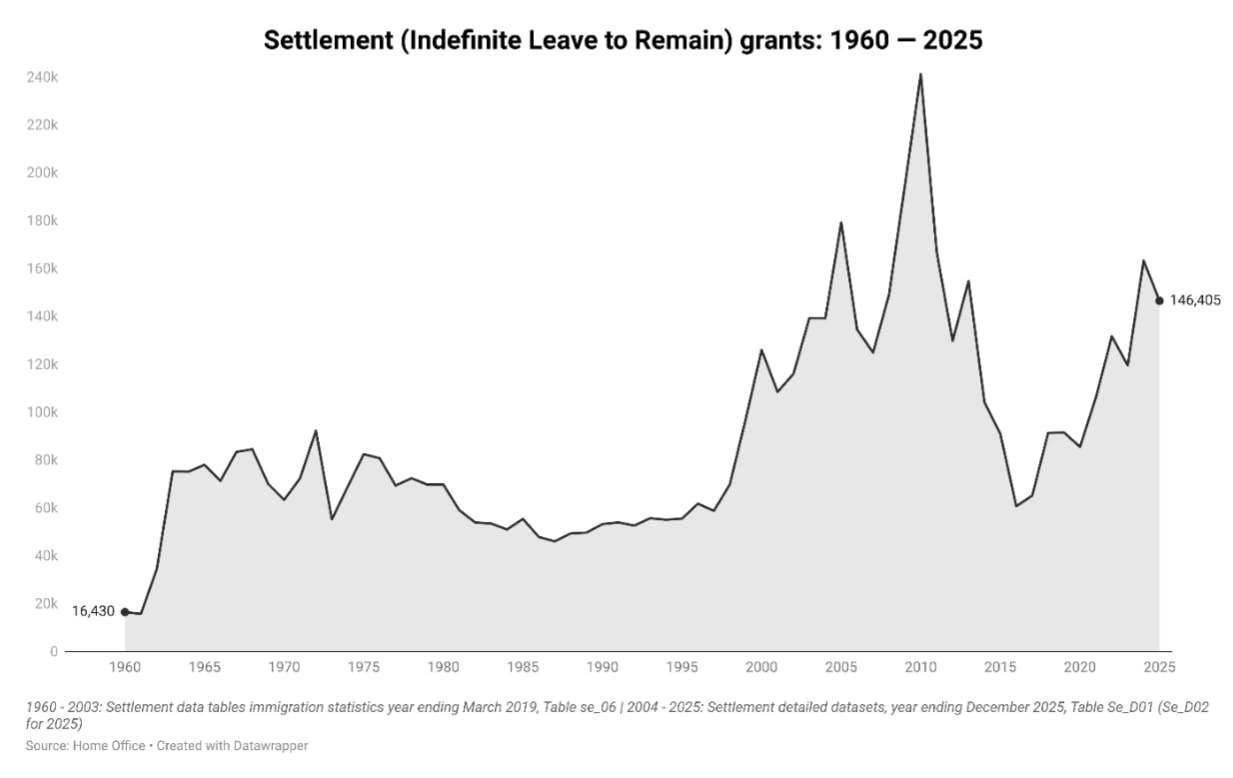
It’s worth noting that the Afghan nationals who were relocated to the UK under the Afghan Citizens Resettlement Scheme (ACRS) and Afghan Relocations and Assistance Policy (ARAP) schemes and were subsequently given ILR are not included in the quarterly Home Office immigration statistics.
Between 2021 and 2025, 37,950 Afghan have been relocated to the UK under one of the various relocation schemes. According to the Government, 12,958 ILR grants have been issued to these relocated Afghans.
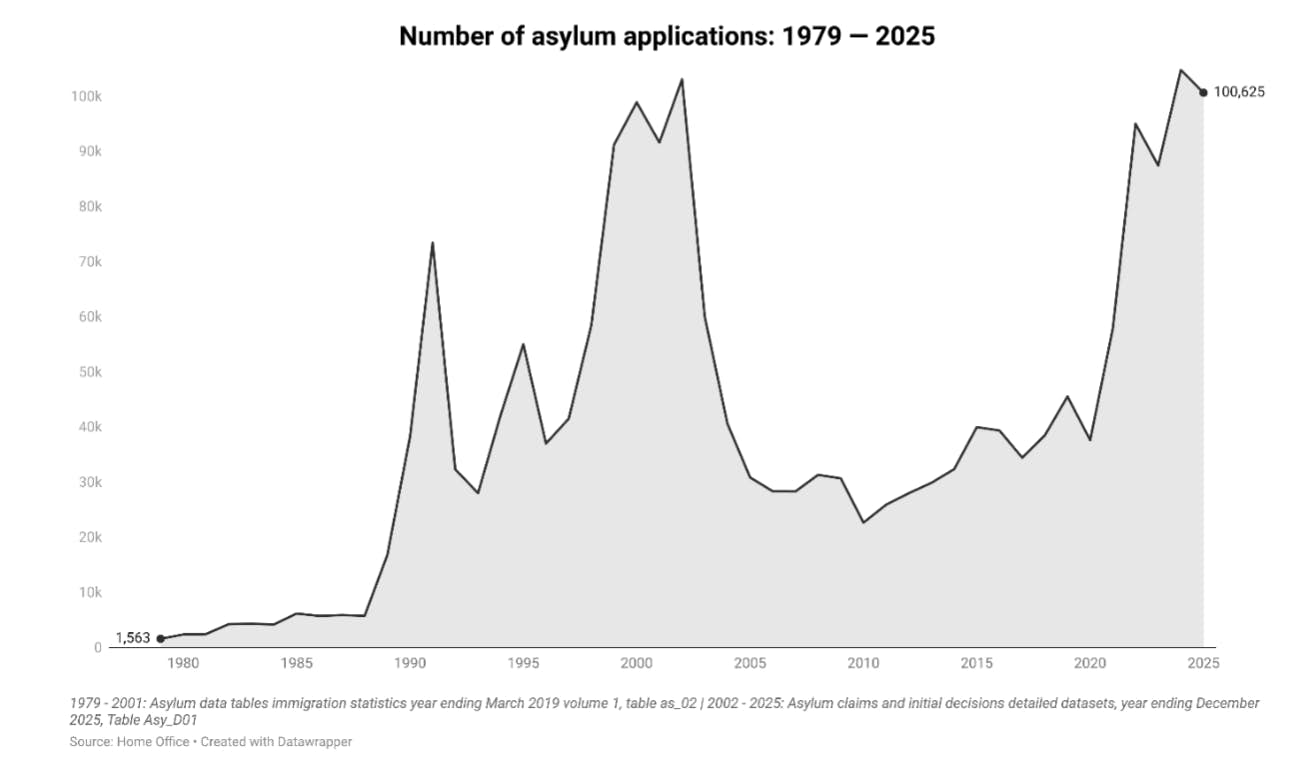
100,625 people claimed asylum in the UK in 2025, this is down from the peak of 104,764 in 2024, though remains well above recent levels. There were 45,537 asylum applications in 2019.
Many of the people claiming asylum did not arrive via illegal routes, of those who applied for asylum in 2025 (100,625), 52,452 (52 per cent) arrived via some form of illegal entry (e.g. via small boat or the back of a lorry), while 39,095 (39 per cent) claimed asylum after having arrived in the UK with some valid form of entry clearance, such as a work, study or visit visa — our asylum system is being abused by legal migrants, not just illegal ones.
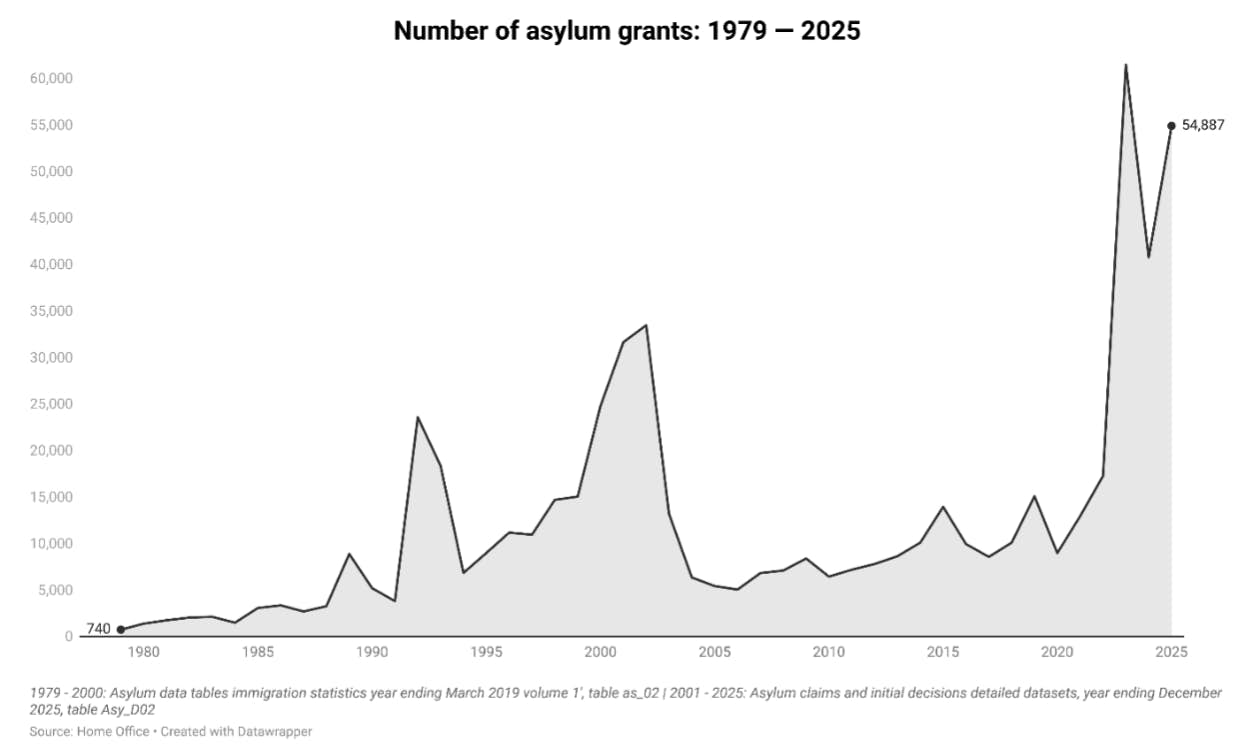
The number of asylum grants in 2025 stood at 54,887, this is below the peak in 2023, which stood at 61,478, though this is an increase over the number of asylum grants in 2024, which stood at 40,754.
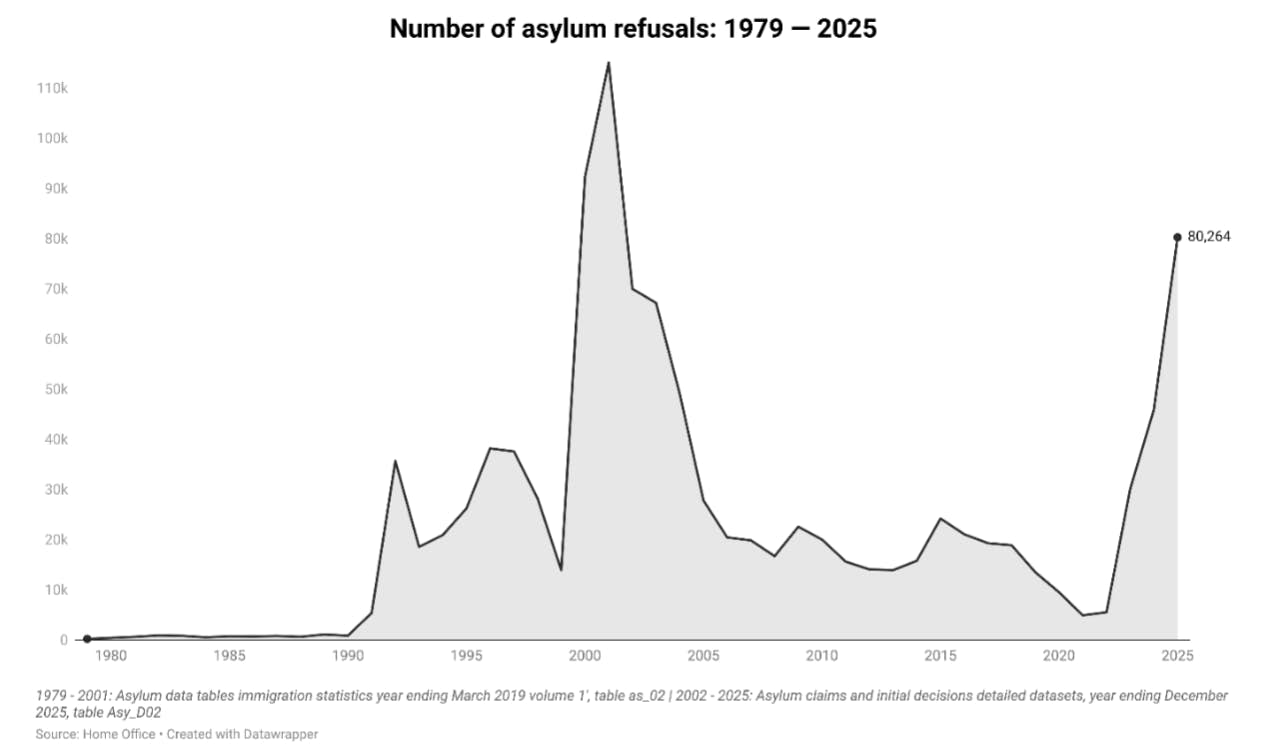
Asylum refusals are at recent highs, with 80,264 refusals in 2025, up from the 45,889 refusals in 2024 and 30,078 refusals in 2023.
In 2025, the initial asylum grant rate stood at 42 per cent, a slight decrease from the 47 per cent in 2024. This is a step in the right-direction. Having a high asylum grant rate is itself a pull factor, as these migrants will seek out countries which have lax asylum rules and high grant rates.
The initial asylum grant rate does warrant some scepticism however, this is because even if an asylum seeker has their claim refused, they aren’t necessarily deported and they have numerous legal avenues to appeal, thwart and prevent their removal.
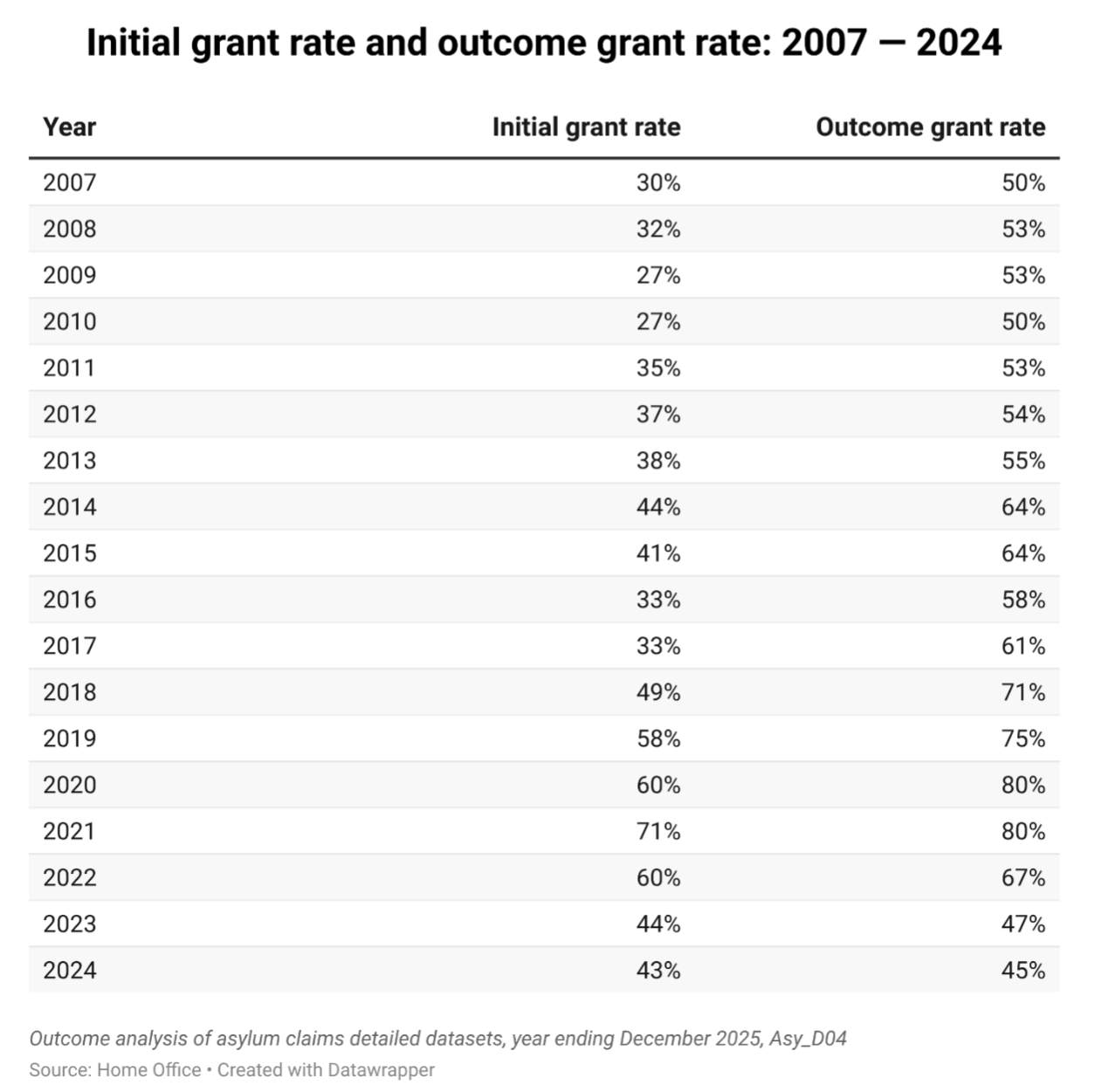
The Home Office produces a separate outcome analysis of asylum claims within their statistical release that contains the asylum grant rate after appeals and any discretionary asylum approvals by the Home Office.
Below I’ve created a table covering 2007 to 2024 with the initial asylum grant rate (left) vs the outcome asylum grant rate (right). As you can see, asylum grant rates significantly increase after outcomes.
Even if the small boats were to stop tomorrow and illegal migration into the UK completely ceased, a significant percentage of the 194,000 (and growing) small boat arrivals since 2018 will get their asylum claim approved, perhaps not an initial decision, but on appeal or via discretionary approval.
Very few small boat migrants are deported, between 2018 and 2025, 192,334 illegal migrants arrived via small boat, over the same period, just 7,612 were deported, equating to 3.96% of small boat arrivals being deported.
If the Government, or future Government wants to make inroads and deport significantly more people, they are going to have to start deporting people to Afghanistan, Syria, Iran, Sudan, Eritrea and other such countries — even if it means signing agreements with these countries.