Golf has clung to the shell of the man that was once Tiger Woods for too long as it struggles to chart a future without the player who has been the greatest draw, and money-machine, in the modern game.
It has indulged his recklessness for too long and looked the other way when he has risked his own life and the lives of others with a terrifying level of negligence behind the wheel of a series of cars.
It has watched on for too long as he failed to express penitence or regret for his various vehicular misadventures. It has enabled him by treating him like a hero for misdeeds that do not befit a hero.
Golf has let him down for too long, too – its focus has been on encouraging him to get back to the course and mend his injuries as soon as possible when it should have been on helping him to overcome a far bigger battle, an apparent dependency on painkilling drugs.
The truth is this: Woods is lucky – and golf is lucky – that he has not killed an innocent person in the series of accidents and incidents in which he has been involved in the last nine years.
In May, 2017, not long after he underwent spinal fusion surgery, Woods was found passed out behind the wheel of a Mercedes-Benz on the side of the road around 3am in Palm Beach Gardens, Florida.
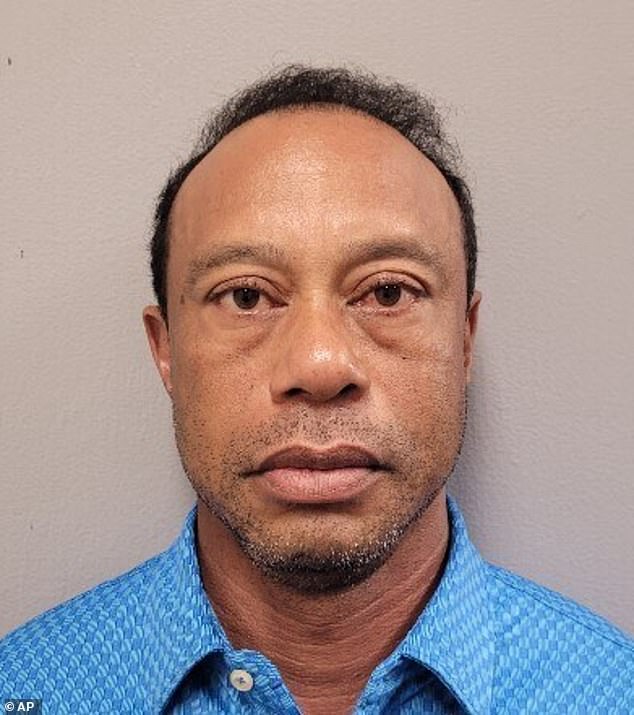
Tiger Woods stares down the lens in his police mugshot after being arrest for DUI on Friday afternoon
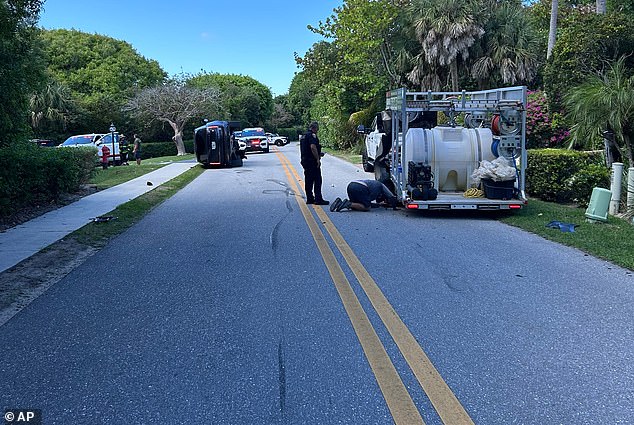
Woods flipped his SUV onto its side after clipping a trailer (right) while attempting to overtake
He was found to have prescription drugs in his system; Vicodin, Dilaudid, Xanax, Ambien and THC. He entered an in-patient rehab facility for prescription medication addiction. He later pleaded guilty to reckless driving.
In February, 2021, on his way to a photo-shoot near Los Angeles, Woods lost control of his car at speed. It struck the central reservation, crossed into the opposite lane, rolled over several times and then plunged off the road and down an embankment.
Police said he was driving at 87mph in a 45mph zone. There was an empty, unlabeled pill container in the car. Woods told police he thought he was in Florida. They did not run a toxicology test.
Woods was seriously injured and required multiple operations on fractures in his lower right leg but when he eventually returned to golf, none of the questions he was asked concerned whether he felt any contrition for the harm he could have caused others.
The only thought appeared to be for Woods’ physical recovery and for when and where he might return to golf, not for the fact that he had quite clearly become a danger to others and to himself.
And now it has happened again. Now we are being assailed with more blurry-eyed images of Woods staring hazily into a police camera for another mugshot after rolling his Land Rover on a quiet residential street near his home in Jupiter, Florida.
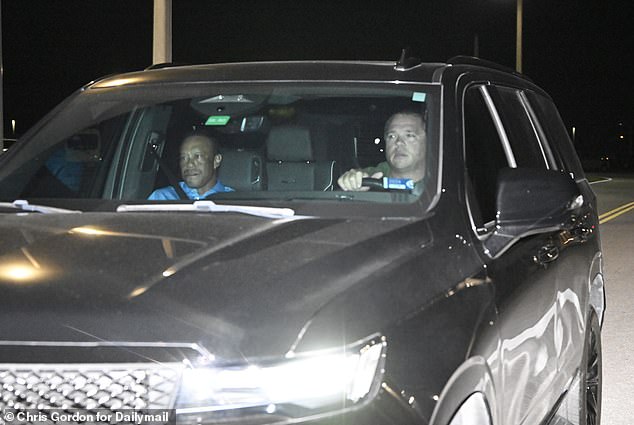
Tiger Woods was driven away from Martin County Jail after being bonded out on Friday night
Woods did not have alcohol in his system but he refused to take a urine test and police at the scene said he appeared to be impaired. We have seen this movie before and it’s starting to feel like a tragedy.
The pattern repeats. It has been repeating since 2009 when Woods drove his car into a fire hydrant while attempting to flee his wife Elin Nordegren, who was said to have confronted him in the midst of problems in their marriage.
If Woods appears to have a dependency on pain-killing drugs, he also has a dependency on golf and golf has a dependency on him. In the past, when he has transgressed, golf has forgiven him and then golf has redeemed him.
The outstanding example of that pattern was his recovery from the spinal fusion surgery and his rehabilitation after he was found passed out in his Mercedes, which had two flat tires, in 2017.
Woods has had a series of back operations in the long span of his incredible career and even though there were times in the build-up to that surgery when he could barely walk, let alone play golf, he pulled off one of the greatest comeback triumphs in the history of sport when he won the Masters in 2019, his 15th major.
And the narrative, of course, is that that makes all the pain and all the suffering and all the pills and all the car crashes worthwhile.
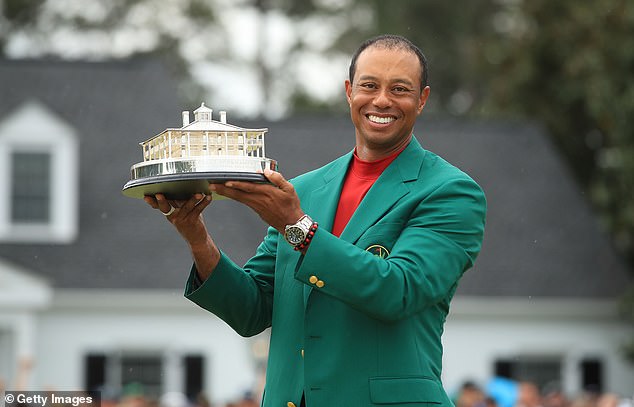
The crash is the another low point for the legendary golfer, coming weeks before the Masters
Even last week, Woods was still talking about the prospect of returning to the Masters next month for another appearance at Augusta National, the course that he loves more than any other, the course where the full bloom of his incredible talent was first advertised to the world when he won the tournament in 1997.
Woods played in an indoor event staged by The Golf League in Palm Beach, that was attended by his girlfriend, Vanessa Trump, and assorted members of the glitterati, and refused to rule out playing in Georgia.
That dream felt unlikely last week. It feels impossible now after Woods latest misadventure.
It is time for Woods to stop trying to prove he can be competitive again. It is time for golf to let him go.
It is time he learned to help himself before it is too late. The picture of that flipped car on the road felt like a metaphor for a gilded life that is turning into an American tragedy.