To the DPD driver who knocked on the door of 10 Old School Close, in Banks, Lancashire, shortly after midday on June 14, 2023, it was just another delivery.
He handed the object, a large oblong wrapped in black plastic, to the man who answered the door – a black male, he recalled, with a ‘terrible’ attitude.
The parcel had the words: ‘Bladed items: Delivery to 18+ only’ printed in a large red letters on the packaging, but there was no need to check ID; the recipient was clearly in his 40s.
A photograph taken on the driver’s handheld computer shows the item sitting inside the front door of the house.
Little did he know that inside was a 22-inch machete knife.
Nor was he aware that this was the address of Axel Rudakubana, the monstrous killer who, just over a year later, would go on to slaughter three children and injure ten other people, at a dance class a few miles from his home.
Chillingly, this was far from the only delivery of this type to the Rudakubana house in the months and years leading up to the Southport atrocity on July 29, 2024.
Much has been made of the fact that the killer, now 18, was able to buy the knife he used in the attack – namely an 8-inch chef’s blade – from the online retailer Amazon.
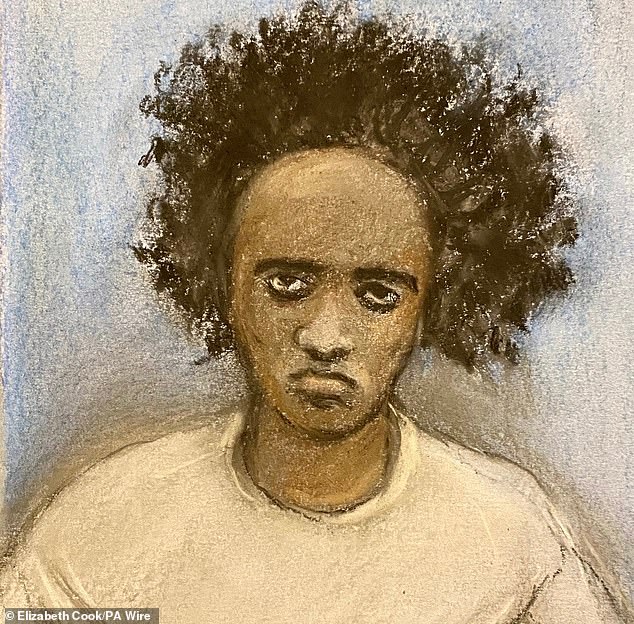
Axel Rudakubana murdered three girls in Southport last summer and tried to kill many more
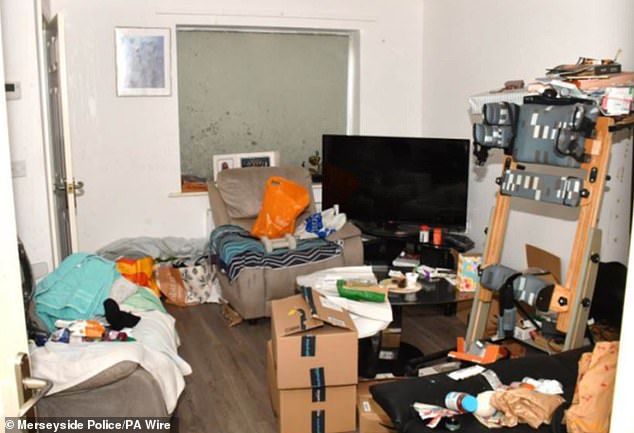
The lounge where Rudakubana slept, covered in rubbish such as Amazon delivery boxes
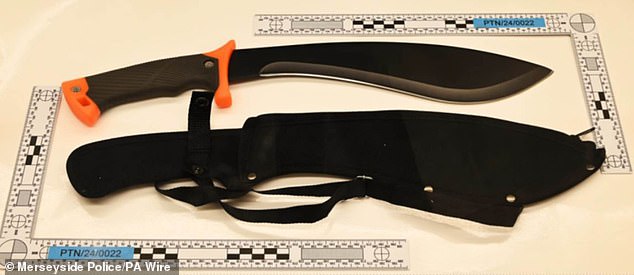
Two deadly machetes seized by officers in the aftermath of last year’s stabbings
We know, too, about the Tupperware box under his bed containing a crude preparation of the toxin ricin, which he had attempted to make using castor seeds.
But according to disturbing new evidence, Rudakubana had, in fact, been collecting a vast cache of weapons, each one capable of causing mass fatalities.
Over the past fortnight, the Southport Inquiry – the forensic examination of the events leading up to the incident – has heard evidence from couriers and other professionals connected with delivery companies DPD, Evri, Whistl, Amazon and Royal Mail.
Their accounts and other details revealed in the inquiry mean that the shocking scale of Rudakubana’s evil can be laid bare for the first time.
In total, 13 – yes, 13 – more weapons or weapon-making materials were delivered to the Rudakubana home prior to the atrocity.
Police who searched the address found a machete with a 12-inch blade in his bunkbeds. A second, with a 16.5-inch blade and dubbed the ‘Black Panther’, was found nearby, still in its packaging.
Yet another machete, the one delivered by DPD, was on top of the wardrobe in his parents’ bedroom, unopened, along with an extra-large sharpening stone.
Also under Rudakubana’s bed was a hoard of equipment bought with the express purpose of making toxic chemicals: kitchen scales, measuring cups and flasks, a pestle and mortar, safety goggles and a litre bottle of pure alcohol.
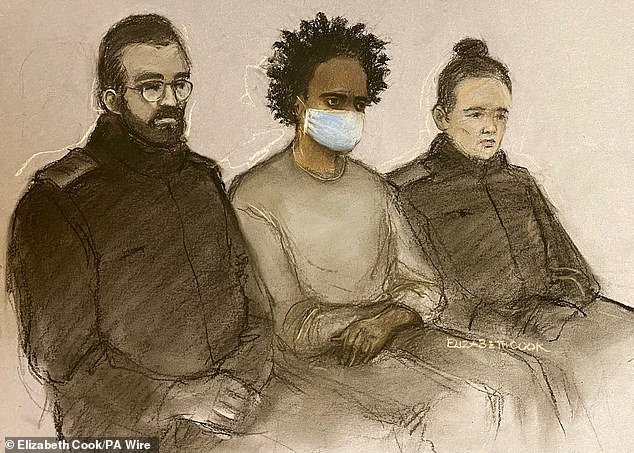
Rudakubana in court. He was sentenced to a minimum term of 52 years for his crimes
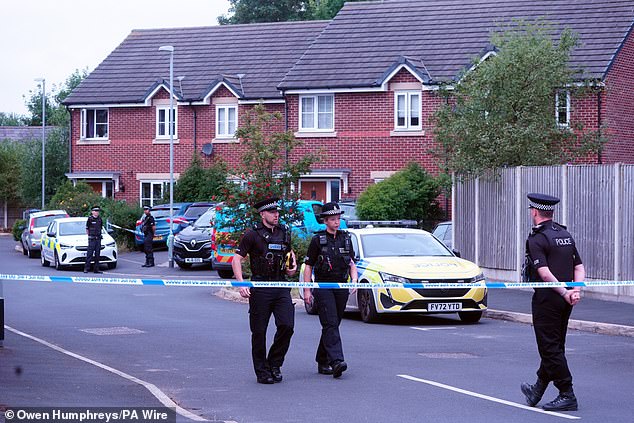
Police officers near the now 19-year-old’s home in Old School Close, Banks, Southport

The killer’s father, Alphonse. Rudakubana used his details to make several purchases online
As well as ricin, the killer was found to have documents relating to the making of nitrocellulose, a highly flammable explosive, and formaldehyde, which can cause chemical burns.
Elsewhere in the house, police made yet more shocking discoveries: two hunting bows and sets of 12 arrows, four smoke grenades, a 2.7kg sledgehammer and another 8-inch kitchen knife.
In the dingy family lounge with mould on the blinds, which the murderer was using as a place to sleep, police uncovered a set of brown glass bottles with matches taped to the outside.
Rudakubana had also bought a jerry can and, just seven days before the Southport attack, asked his father to buy him petrol – the missing ingredient to turn the bottles into viable explosive devices, namely Molotov cocktails.
Unsurprisingly, amassing this huge, hidden arsenal was not the work of a mere few months.
Records of deliveries to the Rudakubana home show he started making orders in January 2022, when he was 15 years old. They kept coming, at disturbingly regular intervals, until July 2024, just two weeks before the massacre.
So how was a teenage boy living at home with his parents – a boy known to police and anti-extremism authorities, with a history of carrying knives, no less – able to get his hands on lethal weapons on such a vast and terrifying scale?
For the most part, it seems, Rudakubana was able to bypass online age verification requirements, imposed by law on the sale of items that could cause harm, by using fake ID documents, the source of which is unknown.
Many of the other purchases were made on Amazon, which requires users to be 18 or older to set up an account – and so allows the online sale of age-restricted items.
Some of these – the smoke grenades, for example, and the sledgehammer – were not subject to ID checks on delivery, as they have other uses and do not constitute ‘weaponry’. Others, such as the kitchen knives, were.
And this is where the picture becomes more troubling.
Of the 15 suspicious deliveries to the Rudakubana home between January 2022 and July 2024, at least four (including the murder weapon itself) are known to have been signed for by – and handed over to – his father, Alphonse.
Alphonse’s name, and initially, his credit card details, were used by his son to make several of the online orders. Other parcels made their way into Axel Rudakubana’s possession.
But evidence heard in the inquiry these past few weeks makes it clear that both parents – Alphonse and Laetitia – were aware, to some degree, of what was inside.
According to a police statement given by Alphonse on July 31 last year, he had noticed chemicals and a bow and arrow set in his son’s bedroom, when he’d gone in there nine days previously to tidy up.
‘I do not know how he got these items; I assume they must have been delivered,’ Alphonse said. He later admitted he had seen the containers now known to contain the crude preparation of ricin, as well as the smoke grenades.
That same day, Alphonse would go on to stop his son from taking a taxi to Range High School in Formby – from which he had been expelled in October 2019 for carrying a knife to take revenge on an alleged ‘bully’ – as he suspected he had another knife in his rucksack.
Despite these suspicions, and what he had seen in Axel’s bedroom, he did not inform the police.
Packaging for the knife used in the attack was discovered on the first-floor hallway of the cluttered three-bed semi inside a carrier bag which, detectives found, bore Laetitia’s fingerprint.
And as far back as March 2022, when his mother was interviewed by police after Axel was caught on a bus carrying a knife, she said her son talked about poison.
Giving evidence to the inquiry this week, PC David Fairclough, who attended the Rudakubana home after that incident, said of Laetitia’s reaction: ‘I was shocked by the lack of shock on her part… she said he had mentioned poison previously to her.’
But then Alphonse and Laetitia Rudakubana, who claimed asylum in the UK from Rwanda in 2002, had been having problems with their younger child for years.
Axel first came to the attention of local mental health services in April 2019, when he was 12.
What started as anxiety issues (he disliked being in crowds, hated others hearing him swallow, and had a fear of spiders and mosquitos) and an autism diagnosis quickly escalated, however.
By October 2019, when he was expelled from Range High School, official notes show he seemed increasingly angry.
Two months later Rudakubana returned to Range High School to attack an old classmate with a hockey stick, breaking his wrist.
Later, it transpired he had also carried a kitchen knife in his rucksack – and he received a ten-month youth referral order after pleading guilty to assault, possession of an offensive weapon and possession of a bladed article.
At home, meanwhile, things were going from bad to worse. In December 2020, Rudakubana’s GP noted that he had ‘smashed things at home when asked to complete school work’.
In July 2021, after an appointment with a psychiatrist, he was prescribed beta blockers to help with his worsening anxiety.
In September, he was put on anti-depressants. Two months later, on November 5, 2021, his mother made her first 999 call – alleging her son had lost his temper and started throwing things around the house after a stranger knocked on the door.
The next emergency call came three weeks later, on November 30. His parents told police an argument had broken out over dinner, resulting in Rudakubana kicking his father, throwing a plate of food and jumping on a rental car, cracking its windscreen. At the parents’ insistence, no action was taken after either call, despite police attending the address.
It was the same story on May 14, 2022, when his parents tried three times to call 999, uttering the words ‘We need police, please’, before the line went dead. On this occasion, the teenager had awoken in the early hours of the morning, demanding access to a laptop.
When his parents said ‘no’, he threw food around the kitchen, then locked himself in the bathroom and overfilled the bathtub, causing the electricity to short. Once again refusing to take things further, Alphonse told the attending officer Axel was ‘getting older and stronger’ and admitted he was ‘struggling to cope with him’.
Other attacks on his parents, detailed in the inquiry, included throwing juice over his father, kicking him in the groin, emptying a carton of milk over his parents’ bed and once, in an attempt to get access to one of the machetes he had ordered online, threatening his dad with a knife.
Over the next two years Axel withdrew from society. He dropped out of education, stopped leaving the house, frequently refused food and didn’t shower or bath for months at a time.
PC Fairclough, the officer who visited the house after the knife on the bus incident, noted that Alphonse and Laetitia seemed ‘very supportive’ and ‘responsible’, making immediate efforts to lock away their kitchen knives so their son couldn’t access them.
‘They appeared stressed… they appeared at their wits’ end,’ he told the inquiry this week. ‘The mother claimed she was crying out for extra support and she felt it was falling on deaf ears.’
Speaking exclusively to the Daily Mail, Geoff Grice of Southport’s Community Church, who continues to have weekly phone contact with the family, now in hiding in an undisclosed location, says church members knew things were not easy for Alphonse.
‘We knew he had tensions and problems at home, and was seeking help… with his kid,’ he says. ‘He shared something of that. It was not an easy job for him.’
Alphonse, he adds, was a ‘lovely, warm, kind man’ who, along with his wife, was trying his best for his troubled son.
But others who came into contact with the family suggested this did not always ring true. Back in December 2019, after the hockey stick attack, a police officer noted that Rudakubana’s parents were ‘in denial over how serious this actually is’.
‘Parents are alarmingly playing the situation and his behaviour down,’ he added.
Teachers who attempted to visit the house in subsequent years said the parents often refused to let them in.
When Rudakubana was referred to Prevent, the UK’s anti-terrorism programme, for the third time in April 2021 (he’d previously been referred in December 2019 and February 2021), one teacher said she felt she had ‘lost the support’ of his parents.
A psychiatrist who worked with Rudakubana asked to be removed from his case in 2022 as she found Alphonse, the father, to be ‘intimidating’ and ‘verbally aggressive’. She told team members she ‘no longer felt safe’ working with him. Indeed, Alphonse’s five-page police statement after the Southport massacre last summer makes for difficult reading.
In it, the 50-year-old taxi driver praises his son’s intelligence and sporting ability, and describes him as ‘very serious about his appearance and image’. He appears to blame his deteriorating behaviour on the alleged bullying at Range High School – evidence of which, the school says, was never found. Alphonse claims it meant his son ‘lost his friends and gradually dropped his hobbies and interests’.
Yet his description of his son, his fixation on lethal weaponry, and the way he dominated the family home is strangely naive, almost defensive in tone.
‘Axel spends his day-to-day in the living room of our house,’ Alphonse’s statement continues.
‘He is very dismissive of anyone who tries to speak to him, if by speaking to him it interrupts the videos he is watching.
‘He has a temper and at the slightest thing he would throw dishes or cups to the floor in rage.’
Prior to the Southport attack, he adds, Axel had been giving him ‘the silent treatment’.
‘If he wanted something, he would write his request on his tablet computer and show it for me to read. The night before the incident, however, Axel broke the silence and came to speak to me for about an hour or so about the videos he was watching on YouTube and Twitch.’
On the day in question, he claims, he and Laetitia believed their son, the violent, volatile teenager who had barely left the house in months, and who had been stockpiling deadly weapons right under their noses, ‘was just going out for a walk’.
They, of course, could not possibly have imagined the atrocity he would go on to commit.
But questions have been raised over just how much they truly knew about their child.
In the coming weeks, their elder son, Dion, who was away at university in the year preceding the attack, is expected to give evidence to the inquiry.
It is not yet known whether Alphonse and Laetitia will appear.
If they do, one can only hope they will answer the poignant and pressing question so eloquently put to the inquiry by David and Jenni Stancombe, the parents of Elsie Dot Stancombe, one of the three little girls mercilessly killed by Rudakubana that day.
‘The parents of the boy who killed our daughter were fully aware of the risk he posed,’ they said. ‘They lived with him. They knew he had access to weapons.
‘He was involved in violent behaviour and he posed a danger to others. Police and safeguarding services had visited that home and still it was deemed appropriate for a child to live there with no serious intervention.
‘No action was taken. Why?’