Thousands of people have gathered at Stonehenge to mark the winter solstice – as huge crowds formed to witness the sunrise on the shortest day of the year.
Families and friends were heard cheering as they watched the spectacle this morning in Wiltshire.
Onlookers braced the chilly weather and drizzle amid the brightening skies – with folk dancers and pagan revelers also turning out for the occasion.
Describing the event as a ‘revered cultural moment in ancient history’, Will Scutt, from English Heritage, said visitors would be allowed to gather closer to the stones than ever before – but urged for people to treat them delicately.
He told the BBC: ‘We’ve got really rare lichens on them and incredible carvings on them, so I’m hoping that people will respect the stones.’
Photos from this morning show revelers dressed in bright red outfits as well as Brits who have come with the chilly weather in mind – donning thick hats and scarves.
Folk dancers were also seen performing in traditional outfits with some sporting flower crowns – and on occasions, a full face of paint.
One pair celebrating – Kim Tester and Paul Ransom – said they were returning to the ancient monument again this year to ‘recharge’.
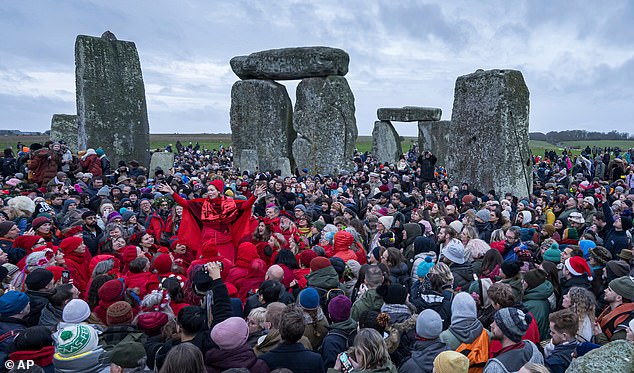
Thousands of people have gathered at Stonehenge to mark the winter solstice – as huge crowds formed to watch the sunrise on the shortest day of the year
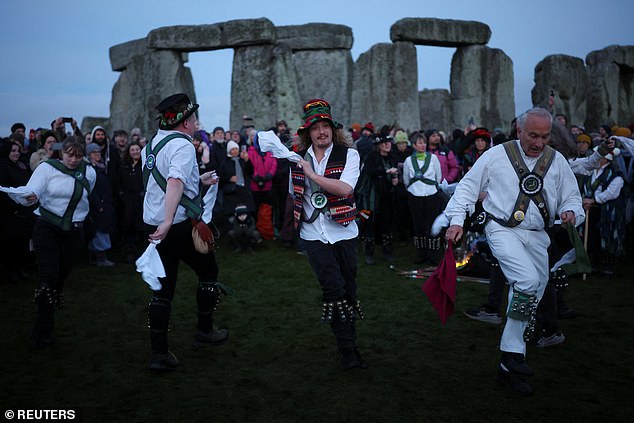
Folk dancers were also pictured performing this morning in traditional outfits
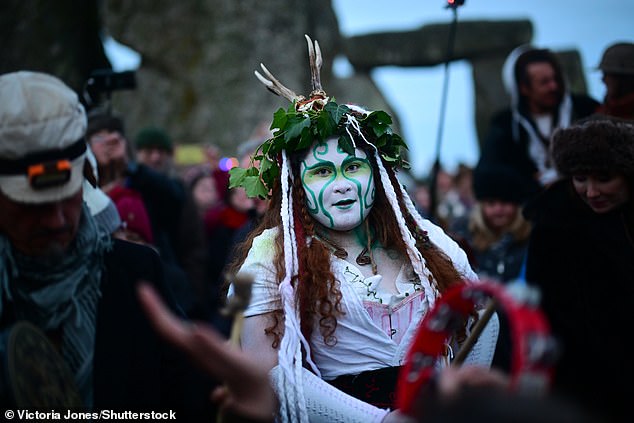
Folk dancers were also seen performing in traditional outfits with some sporting flower crowns – and on occasions, a full face of paint
Ms Tester told the BBC: ‘We’re coming out of the darkness and then into the light again, so for me, it’s about rebirth.
‘We just love the atmosphere, it’s beautiful.’
Mr Ransom added it was an ‘honour’ to be so close to the stones themselves which he was ‘grateful’ for.
On average, Brits will receive just 7.5 hours of light, although the exact duration will vary based on how far north or south someone is.
While temperatures will continue to drop, the hours of sunshine will increase from today.
The word ‘solstice’ comes from the Latin words ‘sol’ (sun) and ‘sistere’ (to stand still)
As well as marking the shortest day of the year, today also marks the first day of winter in the astronomical calendar.
This calendar is based on the tilt of the Earth, and sees winter begin on 21 December 2025 before ending on 20 March 2026.
In contrast, the meteorological calendar always has the first day of winter as 1 December, ending on 28 (or 29 during a Leap Year) February.