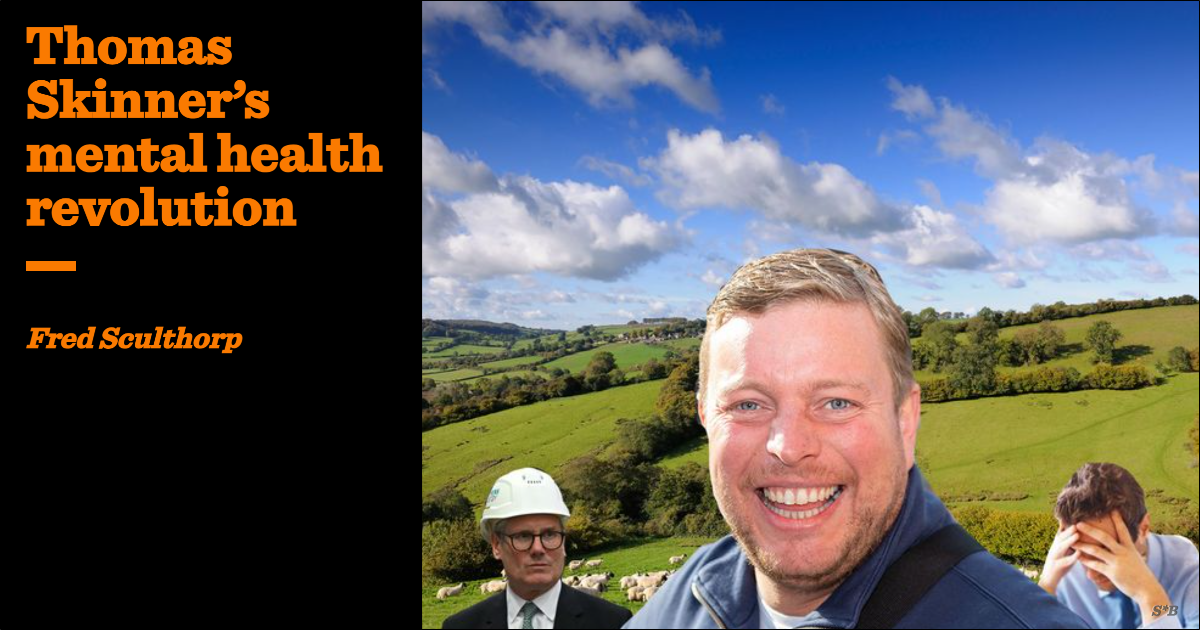
It was dawn in the Essex Village of Great Warley and a gathering of men was taking place next to the prim village green. The night before Thomas Skinner had put out a call on social media for “blokes to help blokes” on a mental health walk through the woods. Waiting by the war memorial was a parked black cab, with two men lurking inside who carried the nervous anticipation of first time doggers. We had come not to enjoy ourselves, but to talk about our feelings.
No one really knows what constitutes a normal person in Britain anymore, and after a successful run of gorging on big meals and saying “bosh”, it seemed like the Romford-born market trader would fit the role nicely. Last year, Skinner emerged from this everyman social media virality to become a sort of populist kingmaker — courted by everyone from Dominic Cummings to the Prime Minister as a means to understand the mystery of why Mondeo Man had started talking about civil war during focus groups in Hull.
Skinner-mania boiled over when he teased an appearance at the England and Now conference in Westminster alongside the historian Robert Tombs and Rupert Lowe. “I didn’t really know what it was,” he told me uncharacteristically pensive later on, as if he had never really confronted what had transpired that day. Since then, Skinner had traversed different universes in the space of a year, acting as a go-between between the travelling court of JD Vance and the cast of Strictly Come Dancing.
Now he was doing mental health. One of the strangest fads in Britain is the idea that feelings are some sort of repressed taboo, despite the nation agreeing on almost nothing except that we are all unhappy and in need of help. This is the legitimising purpose that links Keir Starmer to things like Rylan, Good Morning Britain, NHS talking therapies and the BBC: the promise of mental relief in the face of hardship that makes up the last of any discernible national psyche. With its forced fun and faux empathy, it has all the sinister therapeutics of a seedy end of the pier show run by a paedophile.
Skinner had once seemed beyond this corruption. From the world of SoccerAid and Celebrity Masterchef he had renegaded and started attacking Sadiq Khan and Digital ID. This sort of behaviour was strictly taboo for mental health Britain, where having the temerity to direct “anxiety and depression” towards the state of the country and the people responsible indicates only an unhinged and divisive madness.
A run-in with the press about an affair and a squabble with the BBC over voting on Strictly, however, had left Skinner wounded. His expression on the social media card advertising the event was one of lobotomised wonder. Perhaps he had caved into the pressure of having to be an authentic normal person in the public eye. Now he wanted to be a fake normal person. To see him succumb to mental health Britain indicated its insidious and demoralising spell. I had come on the mental health walk because somewhere, at the back of my mind, I believed that I could save him from turning into the next Joe Wicks.
Within a few minutes, this cynical act crumbled when out of nowhere he shook my hand and gazed at me with his magical blue eyes. “Hello mate, good to see you,” he said. Skinner in real life is exactly how he is on his social media videos. It is never clear if you are talking to a human being or an Instagram reel, and it is this that makes the experience of meeting him both thrilling and lonely.
“I can’t believe this is happening,” I said, imagining the sort of thing a grateful depressive would say. Skinner took the thoughtful beat of a therapist. “Well, people never fucking leave the house these days so it’s just nice to get out and have a walk,” he said. “That’s true,” I continued unnecessarily, “but aren’t you worried about any old weirdo just turning up?”
Skinner chose to ignore this last comment, turning away with a fixed grin as if to imply I might as well be talking about myself. The morning light was filtering through the trees, and now there was the menacing sincerity of pagan ritual: fathers who had come especially from places like Ongar were offering up their sons to his touch. Suddenly we were standing in the midst of a beautiful, blue sunny morning that had revealed a worryingly large crowd of vaguely troubled men.
The night before, the planned gathering had attracted a flurry of scorn and concern on social media. “Will there be safeguarding measures in place?” someone had nagged from the keyboard. This, as the responses implied, was exactly this sort of woke fussing that was driving men insane. What was wrong with blokes helping blokes on a nice long walk? Then from a nearby huddle I heard the words “split personality disorder”. I looked to Skinner for reassurance but he was gone. Were we really ready for what might unfurl over the course of an hour traipsing alone together through the woods?
Someone needed to take control. A man who looked like a lower league football manager who had spent his life motivating lost causes stood on a bench. Someone had alluded to his abilities as a hypnotherapist, and this blokey feel-good stream of consciousness was indeed mesmerising. Pregnant women, Muhammad Ali and creative visualisation were phrases that jumped out from his two minute, completely incomprehensible yet uplifting team talk. At the end we all looked at Skinner for him to decipher: “Positive feelings only!” he roared and we were off.
We marched up the road in a column, tooted along by supportive cars. Horses in nearby fields bolted. They had never seen anything like this. This part of England lies in the strange limbo between London’s Zone 6 and deep Essex. A place my Uber Driver, having spent years drifting around outer London, explained was now his preferred beat because it was what he thought England was like when he imagined it from Nigeria. Others on the walk, from Dartford, Rochester, Croydon felt the same longing. Somehow, in the space of 10 years, the places they thought they knew had changed. They had become grimier, alienating, unsettling and foreboding in a way they struggled to fully explain or recollect.
This feeling of loss with all its particulars put us safely beyond the standard mental health discourse. Anything that whiffed of the insincere, therapeutic jargon of Big Mental Health would not do. This is something I soon discovered when I targeted a father and son with a series of vague and creepy questions, like a prying BBC breakfast presenter trying to get them to open up. The son regarded me with horror in a way that restored humanity to the situation. “It’s just about real life experiences mate,” said the father, hoping this would ward me off.
He was right. Most of us were trying to explain who we were, and where we were from in a way that was exotic and revealing even to ourselves. One tall bearded man with a large, wizard-like stick was reeling off a series of entertaining anecdotes about ex-girlfriends, his travels across the backwaters of Essex discovering stashes of weapons on caravan sites. It was unplugged, boastful, curious and slightly giddy, the way bored and feral children who have just met talk to each other on a long summer afternoon in some pub garden. The man with split personality disorder seemed to be doing great.
Men’s mental health awareness had indeed awoken something in the male English psyche
Arguably, Skinner was not alone with his initiative. The night before, I had gone on an algorithmic romp through the new mental health landscape on Instagram and TikTok. The images were both exhilarating and disturbing: flabby and shirtless middle-aged men hugging each other in woods, unfathomably violent and conscientious twenty-somethings fed up with the 9-5 drilling in makeshift bootcamps. Men’s mental health awareness had indeed awoken something in the male English psyche, but it was not exactly taking its cues from Caitlin Moran’s What About Men?
Back at the pub, I asked Skinner where it was all going. “You’ve got to start small and do it in every town,” he explained. “I just want to kickstart blokes talking to blokes. When I was a kid, I’d go out on a bike and come home when it got dark. Your dad and his mate would be in the pub and there was just a bit more of a community life.” A crowd had gathered around and were nodding along in stern agreement. Was he still interested in working with Dominic Cummings, in running for London mayor? “You never know what’s going to happen in life, mate,” he said.
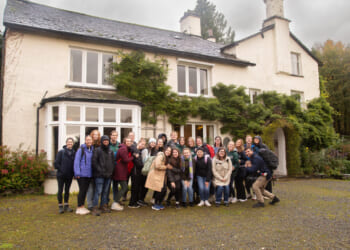
The group gathered for a photo outside the Thatcher’s Arms. They looked unrecognisable from when they had arrived under cover of darkness: chirpy and fresh. A rousing chorus of “Keir Starmer’s a wanker” broke out and then they dispersed and quietly went their own separate ways.