Bags in hand at a Riyadh shopping mall, Hatem Shimri has a simple message.
“There is no war here,” he says. “Don’t believe what you see on TV or read on Twitter. Life is going on as normal, [and] we are living our lives. Come to Riyadh and see for yourself.”
If Saudi Arabia is being dragged into a regional war, its citizens and residents say they don’t feel it, voicing a sense of calm that is remarkably consistent.
Why We Wrote This
In stark contrast with residents of other Arab countries in the Gulf region, Saudis exhibit a decidedly blasé attitude toward the U.S.-Israel war with Iran. Conversations focus on jobs and the economy and reveal a calm faith in their government’s ability to provide security.
Neighboring Qatar, Bahrain, Kuwait, and the United Arab Emirates issue daily phone alerts for residents to shelter indoors from incoming Iranian drones and missiles that are hitting hotels and residential towers. But Saudis are out en masse in outdoor markets, shopping malls, food courts, and cafes.
Across the country is a mixture of confidence, trust in its leadership and the United States’ security umbrella, and belief that the U.S.-Israeli war with Iran will wrap up before its impact is felt in the kingdom.
Saudi Arabia has perhaps the most to lose from a widening regional war, yet among Gulf Arab citizens, Saudis are worrying the least. Even an Iranian missile strike that wounded a dozen Americans at an air base an hour outside Riyadh on Saturday didn’t appear to shake Saudis’ confidence.

While Saudi Arabia’s oil exports reportedly have been reduced by 40% because of Iran’s closure of the Strait of Hormuz, gas here is still $2.20 per gallon – one of the lowest prices in the world. Saudi Arabia imports 80% of its food, yet the prices of clothes, food, and electronics have not gone up, even as the conflict disrupts air travel and global shipping.
While airports are closed in Kuwait City, Doha in Qatar, and Manama in Bahrain, and partially closed in Dubai and Abu Dhabi in the United Arab Emirates, dozens of domestic and international flights land and take off daily at Riyadh’s gleaming King Khalid International Airport.
To be sure, Iran and its proxies target U.S. bases and infrastructure in the kingdom with missiles and drones on a daily basis, but the majority are knocked down by Saudi and U.S. air defenses – at a cost of millions of dollars each day – contributing to Saudis’ sense of safety and calm.
Instead of the war, Saudis returning from Eid holidays talk of finding jobs, university studies, which stocks to invest in, and where to vacation.
“Those who are not following the news closely outside the region may think Saudi Arabia and the Gulf is a region full of explosions and war,” says Rakan Qahtani, a fourth-year ophthalmology student in Riyadh. “It’s the wrong image.”
“Trust in our government”
In conversations – both private and on the record – Saudis expressed a trust in their military and a feeling of security that is at odds with the rest of the Gulf.
“People are all going out freely, there is no fear, no problems have happened,” says Faisal Muteb, a university student at King Saud University, who was hitting the streets in Riyadh to record interviews for an assignment.

“We have trust in our government and their orders. We know their thinking is completely in citizens’ interests,” he says. “We are relaxed.”
As of Sunday, Iran had targeted the kingdom with 815 drones and 65 missiles, the Saudi Defense Ministry said. But Tilal, an Uber driver from Taif, says his concerns are not Iranian drones, but when he can land a steady job.
“We are all looking for stable work and building our future,” says Tilal, who moved to Riyadh three months ago. “For many of us from outside towns and villages, we are all coming to the capital to get ahead.”
“We are focused on starting companies, completing our higher education degrees,” says Nour, an entrepreneur in Riyadh who did not wish to use her full name. “Saudi Arabia has gone through a transformation, and we are a growing economy and country. Our focus is development and progress, not war.”
“We want to live in peace”
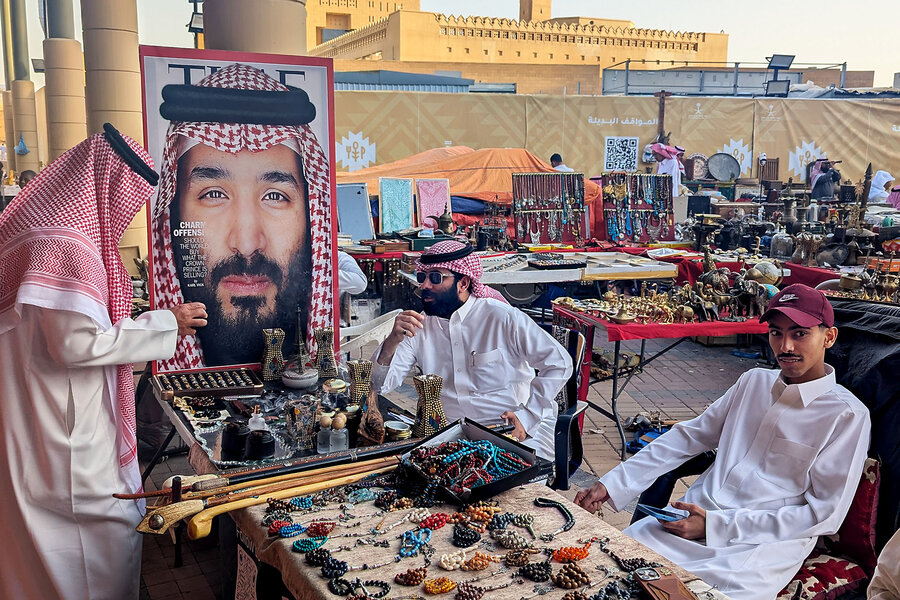
At a crowded outdoor market in Riyadh, outside a mosque, prayer-goers haggled on Friday over boxes of dates, incense, vegetables, and fruits.
“We Saudis only fear God. We want to live in peace. This is between two escalating sides [Iran and Israel]. It is not our war, and the war hasn’t reached here,” says Khaled Rahman, selling nuts and spices from the back of a pickup truck, along with his most popular item, Iranian saffron, a key ingredient in Saudi coffee.
A lone jet roared overhead. Later, the Ministry of Defense said it destroyed six ballistic missiles and two Iranian drones targeting Riyadh that day.
On Iran, “the only future is for us to live side by side,” Mr. Rahman says with a smile. Besides, he adds, “their saffron is the cleanest.”

“Living a normal life is not ignorance, but a deliberate show of strength and resilience,” says Khalil Shamiri, a retired businessman in Hail, in northern Saudi Arabia.
“Every Saudi knows the cost of this war,” he notes, but “we won’t stop our joy, celebrating Eid, working or enjoying life. Iran can’t intimidate us.”
U.S. “must finish the job”
Support for the security partnership with the U.S. is high, and there’s a general sense that the kingdom’s fortunes lie with a continued alliance with Washington.
Ibrahim, a university student from Mecca who did not wish to use his full name, says he spotted an Iranian drone over Riyadh two days earlier that was knocked down. Like many, he is confident the kingdom’s security and economy will hold up, but is eager to see the Iranian regime “finished.”
“Americans must finish the job. We can’t live next to an Iran that hits every country and holds the world hostage. We know the Americans won’t just start a war and leave,” he says. “The Iranians don’t have a single friend in this world for a reason. They don’t behave like a normal state.”
All wanted the kingdom and the other Gulf states to avoid entering the war and escalating the conflict.
“If Gulf states weren’t wise, they would hit Iran right back,” says Walid Sharif, a Riyadh driver. “But instead, they practiced restraint. Because Gulf states know if they enter the war, even if they win, there will be large costs: to their economy, to the lives of their people,” he says.
At the same time, Saudis told the Monitor they would support Saudi offensive action against Iran should it damage the country’s critical infrastructure.
“The crown prince … gave the Ministry of Defense orders to strike Iran if they target our desalination plants or electricity networks. Water and energy are the red lines,” says Ibrahim. “If we strike Iran, all the country will be united backing it.”