Early one morning in 2009, Ndèye Fama Seck’s husband packed a bag. He was going out to help a migrant boat that had capsized near the beach, he said.
Days went by, then months, without a word. In the past, they had discussed the possibility that he might take a clandestine boat to Spain in search of a better life for them both. She knew he must have gone.
But she will never know what happened next.
Why We Wrote This
Most clandestine migrants leaving West Africa for Europe are men. But the experience also transforms the lives of the women they leave behind.
Since then, Ms. Seck has been living day to day, skipping meals so that her four children have enough to eat. She stays inside when she can to avoid the wayward glances from neighbors, who blame her for letting her husband go.
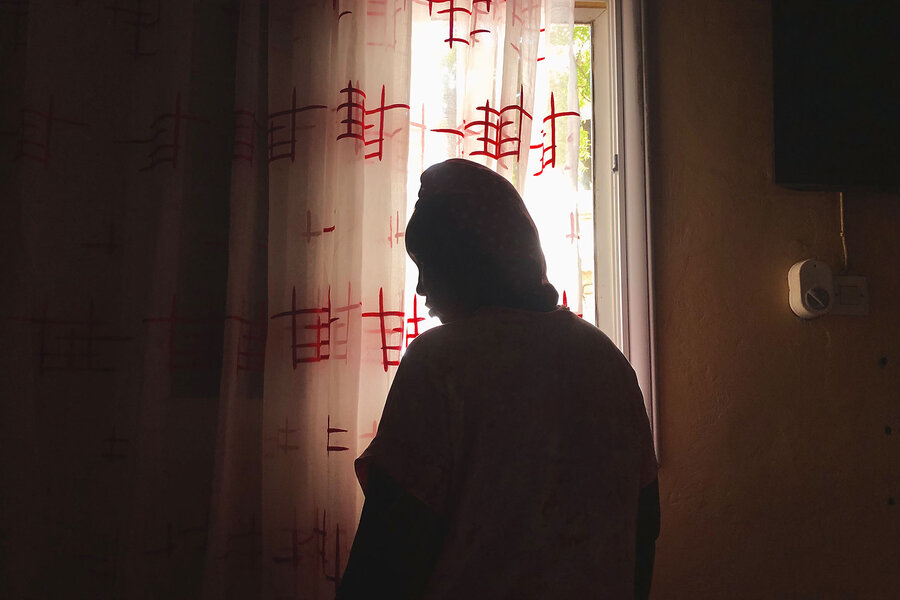
“People say, ‘Look at her, she got greedy,’” she says, sitting on a red and white flowered bedspread at her sister’s home in the Dakar suburb of Thiaroye-sur-Mer, where she comes when she can’t afford to eat. “‘Now, she needs to work like the rest of us.’”
Every year, tens of thousands of West Africans pay smugglers to carry them to Europe by sea. In 2024, 46,843 people – most of whom were Senegalese men – took the Atlantic Ocean route to Spain’s Canary Islands, according to the Spanish interior ministry. More than 10,000 either died or disappeared along the way.
For every man who arrives safely in Europe or vanishes off the map, there is a woman left behind: a wife waiting for her husband to return, or left to grieve his loss. As they battle stigma and financial instability, these women must build a new life, one for which there is no script.
“Whether their husbands survive the trip to Europe or not, women left behind are like widows,” says Ravenna Sohst, a policy analyst at Migration Policy Institute Europe, who has studied how migration affects local communities in Senegal.
“A patriarchal society”
Tabara Seck, who is not related to Ndèye, never imagined becoming her family’s sole breadwinner.
But after her husband – a fisherman – disappeared at sea in 2008 on his way to Spain, she had to adjust. Instead of staying home with her three children, she started selling bags of ice to her neighbors, using a freezer unit she bought on credit, and cooking for baptisms and local events on the side.

Now that her children are older, everyone contributes. One of her sons works as a tailor, her daughter cleans houses. All together, they earn between 2,000 and 4,000 CFA francs a day – between $3 and $7.
“Sometimes we have enough, sometimes we don’t,” she says, sitting in her bedroom in Thiaroye-sur-Mer, blotting her eyes with the edge of her long floral skirt, “We live day to day.”
Migration widows, like all women in Senegal, begin from a place of profound economic disadvantage. Men in Senegal earn, on average, about twice as much as women. And while rural women make up at least 70% of the country’s agricultural work force, more than 90% of farming land is controlled by men.
“We live in a patriarchal society,” says Yayi Bayam Diouf, an activist in Thiaroye-sur-Mer, who works with women affected by migration. “Women depend heavily on their husbands financially.”
Some widows fall into unregulated, clandestine prostitution. Ndèye Fama Seck says she thought about it during tough times. Ultimately, though, she decided she would rather go hungry than turn to sex work.
“I don’t want my children to see me doing that,” she says. “What kind of example would I be giving?”
Finding themselves unexpectedly thrust into the role of family provider is not the only challenge for women whose husbands have disappeared at sea. Without the proof of a body, there can be no death certificate. Without a death certificate, widows cannot apply for government subsidies, nor claim life insurance or a family inheritance.
A new and dignified life
Ms. Diouf, the activist, wants these women to have another way out.
After losing her son to a failed migration attempt in 2006, she became the first professional fisherwoman in Thiaroye-sur-Mer. Initially, when she applied for a license, the village elders balked. But she eventually won them over with a simple argument: There weren’t enough men left in the village to keep the fishing economy going.

Ms. Diouf soon broadened her fight for economic equality.
Through her Women’s Collective for the Fight Against Illegal Immigration, she teaches widows to make local products, such as hibiscus juice and homemade soaps, to sell at Senegal’s stand at the annual Salon International de l’Agriculture in Paris. She has also pushed city officials in Thiaroye-sur-Mer to provide certificates of disappearance for migrants lost at sea.
“The consequences for women affected by migration are huge,” says Ms. Diouf, sorting through bottles of jam recently made by women in her collective. “I want to show them that it’s possible to live with dignity.”
Her advocacy adds to networks of solidarity among women already in place here. Because women often lack the collateral and credit history needed for formal bank loans, many form communal savings groups called tontine.
At regular intervals, group members put a fixed amount of cash into a collective pot. The sum is then distributed to one woman in the group at a time, enabling them to set up a small business or make a large household purchase.
Holding out hope
But money alone cannot make up for the loss of a man at home. Widows in Senegal are frequently shunned by their communities and abandoned by their husband’s family. Fortune tellers and local rumor mills might circulate accusations against a woman, saying that she is a witch who caused her husband’s death. Many women leave town to escape such a fate, while others quickly remarry, often to one of their former husbands’ brothers, a traditional practice here.
Even those whose husbands arrive safely in Europe say they feel like widows most of the time. When Fatima Kane’s husband set out for Spain two years ago with their 17-year-old son, she had to grieve the loss of her married life.
“I’m still a young woman … I have needs,” says Ms. Kane from her family home in the fishing village of Joal. “Being here for so many months without your husband is very hard.”
Even those whose husbands have disappeared without trace often hold out hope that they will someday return.
In the one-bedroom home that Tabara Seck and her three adult children share in Thiaroye-sur-Mer, purple paint chips off the walls and black mold spots the ceiling. It has become cramped, with all four of them squeezing together each night on one double bed.
She has often thought about leaving this house, she says. The more time passes, the more she is starting to accept that her husband is gone. But she stays, she says, on the off chance that he will come back. When he does, he’ll know where to find her.
“He sacrificed so much for us,” says Ms. Seck, whose husband’s photo still sits in a frame near her bed. “I feel him everywhere.”