This article is taken from the February 2026 issue of The Critic. To get the full magazine why not subscribe? Get five issues for just £25.
“They raided Dr Feelgood’s at ten past three in the morning, by which time several customers were cavorting with the handful of Asian sluts and several others lying with their heads face down on the beer-stained table tops.”
How does this opening sentence read four decades after it first appeared in print? Bringing as much objectivity to the task as I can muster, I’d say it sounds rather enticing (what kind of a low haunt is Dr Feelgood’s? Who is doing the raiding? Where exactly is our raisonneur stationed?) whilst betraying marked echoes of one of the stories in William Boyd’s collection On The Yankee Station (1981).
“Asian sluts” would naturally be impermissible in the exacting moral climate of 2026. Oh, and the bit, a page or two on, about “surmises about the past” bringing to mind “a single characteristic image” is a straight steal from Anthony Powell’s A Question of Upbringing (1951). But then, as somebody once remarked — it may well have been Powell himself — a first novel is unlikely to amount to very much more than the sum total of your influences to date.
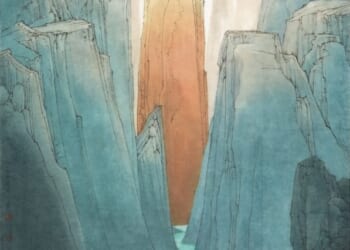
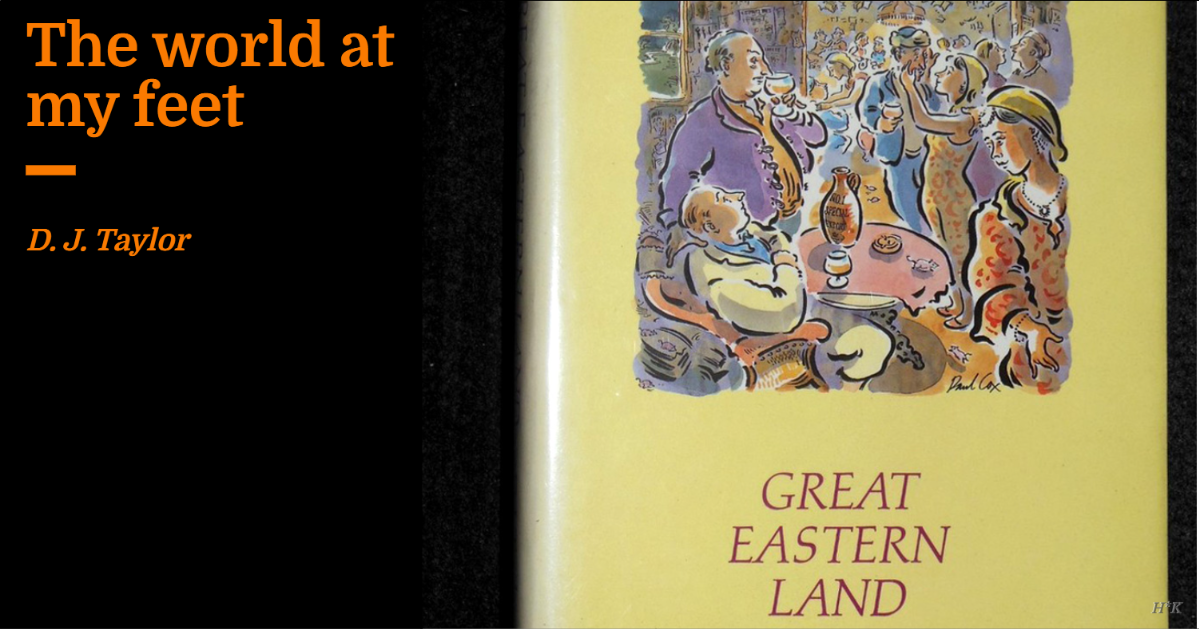
Great Eastern Land was published 40 years ago this month by the fine old firm of Secker & Warburg for an advance of £750 (about four months’ rent on my Pimlico flatshare: £3,000, say, at today’s values.) The cover was illustrated by Paul Cox who is still going strong (and illustrating The Critic’s Romeo Coates).
Strictly speaking, it was a not a first novel but — an important distinction — a first published novel. There were at least five predecessors, beginning with the two drivelling teenage Tolkien fantasies and proceeding through a breakdown-of-democracy dystopia (a genre much in vogue in the strife-ridden 1970s) and a gloomy autobiographical splurge gamely entitled Tomorrow Belongs To Me to a Simon Raven-esque Oxford novel full of epigrammatic dialogue called The Garden Party written in three weeks whilst nervously awaiting the result of Finals.
Inhale whiffs of that intoxicating old-style publishing atmosphere
At that age (24) to have written a book, to have had it accepted, courtesy of a wonderful woman named Jane Wood and her boss John Blackwell, to have sat in an ecstasy of self-absorption over proofs, cover design and catalogue entry was a teenage dream made real. Nothing else mattered as the year between acceptance and publication dragged by — why couldn’t they publish it now? Why wasn’t it their autumn lead rather than having to wait until the debutant’s spot of late January? — not my job, not my social life, nothing except the receipt of that first darling copy, gleaming and resplendent in its shiny jacket as it tumbled out of the jiffy bag, an experience so exalted that I more or less fainted on the spot.
Re-reading it, which I did the other week, for the first time this century was an odd, verging on the painful, experience. There were two “Great Eastern Lands”, one an imaginary landscape in southeast Asia (J.L. Carr very charitably said that it reminded him of the India through which he’d travelled in 1939); the other my native Norfolk; the title was inspired by a song by the Australian band Icehouse called “Great Southern Land”, i.e. the Antipodes.
Half of it was thinly-obscured memoir from the college-to-London flatland days and the other half Oriental fantasy of a kind which, given modern racial sensitivities, probably wouldn’t be allowed these days; the two spheres spliced not very plausibly together by some amateurish reflections on the nature of history. Some of it didn’t sound too bad, but there were whole stretches that seemed gauche to the point of embarrassment.
As for the personal stuff, one or two people sent postcards cheerfully — or not so cheerfully — identifying themselves amongst the cast, whilst my father suffered the indignity, whilst on a visit to his local bank, of having a crony inform the rest of the queue “He’s dead,” this fate having claimed the narrator’s father in the book. To my horror, the re-read disclosed that several minor acquaintances of the period — in particular a notorious Oxford character called Steve Micalef — hadn’t even been given pseudonyms.
What was it like to bring out a first novel 40 years ago? How did the mechanics work and who was there to wave you on your way? In practical terms, the whole thing seemed absurdly straightforward. I had an agent (Mary Wesley’s son, Toby Eady) who, on receipt of the manuscript, sent it to the firm of Blond & Briggs, whose kingpin, the legendary Anthony Blond, turned it down. In retrospect, I was rather glad about this, for Blond & Briggs was a somewhat shaky equipage which shortly afterwards went bankrupt after Blond, having signed up for a Japanese co-edition of a book about the Sistine Chapel, omitted to insure himself adequately for a fall in the value of the yen against the dollar. A week later it went to Secker, allegedly “looking for new writers”, who after a certain amount of procrastination miraculously took it on.
All this — ease of access, that gratifying sense of serious people falling over themselves to wave you into a highly exclusive club — I treated not as an outrageous stroke of fortune but as my creative birthright. I was the future of the English novel. It was simple as that. Secker had once published Orwell. They were currently publishing, amongst my particular heroes, Piers Paul Read, Malcolm Bradbury and David Lodge. Now they were publishing me.
The “D.J.” came in around this time, to detach me from the half-dozen or so zoo vets, Punch editors and radio producers who operated as “David Taylor”, which still didn’t stop Carr, a couple of years later in the wake of a baffling conversation about mileages and spare parts, from asking, “You’re not the motoring correspondent of the Daily Telegraph, are you?”
It seems Secker & Warburg no longer exists, even as an imprint: certainly the Karl Ove Knausgaard novels which Penguin Random House used to publish under the “Harvill/Secker” banner now omit the suffix. Four decades ago, it was a standalone firm with two dozen staff working out of a four-storey house in Poland Street. There you could sometimes find Barley Alison, chatelaine of the Alison Press, fast asleep at her desk or exchange badinage with Sylvia, the cockney receptionist.
You could also inhale whiffs of that intoxicating old-style publishing atmosphere made up of long lunches, cracked-open bottles, boozy launch parties and an insistence that the book was more important than the money it may or may not make.
Even the proud author of Great Eastern Land — advertised in the spring catalogue at £9.50 above a pretentious blurb about “sidelong glances at the metaphysics of fiction” and a photo of yours truly looking all of 15 — was taken aback by this resolute lack of commercial fervour, the jokes about “next year we might make a profit” and the employee who remarked of the incoming MD that she hoped he wasn’t going to stop her hunting.
What about the sales opportunities that might be afforded by the book’s (partial) East of England setting, I enquired. “Ah yes,” the reply came back, “Good idea, but you see our East Anglian chap isn’t actually terribly good.”
By this stage, the assumption that bringing out your first book was an innately glamorous affair had collided with some of the realities of the mid-1980s book trade. In those days publishers took a punt on first novels. There were lots of them, the majority far from lavishly produced — I was lucky with my Paul Cox jacket. They were regarded as the commercial speculators of early 20th-century California might do a row of newly-sunk oil wells. A few of them might pay off, but the vast majority would run dry within a week or two.
Jonathan Cape, for example, attracted a deluge of publicity in the spring of 1986 for announcing that they intended to publish ten debut works in the following few months. As the protégé of a rival firm I followed their careers with a keen interest, and at least half of them never made it to number two.
But you could scarcely throw a stone in the literary London of the Thatcher era without hitting someone who was about to break precociously into print, and, naturally, I had my career all planned out. Great Eastern Land would be extravagantly reviewed in all the broadsheets, I told myself. It would win several prizes. probably be made into a film and would certainly turn all the people I’d worked with on Oxford student magazines green with envy. Whatever happened, it would at any rate free me from the shackles of my terrible job editing messrs Coopers & Lybrand’s in-house magazine.
None of these things came to pass. The novel was reviewed, but not in the broadsheet newspapers, and the notices were “mixed”. If the nice man in the Times Literary Supplement detected a “genuine comic gift”, then the gallant ornament of a periodical called British Books News reckoned that on this evidence getting a book accepted for publication was a whole lot easier than he’d always assumed, ha! ha!
Then there was the distinguished literary journalist John Walsh, now an old friend, who performed the almost unheard-of feat of reviewing the book favourably and unfavourably in two separate publications. First was in the long-defunct Books and Bookmen, where a round-up of debut fiction assured readers that if you wanted bumper helpings of style and pizzazz then here was where to find them. The second was in the London Evening Standard. “There’s a review of your book in the Standard” friends would say. “Any good?” “No, awful.” None of this pallid reminiscence amounted to very much, Walsh pronounced, but he predicted a great future for the author “as long as he stops thinking he’s Max Beerbohm.”
There were no prizes, no film offers and no choice but to carry on working for Coopers & Lybrand.
Some months later, when the dust had settled, the hardback turned out to have sold just over a thousand copies, helped on its way by my friend Jaqi, who worked at a book dealer and supplied a monthly selection of new British books to American libraries, and my mother, who bought a bagful at author’s discount to give to friends. Flamingo, an imprint of what was still William Collins Ltd, secured the paperback rights for £1,500, of which the publishers took half — an event with coruscating personal consequences as I ended up marrying the editor. Secker made a small profit; I was a published writer; Walsh got paid twice; honour was satisfied all round.
In an ideal world, this modest success ought to have sent me leaping from my subsidiary crag to the summit of Parnassus. Instead, this entry into Thackeray’s “Corporation of the Goosequill” had exactly the reverse effect: the follow-up took six years. Not that this should surprise anyone with knowledge of the literary life. Like the rock band’s second album, second novels invariably suffer from a suspicion that the author has unpacked so much carefully hoarded experience into the first that there is nothing left to run with except imagination.
On the other hand, Great Eastern Land had its uses. A year later I got another City copywriting job, in a much less ghastly accountancy firm, on the strength of having published a novel. It was also a trump card in the pursuit of literary journalism — a very lucrative market in the late 1980s. In the end, my real memory is not so much of the novel’s publication or reception, but the circumstances in which it was written — lying on the curiously elongated sofa of Flat C, 33 Eccleston Square, on trains speeding home to the real Great Eastern Land or in the basement of the PR agency in Newman Street where I worked in the pre-accountancy days.
In truth, Great Eastern Land’s real begetter is neither Toby Eady nor Jane Wood but a man named Francis Rosati, my then boss, who turned a blind eye to my skiving and once told my colleague, Marcus Berkmann, that “the really important thing is that David finishes his novel”. I haven’t set eyes on him for a third of a century, and he is almost certainly dead but, 40 years on from a world of typewritten manuscripts and corrigenda in red felt-tip, I cherish his memory.