What Mark Carney saw in Beijing was the inevitability of global communism. Let us pray he is wrong…
Okay, I do not care if you are a realist or a structuralist or ecosocialist or liberal internationalist. For the next few paragraphs you are a trainee dialectical Marxist about to be imbued with Xi Jinping Thought. At the end of the piece you will think critically and importantly about all the ways that it is inherently stupid and wrong. For it is wrong, and wrongheaded, but it is what the Chinese Communist Party believes, and that is all that matters.
Let us begin with the basics. Historical materialism tells us that human society progresses through stages — primitive communism, slavery, feudalism, capitalism—each containing within it the contradictions that birth the next. The synthesis emerging from these collisions will be, 当然 (dāng rán — of course, certainly, without doubt), advanced communism. This is the law of dialectical development: an onward and upward movement, a transition from an old qualitative state to a new qualitative state.
You, steeped in your Western liberal assumptions, see chaos. Beijing sees history’s motor turning. The internal contradictions of capitalism are being disclosed, precisely as Marx foretold.
Xi Jinping Thought on Socialism with Chinese Characteristics for a New Era makes this explicit. It is “contemporary Chinese Marxism and 21st century Marxism,” and it holds that the new era is defined by China’s successful development placing it at the vanguard of a global transition, which will see capitalism superseded.
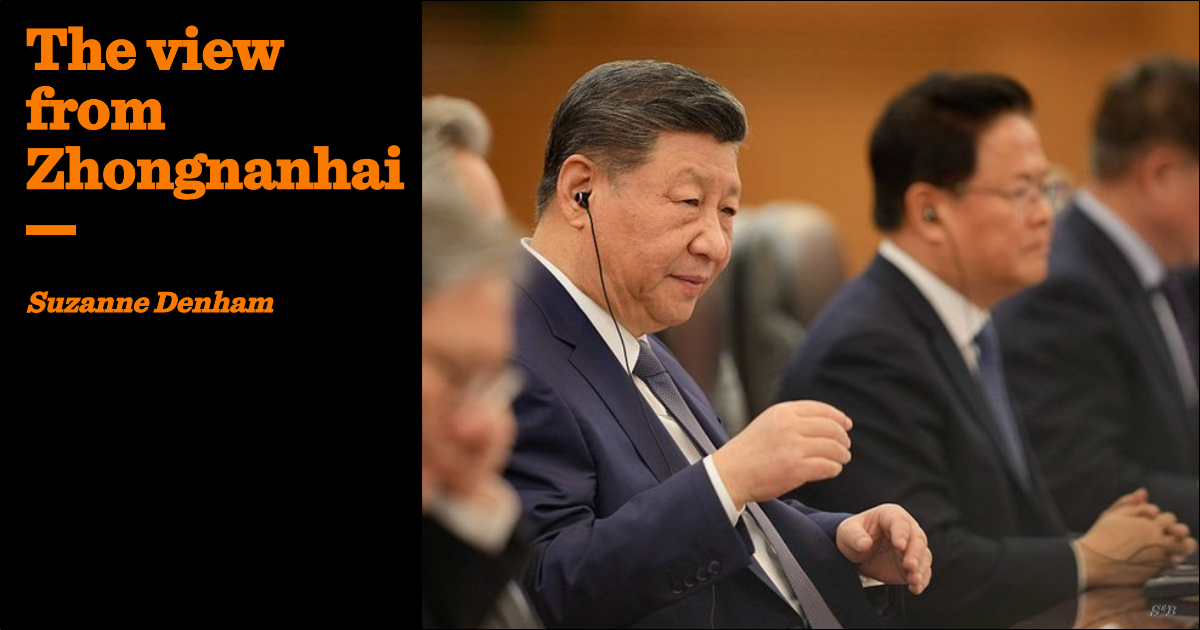
Now. Consider Prime Minister Mark Carney’s January 2026 visit to Beijing — the first by a Canadian leader in eight years. He met Xi Jinping in the Great Hall of the People and announced a strategic partnership centred on energy, clean technology, and tariff reductions on canola and Chinese EVs.
Days later, at Davos, Carney delivered what the CBC called a “eulogy for the old world order.” He said the quiet part loud: great powers have “abandoned even the pretense of rules and values for the unhindered pursuit of their power and interests.” The rules-based order was, he admitted, a “useful fiction” , and called for middle powers to band together in a new world of “variable geometry.”
From Beijing’s perspective, this is recognition of the writing on the wall. Carney — former governor of the Bank of England, former governor of the Bank of Canada, UN climate finance envoy, the platonic ideal of a Davos Man — looked under the hood of the liberal international order and saw what the Party has seen: American hegemony dressed in multilateral clothing. A system maintained by nothing more than American power. Now the fiction is unraveling; 当然, nations must seek alternative arrangements.
Here is where Xi Jinping Thought becomes particularly important. The CCP views Western democracy as inherently unstable. Xi has said China must not “blindly copy the development models of other countries nor accept their dictation.” In 2013, Document Number 9 warned cadres against “Western constitutional democracy” as an existential threat. In 2018, presidential term limits were abolished. The Party views these constraints as Western impositions designed to destabilise communist regimes and force leadership changes that make societies chaotic during what dialectical materialism would term the chaotic period.
The chaotic period before what? Before global communism. Or, in the more polished contemporary formulation, before a Community of Common Destiny for Mankind.
Chinese scholars and diplomats actively study the application of tianxia — the ancient concept of “all under heaven” — to the entire planet. The vision is one where China, as the centre of material and political flourishing, attracts others to conform to it. Not by conquest. By example.
As Macron might say, Trump’s America First is destabilising the old order. But from Zhongnanhai, the appropriate response is: 当然. Of course it is. This is what capitalism does. This is what contradictions look like in their final stage. That is why the Chinese delegate at Davos looked so composed as he read a dull speech about multilateralism and respect between trading partners, whilst all the hall around him was erupting in pandemonium at the actions of the President of the United States to his allied friendly nations.
This is the with friends like these, who needs enemies moment. Carney said publicly that Canada’s relationship with China has become “more predictable” than its relationship with the United States. Read that again. The former central banker is saying that a Leninist one-party state is a more reliable partner than America. As America grows more assertive, the Party’s dialectic — that integration has become the source of subordination — provides an increasingly appealing explanation. You cannot live within the lie of mutual benefit when the benefit flows overwhelmingly one direction.
Xi has been picking off easy targets for years. The developing world, through the Belt and Road Initiative. Middle powers seeking “strategic autonomy” — India, Brazil, Indonesia, the Gulf states. Five national leaders visited Beijing in January 2026 alone, including Canada’s Carney and Britain’s Starmer.
Between American hegemony and Chinese-led multipolarity lies 当然 — a Community of Common Destiny, where international relations are “democratized” (by which Beijing means: where Western countries no longer set the rules) and where development and security are integrated under Party guidance.
Here is the problem with strange bedfellows: they make for bad marriages.
Canada cannot decouple from America. Seventy-six percent of Canadian exports go to the United States. Geography and math have not changed. Carney can pursue “variable geometry” and diversification and strategic autonomy all he likes, Trump can threaten tariffs and muse about the 51st state, but the fundamental integration of North American economies is not optional. Canadians were promised partnership and received subjugation, heard talk of equality and received imbalance, promised free markets and got crony capitalism enriching a few (in their view).
As for China’s “Community of Common Destiny”, examine the practice rather than the theory. Hong Kong. Xinjiang. The South China Sea. The Belt and Road debt traps. When tianxia meets resistance, it does not respond with Confucian benevolence. The danger to middle powers is that their alignment is tactical, rather than substantive. They are arbitraging between empires — and arbitrage, in volatile markets, is how you get wiped out.
Now you may stop being a trainee dialectical Marxist.
The framework I have just outlined is stupid and wrong in at least three fundamental ways:
First, historical materialism is unfalsifiable. Every development confirms the theory; every setback is a temporary dialectical reversal. The theory explains everything and therefore nothing.
Second, the “Community of Common Destiny” is not a framework for mutual flourishing. It is a framework for Chinese hegemony with better branding. Tianxia historically meant tribute relationships and cultural subordination. The contemporary version involves economic dependence leading to political deference. Ask the Uyghurs about common destiny.
Third, Xi Jinping has made China’s political system more brittle, not less. The abolition of term limits, the cult of personality, the elimination of collective leadership, the massive anti-corruption campaign that doubles as a purge—these are not signs of strength. They are signs of a regime that cannot tolerate even internal dissent, that must control information absolutely, and has bet everything on one man.
But the Chinese Communist Party believes it. The entire ideological apparatus of the world’s second-largest economy and most populous nation operates on this framework. Chinese diplomats, Chinese strategists, Chinese military planners — they are not pretending. They are not cynically manipulating Marxist vocabulary for domestic consumption. They, to coin a phrase, actually believe this stuff.
When Mark Carney sits across from Xi Jinping, he is engaging with a revolutionary communist who genuinely believes that the historical forces of capitalism are exhausting themselves, that America’s contradictions are becoming acute, that the “chaotic period” is accelerating, and that nations like Canada will, 当然, inevitably, come to recognise the benefits of aligning with the rising power that embodies humanity’s collective future.
That it is wrong does not make it less dangerous.