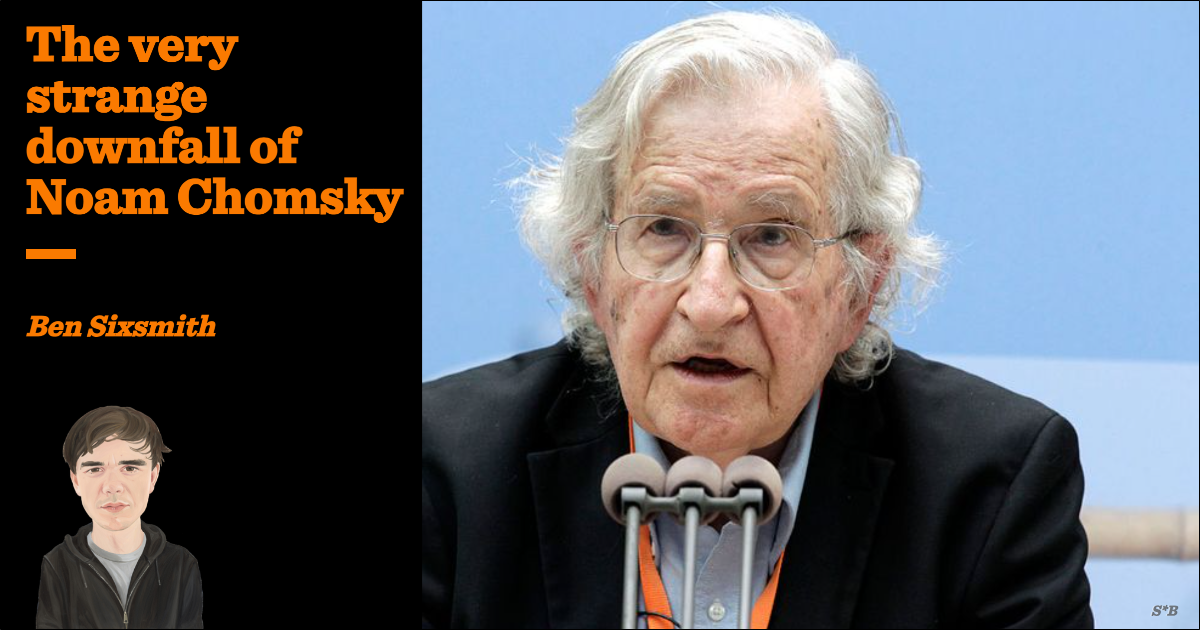
The linguist and social commentator was perhaps the most surprising friend of Jeffrey Epstein

If you’re younger than 35, you might have no idea how much of the internet used to be occupied by people arguing about Noam Chomsky. Left-wingers used to fight with liberals and conservatives at insane length over the merits — or lack thereof — of the ageing linguist and anti-war commentator.
Had Chomsky excused dictators like Pol Pot? He had been too soft on Holocaust Deniers? Was he a denier of genocide in Bosnia? Such questions were fiercely and exhaustingly disputed.
There were real questions to be answered here. But there was also some extent to which arguments over Chomsky were a displaced argument over the virtues of America’s and Israel’s foreign policies.
So, in 2004, Peter Collier and David Horowitz compiled the book-length Anti-Chomsky Reader. The writer and researcher Paul Bogdanor collected “The Top 250 Chomsky lies” (you would have thought 200 would have been enough). A British journalist used to patiently add one star reviews to all of Chomsky’s books on Amazon.
These poor souls would have had no idea that all their work undermining Chomsky’s political reputation would become unnecessary when, at a grand old age, the man himself formed a friendship with Jeffrey Epstein.
Epstein was, of course, a friend of rich and influential men and women from all political persuasions. He was pals with everyone from Donald Trump, to Bill Gates, to the Crown Princess of Norway.
But Noam Chomsky is one of the stranger ones. Aside from occasional far left grumblings about his employment by the military-linked Massachusetts Institute of Technology, no one ever accused him of being too close to the rich and powerful.
Why did he develop a bond with Epstein? To be clear, I am absolutely not suggesting that to have been friends with Epstein made one complicit in his crimes. Epstein cultivated many different relationships, which obviously entailed very different things. Still, Chomsky and Epstein’s friendship was strong enough that the author commiserated with the sex criminal about criticism in the media. He was even chummy with Epstein’s friend, the populist kingmaker Steve Bannon.
Epstein, it seems obvious, was very good at speaking to different people in a manner that would impress them. With intellectuals, he must have seemed more intellectual than a well-connected financier should have been. This came with the bonus that he could offer real-world help, such as when he assisted Chomsky with his financial dealings.
This is actually symptomatic of Professor Chomsky’s intellectual errors
I can’t blame anyone for sticking by their friends. If a friend of mine was accused of criminality, I hope I wouldn’t drop them like a rotten apple. But I hope I would be honest with, and about, them. What appears to have been an email from Chomsky to Epstein in 2019 is a disgrace. He condemns “vultures” who were attacking Epstein amid “hysteria that has developed about abuse of women”. To be clear — of course there were major excesses in the era of #MeToo. But Chomsky was talking to someone who had already been convicted of procuring for prostitution a girl below the age of 18. It was bizarre to dismiss accusations out of hand.
Chomsky’s comparison of criticisms of Epstein to criticisms of himself was revealing. It was perverse — I think even Messrs Horowitz and Bogdanor would have said, “Professor Chomsky, you’re not that bad” — but it was revealing. “I’ve had plenty of experience,” he wrote:
A google search will bring up tons of hysterical accusations of all sorts, even groups devoted to vilifying me. I pay no attention, unless I’m approached for comment on a specific manner …
This is actually symptomatic of Professor Chomsky’s intellectual errors. Once he is convinced of the malignance of a particular force, be it American foreign policy or the mainstream media, he finds it difficult to admit fault on the part of the people in its firing line. This applied to the Khmer Rouge — as the Cambodia expert Bruce Sharp wrote at length — and it appears to have applied to Jeffrey Epstein. Similarly, Professor Chomsky has had the attitude that criticism is easily dismissable. The fact that much of the criticism he has received has been written in bad faith appears to have convinced him both that all criticism is in bad faith and that this makes it impossible for it to be valid. Thus, why listen at all?
His stubbornness leads him to make stupid errors like asking the rhetorical question, “How do you prove that you are not … a rapist?” Sure, it is impossible to prove beyond all doubt that one has never committed rape. But accusations of rape can be detailed and specific enough to be answered — if, that is, they are untrue. (Mr Epstein would have had the chance to effectively do this himself, in court, soon afterwards had he not rather mysteriously died.)
Still, for all that Chomsky erred here, and for all that I believe he’s erred before, I think it would be wrong to dismiss Chomsky on the basis of his associations. His work in linguistics has nothing to do with the company he kept. While I think that there are interesting comparisons to be made between his advice towards Epstein and his attitude towards politics, his work on the latter should still be considered on its own merits.
Of course, I think that work often didn’t have much merit. But it would be wrong to endorse the logic of cancellation — and, of course, the wars in Vietnam and Iraq turned out to be terrible ideas whoever opposed them.